
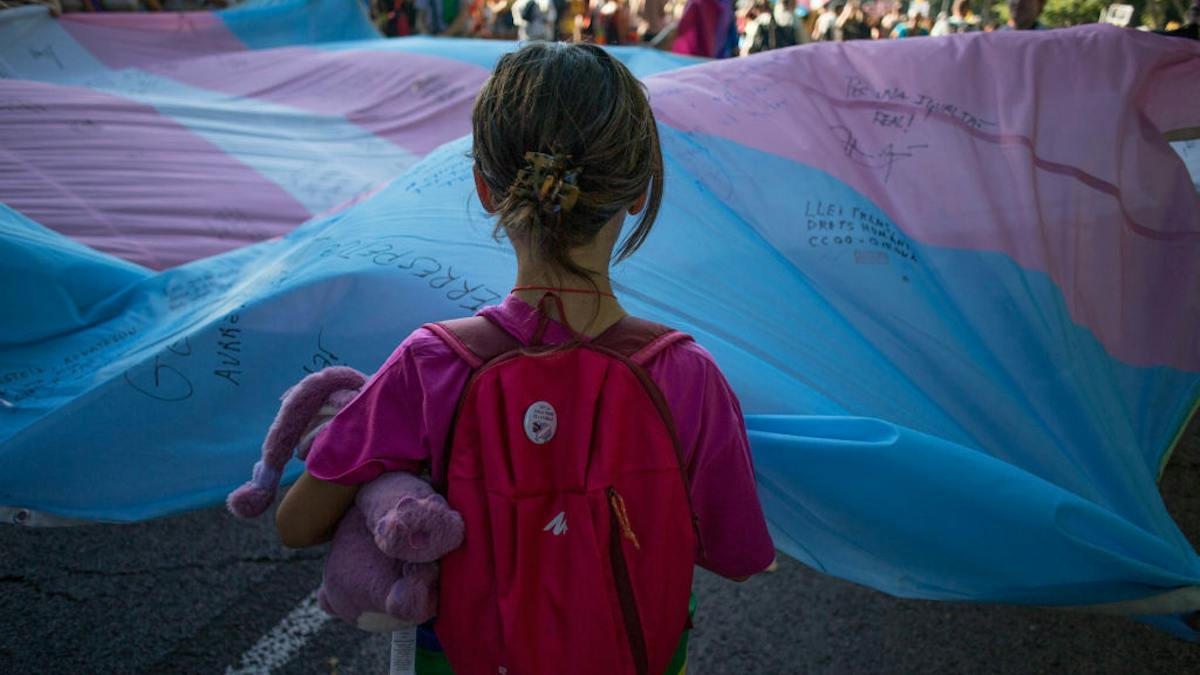
A New Mexico mother is publicly accusing Santa Fe Public Schools of concealing gender-related policies from parents after, she says, her six-year-old daughter was sent into a school bathroom with a biological boy who was covered by a district “gender support plan.”
Kristy Borrego Ojinaga, a lifelong Santa Fe resident and member of Independent Women’s Network, described the episode in a first-person account published by The Daily Wire. The account is her own telling of events, and the school district has not responded publicly in the piece.
According to Ojinaga, the school year started routinely last August. She and her husband were both raised in Santa Fe and attended the local public schools themselves, so they had what she describes as complete confidence that their children would be safe and well cared for. That confidence unraveled a few weeks in.
A quiet dinner, then a difficult conversation
Ojinaga writes that her daughter, normally the loudest voice at the family dinner table, sat silent one evening, staring at her plate. She and her husband assured the girl she would not be in trouble. What followed, she says, was her daughter’s statement that she didn’t like the way a boy was making her feel.
The first-grader told her parents, according to the account, that a boy had followed her into the bathroom — and that her teacher had sent him in there with her. Ojinaga also says her daughter reported that the same boy had repeatedly touched himself in class.
The parents requested a meeting with the teacher expecting to discuss inappropriate behavior. Instead, Ojinaga writes, they got what she calls a lesson in the district’s gender policies.
The teacher told them the boy had a “gender support plan,” meaning the school recognized him as a girl and granted him access to all female spaces. Ojinaga says they were also told it would be more dangerous for the boy to use a bathroom that didn’t match his gender identity than it would be for her daughter to share a bathroom with a biological boy.
She says no one had told parents in advance that their daughters would be expected to share private spaces with a biological male, or that they would need to tolerate inappropriate conduct in a first-grade classroom. Their introduction to the policy came only after their own child came home upset.
Counseling suggestion draws sharp objection
Ojinaga writes that the district’s response went further. Rather than treating the matter as sexual harassment to be punished and communicated to families, she says the school’s “Wellness Coordinator” — whom she notes is not a licensed psychologist — told her that her daughter needed counseling because she was “unaccepting” of other walks of life.
That suggestion is the crux of her objection. Parents teach young girls about boundaries, consent and trusting their instincts, she writes, and they teach them to leave unsafe situations and to use the bathroom in pairs. Instructing a child to disregard those instincts, in her view, teaches her to doubt herself.

She also raises a procedural question she says she pressed repeatedly with the school: if there is a detailed gender support plan for one student, where is the corresponding plan protecting every other student’s privacy, dignity and safety? Her answer, she writes, is that there wasn’t one — and that administrators “gaslit” her into believing she was the unreasonable one until the day she withdrew her daughter from the school.
Parental authority at the center of the fight
The broader argument Ojinaga makes is about who holds authority over children’s education and upbringing. Parents are their children’s guardians until age 18, she writes, and if she has no say over what is shown and taught to her children, she has no real authority at all.
She frames the issue as a conflict between accommodation for one student and the right of every parent to know what is happening in their child’s school life. Support for one child cannot come at the cost of other parents’ right to information, she argues, and parents — not districts — hold the primary responsibility for teaching children about sex, gender, privacy and personal boundaries.
Ojinaga contends the school and district failed in their duty of care, both to her daughter and to every other child in that classroom. Schools, she writes, carry a legal, ethical and professional obligation to safeguard the children entrusted to them, to take legitimate safety concerns seriously and to communicate honestly with families. In her telling, the district instead minimized her daughter’s discomfort, deflected questions and treated transparency as optional.
“Schools exist to educate children, not replace mothers and fathers,” she writes, arguing that when institutions withhold information about a child’s classroom environment on the belief that they know better, they stop partnering with families and start displacing them.

She closes by asking what schools might conceal next if they can decide today what parents deserve to know — a question she says should concern every parent, not only those in Santa Fe.
A local fight with national echoes
The account lands in the middle of a running national dispute over how school districts handle transgender students, bathroom and locker room access, and how much parents are told about policies affecting their children. New Mexico has been a particular flashpoint, with state guidance and district practices on gender support plans drawing sustained criticism from parent groups and conservative advocacy organizations.
Ojinaga’s piece is advocacy as much as testimony: she describes herself as “on a mission” to stop parents from being excluded from their children’s classrooms and says she is working to empower parents to confront the Santa Fe Public School Board. Independent Women’s Network, the group she belongs to, has been active in parental rights campaigns around the country.
The Daily Wire account does not include a response from Santa Fe Public Schools, the teacher named in the episode, or the family of the boy described. It also does not specify which school the daughter attended, and the district has not publicly commented on the allegations as described.
What the piece does make clear is the shape of the argument Ojinaga intends to press in Santa Fe and beyond: that a gender support plan written for one student created obligations the district never disclosed to the parents of every other child in the room — and that those parents, in her view, should have been told before their six-year-olds walked into a bathroom, not after.
Source: www.dailywire.com — https://www.dailywire.com/news/why-santa-fe-schools-silenced-my-daughter-and-gaslit-parents-like-me
Source: www.dailywire.com
Related coverage
- Supreme Court Presses Colorado Over Exclusion of Christian Schools From Preschool Program
- Father of Flight 93 Hero Todd Beamer Blasts Abdul El-Sayed in New Senate Ad Over Hasan Piker Tie
- Tom DeLonge Tears Up as Padres Fans Belt ‘All the Small Things’ During Playoff Win
- Jeffries Says DSA Members Will Be Part of Democrats’ ‘Broad Caucus’