
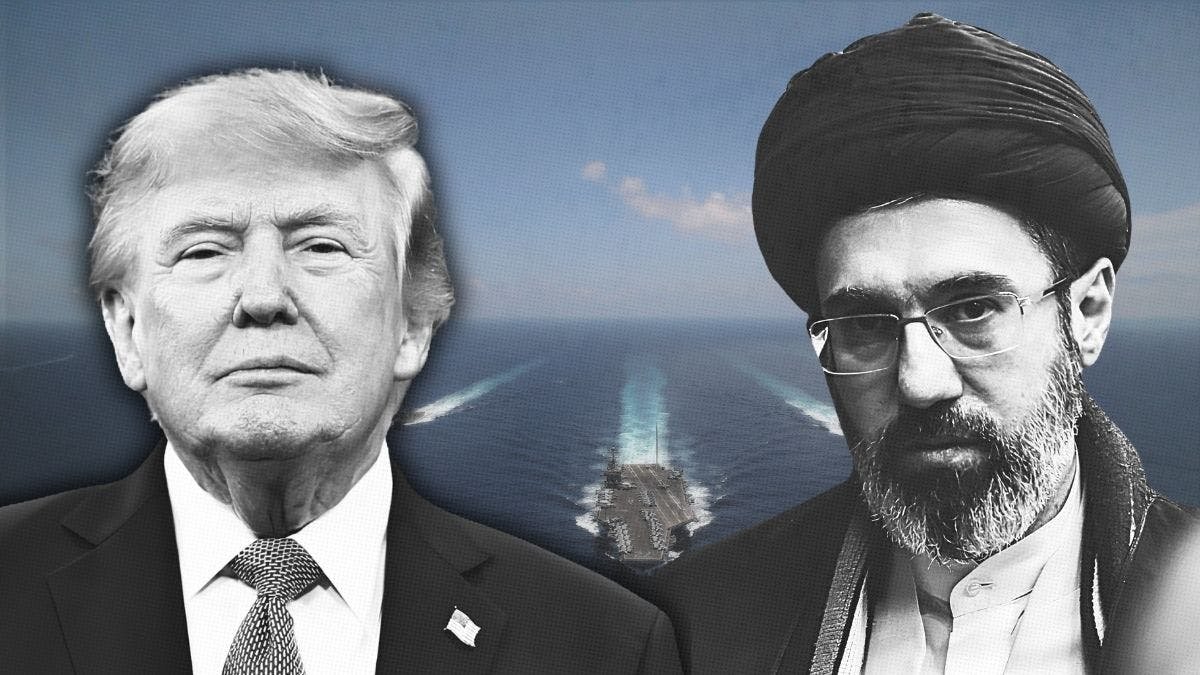
Six months after the United States and Israel launched Operation Epic Fury against Iran, the Islamic Republic has absorbed punishing blows to its military, economy, and leadership — yet the regime remains firmly in power. The conflict, which began on February 28, has evolved from a high-intensity military campaign into a grinding economic war, with no end in sight and a list of unresolved questions that could shape the region for years.
Decapitation Strike: Khamenei’s Death and the Succession Crisis
The war’s most consequential single strike came on day one, when Supreme Leader Ayatollah Ali Khamenei was killed. His death removed the central figure in Iran’s political and military system, but it did not collapse the regime. Instead, it forced a succession process in the middle of a war, with his son, Mojtaba Khamenei, yet to appear publicly or assume the role his father played for decades.
Iran’s senior military leadership also took catastrophic losses. Israel said its opening strikes killed dozens of top commanders, including IRGC Commander Mohammad Pakpour and Defense Minister Aziz Nasirzadeh. As the campaign continued, the IDF claimed to have eliminated more than 40 senior Iranian commanders. On March 17, Ali Larijani, secretary of Iran’s Supreme National Security Council and a figure accused of overseeing a deadly crackdown on protesters, was killed in an Israeli airstrike.
Economy in Freefall
Iran entered the war with an economy already battered by inflation and a collapsing rial. Six months of U.S. blockade on the Strait of Hormuz have worsened the picture dramatically. According to Business Insider, Iranian oil exports fell to as low as 65,000 barrels per day in May — a 69% drop from the prewar level of 2.12 million barrels a day. The IMF projects Iran’s economy will contract by 5.4% in 2026, the sharpest decline since 1988, with inflation potentially reaching 68.9%.
The rial has hit record lows, and Iran’s economic Misery Index has risen to 91.1, its highest ever. The Foundation for Defense of Democracies estimates the war has caused roughly $144 billion in damage, equivalent to about 40% of Iran’s prewar GDP.
Military Capabilities Hollowed Out
Iran’s conventional forces have been devastated. CENTCOM claimed that as of May, U.S. forces had destroyed 161 Iranian vessels across 16 classes of warships, crippling Tehran’s naval capabilities. The Iranian air force, which flew between 30 and 100 sorties a day before the war, now flies zero, according to Adm. Brad Cooper, commander of CENTCOM. He also reported that 82% of Iran’s air-defense missile systems had been knocked out.
The nuclear program, already severely damaged by U.S. strikes last summer, has been further degraded. Key facilities remain in ruins, and Iran’s ability to resume large-scale enrichment is significantly constrained.
Axis of Resistance Weakened
Tehran’s network of proxies entered the war in a diminished state. Hezbollah did join the fight but had been gutted by years of Israeli operations. The Houthis fired missiles at Israel with little effect. The fall of Bashar al-Assad in Syria in 2024 removed a crucial ally and severed a key link in Iran’s regional network. The result: a much weaker Axis of Resistance that could not relieve pressure on Iran or expand the war into a broader regional conflict.

Human and Material Costs for the U.S.
The war has not been without cost for Washington. According to the Pentagon, 18 U.S. service members have been killed and another 624 wounded. The dead include Maj. Jeffrey R. O’Brien, Capt. Cody Khork, Chief Warrant Officer 3 Robert Marzan, Sgt. 1st Class Nicole Amor, and many others. The U.S. has also lost at least four F-15E Strike Eagles, a KC-135 tanker, an A-10, a CH-47 Chinook, two MC-130s, and multiple MQ-9 Reaper drones.
Secretary of War Pete Hegseth told the Senate Appropriations Committee in July that the war has cost an estimated $37.5 billion so far. However, NBC News reported that the Pentagon’s internal estimate ranges from $80 billion to $100 billion when including base repairs, aircraft replacement, and stockpile replenishment. The administration requested $67.1 billion from Congress in June.
Strait of Hormuz: Reduced Traffic, Uncertain Future
The Strait of Hormuz remains open, but traffic is far below prewar levels. Reuters reported that in August, only a handful of commercial vessels crossed daily, compared with more than 130 before the war. A U.S.-Iran memorandum of understanding calls for toll-free passage for 60 days while discussing the strait’s future administration with Oman and other Gulf states. A senior Trump administration official suggested this could lead to a longer-term arrangement, but Iran has so far indicated it wants to work only with Oman.
Allies Balk, Talks Stalled
The war exposed limits to U.S. influence among its closest allies. Britain, France, Germany, Italy, and Spain declined to join efforts to secure the Strait of Hormuz. Italy and Spain restricted U.S. military access to bases and airspace, while France denied Israeli aircraft carrying U.S. weapons overflight rights. Britain limited support to defensive operations. Trump publicly criticized several of these nations, sparking diplomatic spats.

Unresolved Questions: Pickaxe Mountain and the Uranium Stockpile
Negotiations to end the war have stalled. A proposed June memorandum collapsed, and the two sides remain divided over Iran’s nuclear program, sanctions, and the Strait of Hormuz. Trump has said he does not trust the regime.
One major sticking point is Pickaxe Mountain, a deeply buried nuclear-related complex near Natanz that was not struck in previous attacks. Satellite imagery shows continued construction and fortification at the site, which some experts estimate is buried at least 100 meters underground — potentially beyond the reach of U.S. conventional bunker-busters. The International Atomic Energy Agency has never inspected the facility, raising concerns about what Iran could develop there. Trump has identified it as a potential target, but for now it remains intact.
Another unknown is the fate of Iran’s enriched uranium stockpile. Before the strikes, Iran held more than 400 kilograms of uranium enriched to 60%, but the IAEA has been unable to verify its current status.
As the war enters its seventh month, the United States and Israel can point to significant military gains and strategic degradation. But with the regime still standing, the economy in tatters, and key nuclear assets still unaccounted for, the question of who is winning — and what victory would even look like — remains as murky as ever.
Source: www.dailywire.com — https://www.dailywire.com/news/six-months-into-the-iran-war-who-is-winning