
A Stanford University notice of intent to hire a foreign financial analyst at a salary of $149,000 is drawing scrutiny as part of a broader argument about how American research universities staff themselves — and whether visa programs meant to import rare expertise are being used for jobs Americans can plainly do.
The Federalist published the analysis, pointing to Stanford’s H-1B filing for a “Financial Analyst 3” and comparing it with the university’s own job postings for the same title and level. Those postings, the outlet reported, require a bachelor’s degree, an ability to perform “accounting-focused analysis,” and “strong Excel skills.”
The H-1B program was created by Congress in 1990 to let employers bring in visiting workers for scientific and technical work requiring “theoretical and practical application of a body of highly specialized knowledge,” building on an earlier temporary-labor category dating to the 1950s for foreign experts of “distinguished merit and ability.” The premise, as The Federalist frames it, is that the visa fills gaps for work no American can do.

Against that standard, the outlet argued, a financial analyst role demanding a bachelor’s degree and spreadsheet proficiency hardly qualifies — particularly in California, which it noted has the highest unemployment rate of any state.
Vance Puts University Visas in the Crosshairs
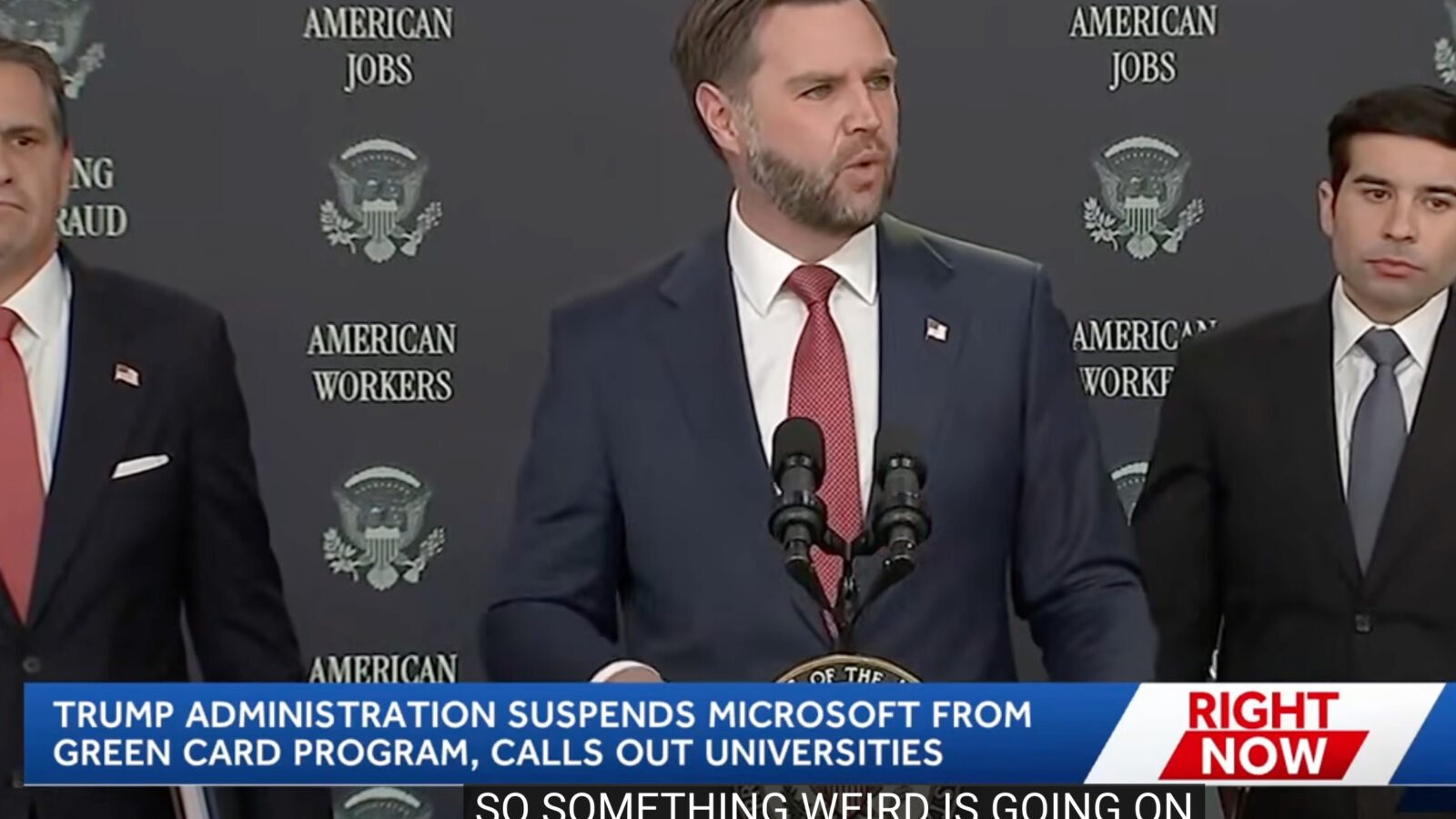
The filing lands amid a push from Vice President J.D. Vance, who held a recent press conference on what he described as abusive corporate use of foreign labor visas. Vance focused heavily on the H-1B, and according to The Federalist, universities are squarely implicated in that conversation.
He also raised the J-1 visa, the exchange program that lets universities bring in foreign researchers for temporary work, typically in STEM fields. At the press conference, Vance said some of “America’s most elite universities bring in foreigners again, to undercut the wages of American residents,” and named nine universities that he said merit investigation.

Reason magazine answered with a defense of the J-1 program headlined “No, Giving Immigrants Research Jobs Is Not Fraud.” The Federalist pushed back on the framing, noting that the J-1 is explicitly a nonimmigrant visa reserved for temporary labor rather than immigration.
The Numbers Behind the Argument
The core of the case, as the outlet builds it, is a mismatch between how many science doctorates American universities produce and how few of those graduates land academic jobs.
A 2023 paper on academic employment after the Ph.D. found that, averaged across fields, “only 25.2% of 2000–2013 STEM Ph.D. graduating cohorts are ever observed in a tenure-track position, compared to an average of 42.8% for 1960–1980 cohorts.” A 2024 study of engineering doctorate holders put the tenure-track share at roughly 12.4 percent, concluding that “most engineering PhD graduates will never secure a tenure-track faculty position.”

The same squeeze applies to postdoctoral fellowships, conventionally a stepping stone toward a tenure-track research post. The Federalist cited National Science Foundation data on the share of Ph.D. recipients taking postdocs across several fields, noting that even the strongest fields only approach roughly half.
Then comes Stanford’s own numbers. The university’s postdoctoral scholars page states that “about 66 percent of postdocs are international.” The Federalist said it sent Stanford a series of questions about the institution’s use of J-1 and H-1B labor and had not received a response.
Grant Money as the Engine
The outlet ties the dynamic to federal grant dependency and the widely discussed “perverse incentives” of academic research, where junior faculty advancement depends on securing government funding. In that environment, the argument goes, a science or engineering professor must generate cash for the university — and cheap foreign labor fits that financial logic rather than any pure pursuit of knowledge.
The Federalist urged readers to be skeptical of rhetoric casting the university as a haven for science pursued for its own sake, with foreign researchers imported solely for the richness of their expertise. Academia, it wrote, is not too pure to respond to financial incentives.
The piece also flagged a separate case: Indiana University, a taxpayer-funded institution, disclosing that it was hiring another foreign worker on an H-1B visa as a software engineer, despite having thousands of alumni with computer science degrees. A state lawmaker quoted in the post said he would fight to end “the H-1B scam” in his own state.
The debate over H-1B and J-1 usage at universities sits at the intersection of immigration policy, higher-education finance, and the labor market for scientists. Vance’s press conference signals that the administration intends to keep pressure on elite institutions over the issue; how far any investigation proceeds, and what it finds, remains to be seen.
Source: thefederalist.com — https://thefederalist.com/2026/10/16/american-universities-are-corporatized-grant-money-factories-that-rely-on-cheap-foreign-labor/