
A federal investment program launched by President Donald Trump is being touted by conservative policy advocates as a potential long-term solution to Social Security’s projected insolvency, offering a market-based alternative to the government’s traditional retirement system.
Trump Accounts, which provide $1,000 federal seed investments for eligible children born between 2025 and 2028, allow families and employers to make additional contributions that are invested in diversified U.S. stock index funds. While initially framed as a program to give children a financial head start, supporters now argue the accounts could serve as the foundation for fundamentally restructuring how Americans save for retirement.
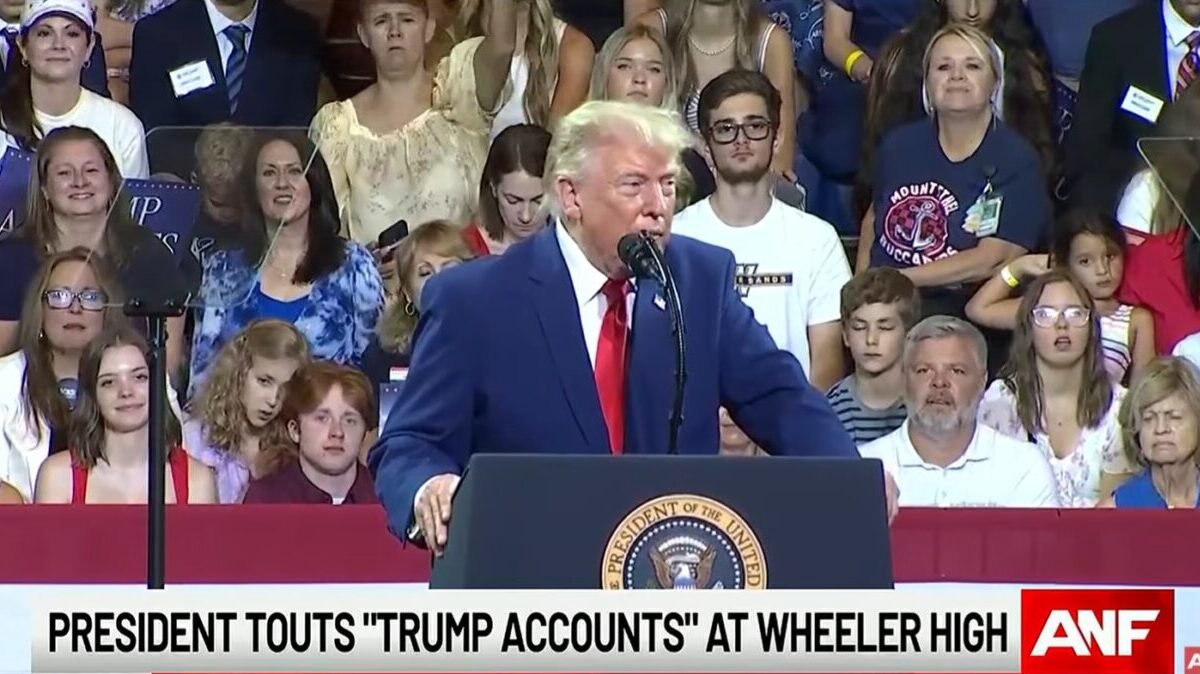
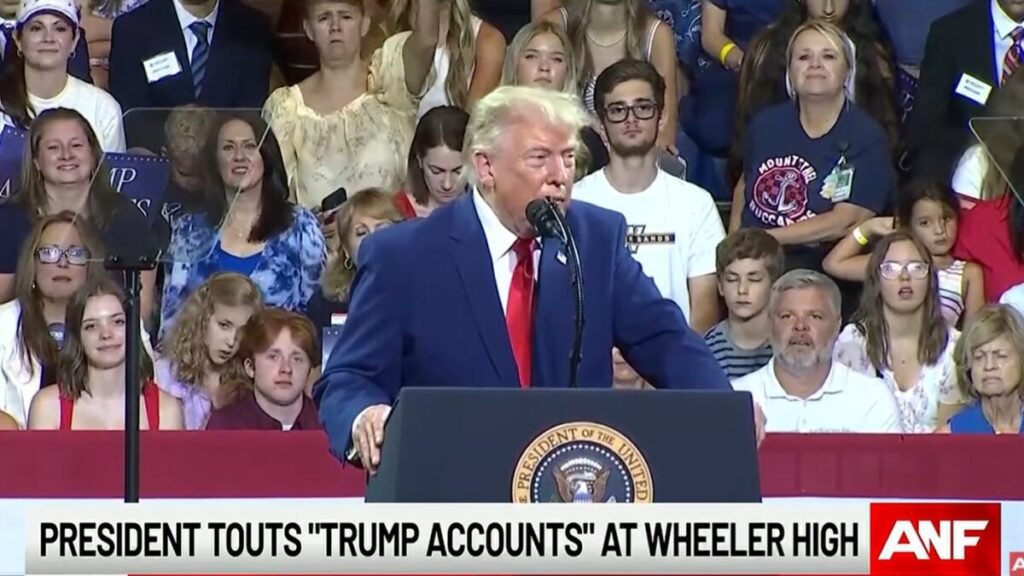
At a July 22 appearance at a high school in Marietta, Georgia, President Trump characterized the program as a departure from past policy, stating that “for decades, Washington gave our children nothing but debt, but Trump Accounts now create a positive financial future.” The president introduced two families who described the accounts as providing financial self-reliance for their children from birth.
The Numbers Behind the Accounts
According to administration estimates cited in reporting by The Federalist, the initial $1,000 government contribution could grow to approximately $5,800 by age 18 based on assumed market returns. If maximum contributions are made consistently, the accounts could surpass $1 million by age 28.
For families making regular contributions beyond the federal seed money, the potential accumulation is substantial. Annual contributions of $250 over 27 years could reach approximately $51,000, while the same contribution extended to age 55 could reach $742,000. At the maximum annual contribution level of $5,000 maintained until age 55, accounts could theoretically reach $13 million, according to the projections.
Connection to Social Security Reform Efforts
Conservative policy advocates are drawing explicit connections between Trump Accounts and previous attempts to reform Social Security through personal ownership models. The program echoes proposals from President George W. Bush’s 2005 reform initiative, which sought to introduce voluntary personal retirement accounts as an alternative to the traditional system.
According to The Federalist, one contributor to that earlier effort sees Trump Accounts as potentially realizing a vision that “simply arrived before their time.” The Bush-era commission aimed to protect current retirees while giving younger Americans opportunities to build wealth through market investments rather than relying solely on government transfers.
The demographic pressures facing Social Security underscore why alternatives are being explored. In 1940, there were 42 workers funding each retiree; that ratio has now fallen to fewer than three. Additionally, when the system was created, average life expectancy was 61 with a retirement age set at 65, while today average life expectancy is 79 with eligibility for benefits beginning at 62.

The Ownership Versus Dependency Debate
Proponents of Trump Accounts emphasize a philosophical shift from government-managed retirement benefits to personal ownership of retirement assets. This approach draws on economic theories advocating for individual control over financial futures rather than reliance on government systems.
A key distinction highlighted by supporters is that privately held investment accounts create inheritable assets, unlike traditional Social Security. While Social Security provides limited survivor benefits for spouses and certain dependents, accumulated payroll taxes do not transfer as personal assets to heirs. Money in private investment accounts, by contrast, remains the property of the account holder and can be passed to family members or charities.
According to The Federalist’s reporting, advocates also view the program as an educational tool, introducing young Americans to market participation and investment principles that they argue are not adequately taught in schools. The goal is to demonstrate that market investment is accessible to all Americans, not just the wealthy.
Implementation and Timeline
Trump Accounts are not positioned as an immediate replacement for Social Security but rather as a gradual transition mechanism. Children receiving the accounts today would not reach retirement age for decades, allowing for a long implementation period during which both systems could coexist.

The program’s structure allows multiple funding sources: the federal seed investment, family contributions, and potential employer contributions. This multi-source approach aims to maximize account growth while maintaining flexibility for families at different income levels.
Political and Economic Context
The Trump Accounts program arrives as Social Security faces a projected insolvency crisis within the coming decade without policy changes. Traditional reform proposals have typically involved some combination of benefit cuts, tax increases, or raising the retirement age, all politically challenging options.
By focusing on future generations rather than current beneficiaries, Trump Accounts attempt to sidestep the most contentious aspects of Social Security reform. The program does not propose changes to benefits for current retirees or those nearing retirement, instead building a parallel system for children that could reduce future reliance on traditional Social Security.
The concept reflects a broader conservative economic philosophy emphasizing market participation, personal ownership, and wealth accumulation through investment rather than government transfer programs. Supporters argue this approach better aligns with economic growth and provides stronger incentives for saving.
Questions and Challenges Ahead
While advocates present Trump Accounts as a potential solution to retirement security, significant questions remain about implementation, including how such accounts would eventually integrate with or replace Social Security, how market downturns would be managed for retirement security, and whether participation rates would be sufficient to achieve the program’s goals.
The program’s success will depend on sustained family contributions beyond the initial federal seed money, consistent market returns over decades, and political continuity across multiple administrations to maintain the program’s structure and funding.
For now, Trump Accounts represent a new approach to a longstanding policy challenge, offering families an investment vehicle for children while potentially laying groundwork for more fundamental changes to America’s retirement system in the decades ahead.
Source: thefederalist.com — https://thefederalist.com/2026/07/30/how-trump-accounts-could-solve-social-securitys-insolvency-crisis/