
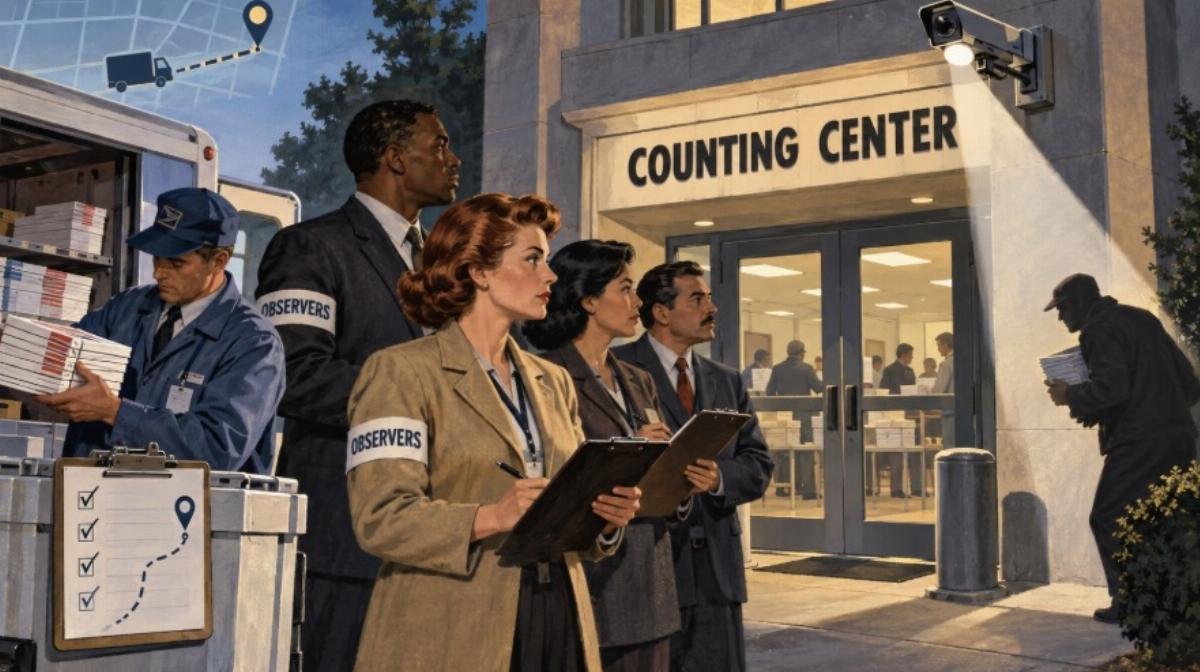
Could a sitting president declare a national emergency over elections — and would any court be able to stop him? That is the question at the center of a new American Thinker essay by retired physician Ted Noel, who walks readers through what he presents as a mostly lawful, largely administrative path to federal election scrutiny in 2026.
Noel opens by crediting Wayne Allyn Root with promoting a “National Emergency for Elections Declaration.” Root’s argument, as Noel relays it, is that a presidential declaration of national security emergency would be insulated from judicial review, and that only a two-thirds vote of Congress — 67 senators — could undo it. Given that more than 33 senators are described as firmly in favor of the SAVE America Act, Noel treats that threshold as unreachable. The tools, in his framing, are already sitting on the president’s desk.
The enforcement question
The harder problem, Noel concedes, arrives after the declaration. Who actually does the watching? Observers would be needed in large numbers, along with an enormous volume of video. Troops could supply the manpower, but Noel acknowledges that deploying the military runs into federal law — specifically 18 U.S. Code § 593, which bars military personnel from interfering “in any manner with an election officer’s discharge of his duties.”
What isn’t barred by statute, he writes, is federal observers. He points to a DOJ fact sheet stating that federal monitors “have a unique ability to help deter wrongdoing, defuse tension, promote compliance with the law and bolster public confidence in the electoral process.” There is even an established process for requesting federal monitoring, and in jurisdictions not already under a court-ordered monitoring arrangement, staff can be dispatched to observe “the election in the field.”
The catch is procedural: the attorney general must sue to obtain an observation order. Once granted, observers may station themselves in “any place for tabulating the votes.” Noel flags the obvious friction point — a judge in the Eastern District of Michigan, for instance, could complicate plans to monitor in Detroit. He calls this a real obstacle but “not insurmountable if one discounts the work of activist judges,” while allowing that the Ninth Circuit could still find ways to say no to observers in Phoenix who, in his view, are simply standing and watching.
His proposed workaround, in the meantime, is for the DOJ and the Republican National Committee to recruit and train civilian observers for every trouble spot — though he notes they generally won’t be permitted to record activity inside polling places.
Cameras outside, not inside
Outside the buildings, Noel argues, the rules loosen considerably. He cites 2020 as the motivating example, claiming that at several polling locations significant numbers of ballots arrived for counting with no chain of custody — pointing to Maricopa County, Arizona, and Fulton and DeKalb Counties, Georgia, as the best-documented cases.
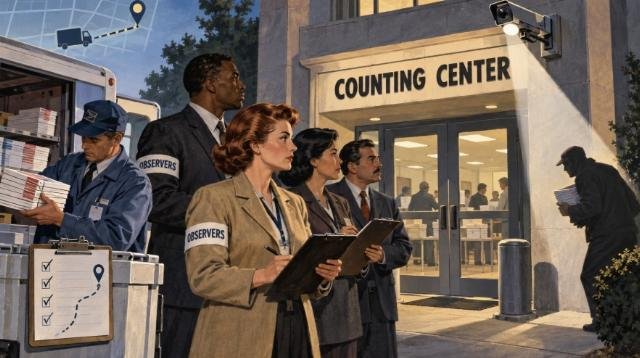
His proposal is 24-hour surveillance of every entrance to counting facilities — not voting locations — for days before and after an election. Because the cameras would monitor election officials rather than voters or private citizens, he contends a legal challenge would be nearly impossible, noting that video recording of state officers has already been upheld as lawful. “As long as a sight line exists, a camera can legally be employed,” he writes.
The operational details matter as much as the legal theory. Noel advises scouting camera placements a month or two in advance, installing and testing equipment weeks ahead, repeating the test a couple of days out, and running live recording around the clock. Doing it without notice, he suggests, is the whole point — bad actors who don’t know they’re being watched might get caught.
The Postal Service angle
Noel also addresses a recent setback: Trump lost his Postal Service ballot-mailing rule at the Supreme Court on procedural grounds, with the Court indicating he was “unlikely to succeed on the merits” and tacitly invoking the Purcell doctrine — too much disruption too close to the November 3 election. Justices Alito and Thomas dissented in part, arguing the delay stemmed from Democratic legal maneuvering and shouldn’t have blocked the rule. Noel, for his part, insists the Postal Service still has options.
His premise is that ballots can legally go only to eligible registered voters, and that because they travel through the mail, the Postal Service can curb fraud without touching local election administration. He lists four categories of ballots that should never be delivered: those addressed to non-residential locations that aren’t known to be occupied or to receive other mail; those subject to forwarding; those sent to rental complexes without apartment numbers; and duplicate ballots to the same person — the last of which, he notes, the Postal Service could catch because it already scans every piece of mail.
Crucially, Noel writes that improperly addressed ballots may constitute evidence of a crime and should be culled during sorting or retained during delivery, then returned to the local election office with instructions to preserve them for voter-roll correction and potential use as evidence. He goes further, suggesting postmasters and letter carriers be told they could face criminal liability as accessories to election fraud if the process isn’t followed.
Then comes his most aggressive proposal: outfitting every letter carrier with a GPS tracker — even something as simple as a phone app, with a requirement that the device stay on the carrier’s person during delivery. Live tracking, he argues, would expose unauthorized deliveries to what he calls Democrat ballot mills. He concedes this does nothing about non-citizen voting, which he says requires a separate approach.
What it does and doesn’t solve
Noel’s closing pitch is modesty about scope. Every action he lists, he maintains, is unequivocally lawful and requires only presidential direction. Asked whether it can be pulled off in the time remaining, his answer is an unqualified yes. Will it fix everything? No — but he warns against letting the perfect defeat the good, promising better next time as new methods of subversion are discovered.
It’s worth being clear about what this piece is: a commentary argument, not a report of actions taken. Noel is a retired physician who posts as “Doctor Ted” on X and hosts a podcast; American Thinker publishes his work in its opinion pages. The legal theories he advances — emergency declaration immunity, DOJ observation orders, warrantless camera placement, Postal Service ballot retention, carrier GPS tracking — are his own proposals, offered as a menu of options he believes a president could use. Whether any of them would survive the courts he so clearly distrusts is a question the essay raises without answering.
Source: www.americanthinker.com — https://www.americanthinker.com/articles/2026/09/trump-can-issue-a-national-emergency-for-elections-declaration/