
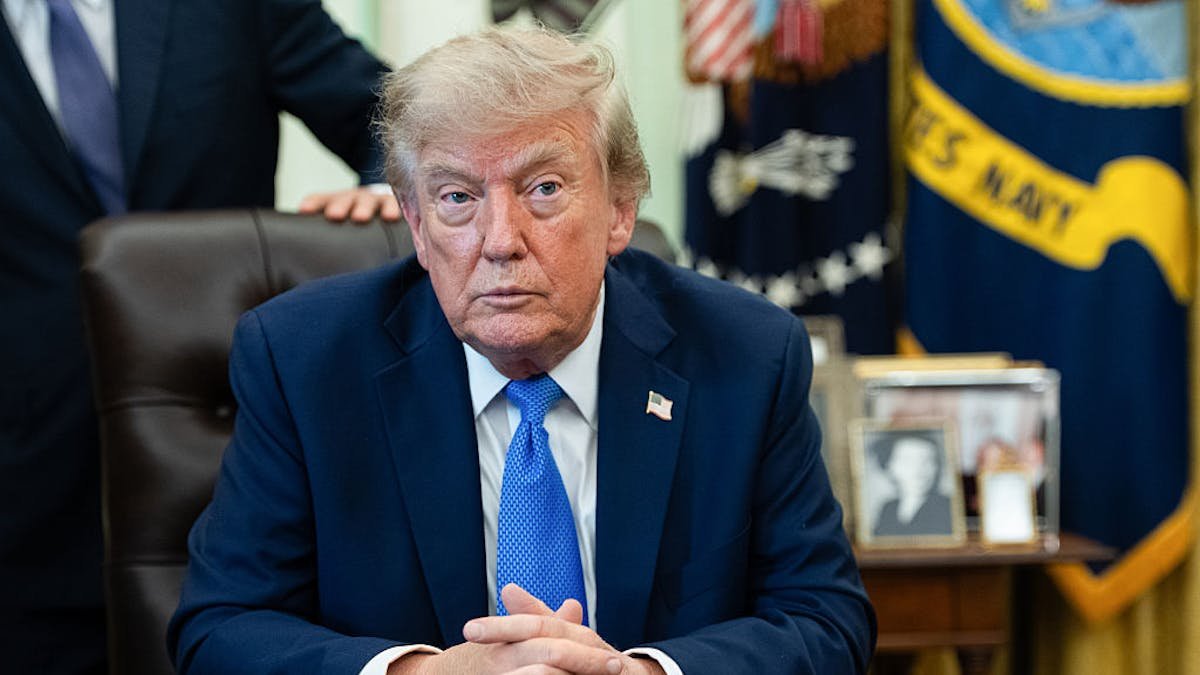
With less than three months until the 2026 midterm elections, Republicans are facing an uphill battle. While some midterm backlash against the party controlling the White House is expected, the GOP’s poor approval ratings on the economy and voters shifting trust to Democrats on that key issue have conservatives, moderate Republicans, and right-libertarians worried. The question, according to Republican strategist Liz Mair, is whether President Donald Trump has both the power and the will to change the trajectory before November.
In a new analysis, Mair argues that while success will be “exceedingly tough to manage,” there are several executive actions Trump could take right now to curb inflation—especially on gas and groceries—and to help vulnerable Republicans hold onto their seats. But many of those actions would run directly against Trump’s core ideology, making them nearly impossible to get him to sign on.
Targeting Real Price Drivers, Not Big Tech
Mair suggests Trump should immediately order the Department of Justice and the Federal Trade Commission to shift their focus away from investigations into Big Tech companies—whose products are often free or very cheap—and instead get “very visibly and vocally aggressive” with big market players who are legitimately driving up prices across sectors like meat, healthcare, and real estate.
She points to Brazilian meat conglomerate JBS as a prime example, arguing it’s “pretty hard to argue” that it is not driving up beef prices. Similarly, she cites large hospital systems like New York-Presbyterian and OhioHealth, along with smaller systems like UCONN Health in her home state of Connecticut, which she says was accused of trying to hike rates billed to United Healthcare by 45% in just one year. Big real estate players like Zillow have also been accused of pushing property prices higher, and federal probes of at least two of these entities are already underway, according to Mair.
Trump could use the bully pulpit more aggressively, including against drug companies pushing inflation-stoking price hikes. While opponents might decry such tactics as “quasi-mob tactics,” Mair argues this is one area where Trump’s “Queens-guy brawler instincts might actually pay off for the American people.”
Tariffs, Iran, Ethanol, and Wind
Beyond antitrust enforcement, Mair outlines several other policy moves that could help—though each comes with political complications for Trump.
First, she argues Trump needs to eliminate all tariffs he has instituted and roll back inherited tariffs from prior administrations, noting that tariffs have driven prices higher and hit grocery prices particularly hard. She also suggests maximizing refunds of tariffs paid by consumers that were subsequently found to have been unconstitutionally levied.
Second, Mair urges Trump to reconsider Vice President JD Vance’s foreign policy push and consider unilaterally ending military action targeting Iran. While this might not bring gas prices down in time for November, she says it deserves serious consideration given the connection between gas prices and grocery costs.

Third, she suggests paring back EPA-imposed ethanol blending requirements, which she says are currently adding an extra 20 cents to $1.00 per gallon of gas while reducing efficiency. That move could be a big political boon if the election turns on gas prices—though it might anger parts of farm country.
Fourth, despite Trump’s well-known hatred of windmills, Mair argues that getting wind power online quickly could keep electricity bills low as power demand surges. She notes that you cannot buy a gas turbine right now, with manufacturers effectively sold out, and a new gas plant won’t deliver power for at least five years. A wind project, by contrast, comes online within 12 to 18 months, and more wind could meet surging demand and keep prices and local taxes lower in states like Texas, Iowa, Ohio, and Michigan.
Political Strategy and Tactics
Policy is not the only arena where Republicans could improve their odds. Mair argues that if Democrats are making the 2026 election about the cost of living, Republicans should try to make it about something else—and they are already trying.
She points to the voluminous dirt-digging and exposing operation targeting Democrat Graham Platner in Maine, which she says has weakened Democrats in the state overall and helped keep Senator Susan Collins in contention. In Texas, Attorney General Ken Paxton is trying to make the race about Democrat James Talarico’s “very fringe leftist views on cultural issues ranging from abortion to transgender kids.”

While Mair is skeptical that such cultural issues can outweigh inflation concerns, she says shining a spotlight on Democrats’ “easy-to-understand liabilities”—including Platner’s alleged rape of an ex and Troy Jackson’s apparent ongoing intimate relationship with a cousin—could help on the margins. It might prevent a Democratic-controlled Senate, given how tight both the Maine and Texas races appear, and it might help narrow a potential Democratic House majority, which could matter if Democrats try to impeach Trump again.
She also suggests that highlighting the role of the Democratic Socialists of America (DSA) and its “arguable or overt antisemitism” could help Republicans in some races, noting that Rep. Mike Lawler’s political fortunes have improved as the DSA has risen, even as the national environment for Republicans has worsened.
Spending Down the War Chest
Finally, Mair argues that Trump could personally help turn the tide by spending down some of the “very healthy funds” currently warehoused in his various committees to aid vulnerable Republicans. In previous midterm cycles, presidents have taken flak for being stingy with their own spending. With Trump in his last term, facing potential impeachments, and with Democrats possibly controlling the Senate, she says it might be time to stop hoarding campaign cash and deploy it freely to try to eke out some victories not currently in the cards.
The Bottom Line
Mair concedes that the result of November’s election is probably almost entirely baked in at this point, and no amount of policy or strategic changes will likely alter the outcomes. But she argues the real reason to make these changes is not political—it is to improve Americans’ lives by effecting better policy now, and at least potentially, to fend off the worst of the damage.
Source: www.dailywire.com — https://www.dailywire.com/news/liz-mair-trump-holds-the-power-to-republican-victories-in-november-but-does-he-have-the-will