
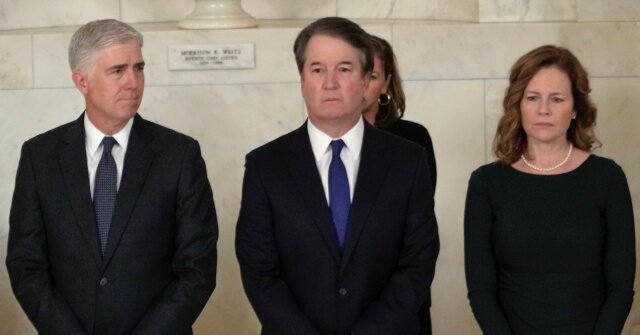
President Donald Trump said he regrets nominating all three of the Supreme Court justices he appointed during his first term, telling TIME in an interview published Thursday that Neil Gorsuch, Brett Kavanaugh, and Amy Coney Barrett have ruled against him too frequently since joining the bench, according to Breitbart News.
Asked directly whether he regretted the three nominations he made between 2017 and 2020, the president did not hedge. “Yeah. Yeah. What can I do? I put them in,” Trump told the magazine. “They voted against me too often. I was very—I gave them the position of a lifetime, and they vote against me often. They vote for me too.”
The admission marks an unusually blunt break from a president toward his own judicial legacy. Trump’s three appointees reshaped the court’s ideological balance for a generation, delivering the conservative 6-3 majority that helped overturn Roe v. Wade in 2022. Three years later, the same justices have become a recurring target of his frustration as a string of high-profile rulings went against his administration.
Frustration Rooted in Two Rulings
Trump tied his disappointment to the court’s decisions on birthright citizenship and his emergency tariffs, two cases that went to the heart of his second-term agenda.
The court in June found Trump’s executive order restricting birthright citizenship unlawful, with Barrett and Kavanaugh joining the majority and Gorsuch dissenting. Trump described the outcome in sweeping terms, casting it as a national injury rather than a personal one. “It’s unfortunate what they did—not to me, to our country,” he said. “And it’s become a corrupt business, all because of the Supreme Court decision.”
He also faulted the justices over a February ruling that struck down his global tariffs. In the interview, Trump argued that a single clause could have shielded the government from a major financial hit. “All they had to do was a little clause saying any money paid does not have to be paid back…would have saved $400 billion,” he said. “They chose not to save that.”
The president’s remarks arrive amid a broader pattern of public criticism directed at the court. Breitbart reported that weeks before the TIME interview, Trump responded to a September ruling that declined to let a Postal Service directive restrict mail-in ballots ahead of the midterms, calling it “another bad decision” from a court he said had been “bullied and cajoled by the Radical Left.”
In a Truth Social post at the time, Trump wrote: “These are not the people I interviewed to serve on the United States Supreme Court, they are merely a shell of their original selves.”
A Question of Loyalty
During the TIME interview, Trump praised the court’s Democratic appointees for voting as a unified bloc, expressing admiration for their cohesion. The interviewer then asked whether loyalty was what he wanted from his own picks.
“I do like loyalty, yeah,” Trump replied.
Pressed further on the point, he appeared to pull back. “No, I don’t want loyalty. I want good decisions,” he said.
The exchange captures a tension that has run through Trump’s relationship with the judiciary since his first term: a president who prizes personal allegiance from the officials he elevates, squared against justices who hold lifetime appointments and are insulated from political pressure by design.
Trump’s frustration is not without counterweight. Each of his three nominees—Gorsuch in 2017, Kavanaugh in 2018, and Barrett in 2020—has also delivered conservative victories on issues ranging from religious liberty to regulatory authority, and the president himself acknowledged that they do not rule against him uniformly. “They vote for me too,” he said, a concession that complicates the blanket regret he expressed.
Still, the interview underscores how fully the president has reframed his own judicial appointments as a source of grievance rather than triumph. The relationship between a president and the justices he installs is often fraught—appointees are famously difficult to predict once they take a lifetime seat—but Trump’s willingness to air that disappointment publicly, and to name each justice he regrets, places him in rare company.
The remarks also raise the question of what, if anything, the president might seek to do differently should another vacancy arise. He did not say in the interview whether he would approach a future nomination with different criteria, and the article did not indicate that any such opportunity is presently at hand.
What the exchange does make clear is that the president views the court less as an independent branch than as an institution whose output he measures against his own political interests—and that he is prepared to say so on the record.
For now, the three justices remain on the bench, holding the lifetime appointments Trump said he gave them. Whether the president’s public frustration carries any consequence beyond the rhetorical remains to be seen, but his statement to TIME leaves little ambiguity about where he stands on the legacy he once claimed as his signature achievement.
Source: www.breitbart.com — https://www.breitbart.com/politics/2026/10/01/trump-says-he-regrets-all-3-of-his-supreme-court-picks/