
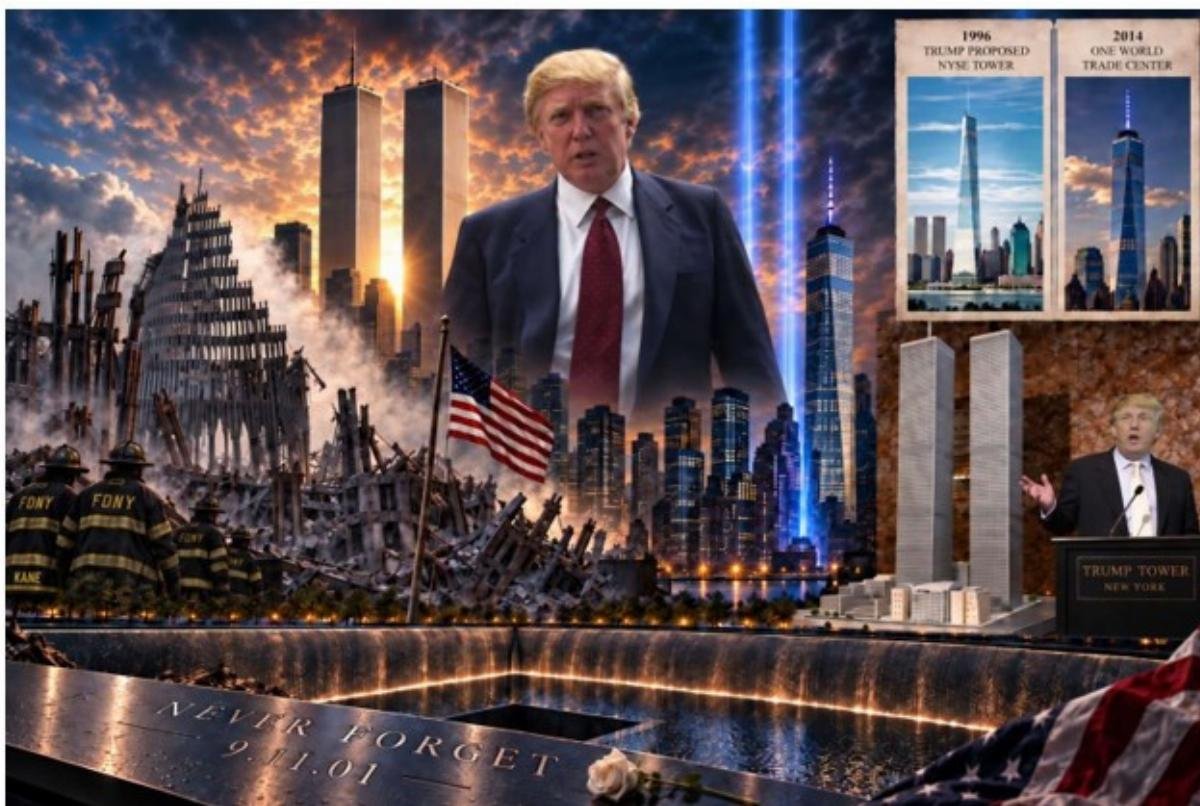
Twenty-five years after the attacks of September 11, 2001, the public memory of what happened in Lower Manhattan has been told and retold through countless lenses: the heroism of first responders, the grief of families, the decades-long hunt for those responsible. What has been touched on less often, according to a new piece in American Thinker, is the role Donald Trump played in the push to rebuild the World Trade Center site — and specifically, in the design that eventually became the Freedom Tower.
Writing for the conservative outlet on the 25th anniversary of the attacks, Matt Kane argues that Trump’s contribution to the rebuilding effort has gone largely unrecognized. The essay, published September 11, 2026, is framed as a reconsideration — the idea being that the passage of time has made it easier to forget the public debate that followed the destruction of the towers, and who was loudest in insisting that the site be rebuilt rather than replaced with something more modest.
A Different Kind of Anniversary Reflection
Anniversary coverage tends to orbit the same themes: the collapse of the towers, the Pentagon strike, the passengers who fought back over Pennsylvania. Kane’s piece steps away from that familiar territory to focus on the years that followed — the wrangling over what would rise in the footprints, and the figures who weighed in on it. For the author, Trump belongs at the center of that story rather than at its margins.
The essay is tinged with frustration at how the record has been kept. The subtitle of the piece points directly at the gap its author sees: Trump’s push to rebuild the Twin Towers, and the Freedom Tower design he, in Kane’s telling, never got credit for. That framing matters. It isn’t simply that Kane thinks Trump was involved — it’s that he thinks the involvement was deliberately or carelessly written out of the standard account.
That claim, of course, sits inside a broader debate. Trump’s relationship with New York City has been tangled since long before he entered politics, and the way the city remembers him — or chooses not to — has become its own kind of political argument. Kane’s essay arrives at a moment when that argument is renewed with a round-number anniversary attached. The author’s position is clearly sympathetic to the former president, and readers should weigh it as such; the piece is an essay of appreciation and reappraisal, not a neutral chronicle.
Why the Rebuilding Fight Still Matters
What gives the essay its weight is the sheer emotional charge of the subject. The battle over the World Trade Center site was not a bureaucratic footnote. It played out on the evening news and in the tabloids, tangled up with questions of what it meant to rebuild, what the site should symbolize, and how a city still bleeding from its worst day should present itself to the world. Trump, who had built his public identity on the skyline just blocks away, was a natural participant in that conversation. Whether he was a decisive force or a well-covered bystander has been disputed for years — and Kane’s essay lands firmly on the side of arguing he mattered more than has been acknowledged.
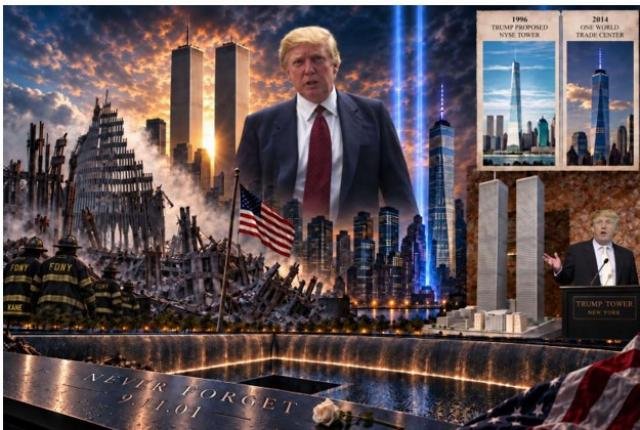
The Freedom Tower itself — now One World Trade Center — carries its own complicated history. The design went through multiple iterations and controversy before a final version was settled on, and the tower was not completed until years after the attacks. Kane’s argument that Trump deserves a share of credit for what ultimately rose there is the kind of claim that tends to provoke argument as much as agreement. Which is precisely the point: on the 25th anniversary, there is still no settled consensus on who shaped that skyline.
An occasion like this forces a reckoning with the distance between the raw drama of the moment and the dry summaries that follow. The story of what happened after 9/11 — not just in Afghanistan and Iraq or in the security apparatus that grew up around the country, but in the physical reconstruction of the site itself — is messier and more contested than the annual ceremonies might suggest. Kane’s essay is a reminder that the rebuilding was a fight, and that fights have winners whose names sometimes fade.
The Politics of Historic Memory
There’s a political layer to this that any reader will recognize. By the time of the 25th anniversary in 2026, Trump had already served a full term and been the central figure in American politics for a decade. His defenders have long contended that media coverage of his pre-political civic and business contributions has been slimmed down or dismissed. Kane’s essay fits neatly into that broader pattern of grievance — which doesn’t make it wrong, but does mean it needs to be read for what it is: an argument from a writer who believes the record has been tilted.
The essay lands amid a wider reconsideration of how anniversaries get remembered and who gets to author the version of events that outlasts them. Twenty-five years is long enough for the rawest emotions to settle into something more curated, and for the people who were present at pivotal moments to slip out of the frame. Kane’s contention is that Trump has slipped out of this particular frame, and that it’s worth pulling him back in.
Whether a reader accepts the argument will depend heavily on what they already think of Trump — which is honest, at least. But there’s a broader observation underneath the political argument: the rebuilding of the World Trade Center was one of the country’s most public acts of defiance after 9/11, and its dramatis personae have never been fully settled. The essay invites readers to reconsider one of those names. Two and a half decades on, the question of who belongs in the story of the site’s rebirth is still being answered.
Source: www.americanthinker.com — https://www.americanthinker.com/articles/2026/09/25-years-after-revisiting-trump-s-role-as-a-champion-for-new-york/