
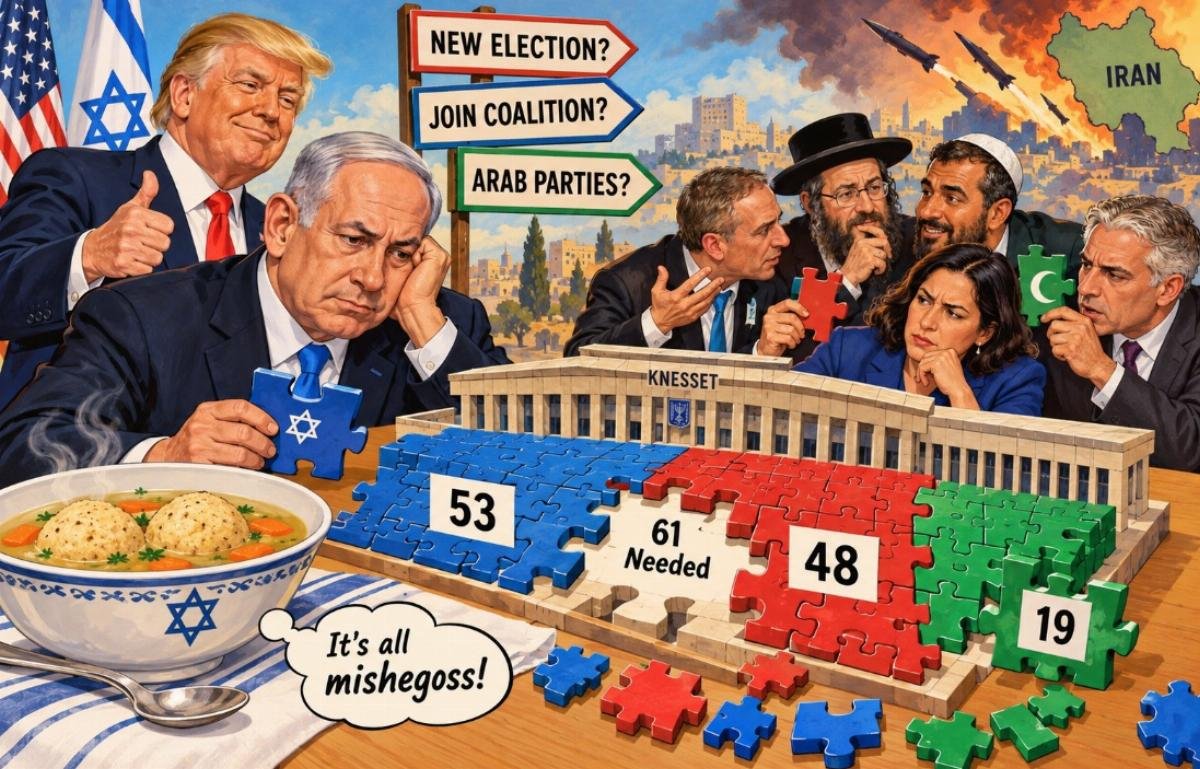
President Donald Trump’s unprecedented intervention in Israel’s October 27 election — a full-throated endorsement of Prime Minister Benjamin Netanyahu posted to Truth Social just nine days before voting — failed to deliver the decisive victory the U.S. president had hoped for, leaving Israel’s government formation in limbo as the country prosecutes an ongoing conflict with Iran.
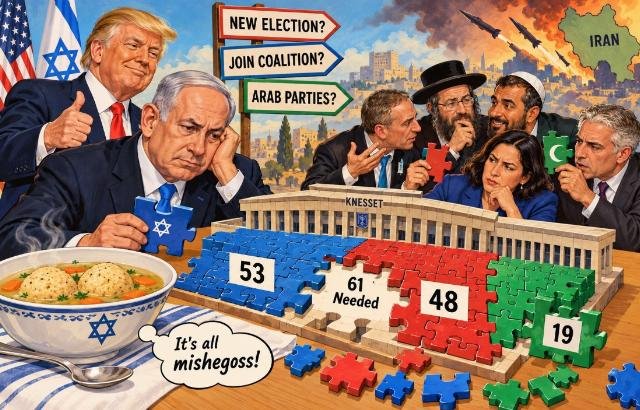
The election results landed Netanyahu’s Likud-led bloc at 53 seats in the 120-member Knesset, well short of the 61 needed to form a government. The opposition secured 48 seats, creating what one conservative commentator described as a “farmisht” — Yiddish for mixed up — outcome that has left both American supporters of Netanyahu and the prime minister himself scrambling to assemble a governing coalition.
Writing for American Thinker, Robin M. Itzler expressed frustration that Israeli voters didn’t heed Trump’s October 18 endorsement, which she argues should have been determinative given the wartime context and America’s longstanding military support for Israel.
Trump’s ‘Complete and Total Endorsement’
Trump’s Truth Social post, which circulated widely on Tel Aviv billboards in the campaign’s final days, pulled no punches in its support for Netanyahu. The president called the prime minister a “Great Warrior” and praised his partnership in “combatting the Islamic Republic of Iran,” while warning that “if Israel has the wrong Leader, which would be anyone other than Bibi, America will have to do this work ourselves, and I am not inclined to do so.”
The endorsement continued: “I have watched Bibi under the most trying of times. Normal men or women in such situations would have wilted under the pressure — But Bibi did not wilt, he actually got stronger, and maintains that same Strength today. This is the kind of Partner that the United States of America is demanding of Israel.”
According to Itzler’s analysis, Trump’s message reached Israel’s 10 million inhabitants with maximum visibility, making the failure to produce a commanding Netanyahu victory all the more perplexing to American conservatives who view the U.S.-Israel alliance as paramount.
The Wartime Leadership Argument
Central to Itzler’s critique is a historical argument about leadership continuity during conflict. She draws parallels to Britain’s steadfast support for Winston Churchill even when Nazi invasion seemed imminent, and American voters standing with Franklin Roosevelt following Pearl Harbor despite early battlefield losses in both the European and Pacific theaters.
“During war, you don’t change leadership,” Itzler writes, framing the current U.S.-Israeli operations against Iran as requiring the same kind of political stability that characterized World War II leadership.
The commentary emphasizes that both Trump and Netanyahu view their mission as existential: preventing Iran from acquiring nuclear weapons and rolling back what they describe as the regime’s “terrorist tentacles” spreading through European nations.
Arab Voter Turnout Complicates Picture
One development that particularly alarmed conservative observers was a reported 27 percent increase in Arab voter participation compared to the previous election. According to the American Thinker piece, Israel’s two Muslim parties could potentially hold 19 seats in the next Knesset — a bloc that Netanyahu explicitly rejected as coalition partners.
“It is out of the question to have a government that is backed by Arab parties,” Netanyahu told supporters in the early hours of October 28, as results clarified that the “Never Bibi” movement had failed to unseat him but succeeded in denying him an outright majority.
Netanyahu pledged that if he manages to assemble a coalition, “it will be a strong new right-wing government,” though the mathematics of reaching 61 seats remain uncertain.
Three Paths Forward
The stalemate leaves Israel facing what Itzler identifies as three basic options: Netanyahu forming a right-wing coalition without Arab party support; a unity government that would require cooperation between Netanyahu’s bloc and opposition parties; or potentially another round of elections if coalition talks collapse entirely.
Each path carries significant complications. A right-wing coalition would require Netanyahu to secure support from smaller parties that may extract policy concessions. A unity government would mean partnering with political opponents who spent the campaign arguing Netanyahu should step aside. And another election would mean continued political paralysis while military operations against Iranian targets continue.
Trump Claims Partial Credit
Despite falling short of delivering Netanyahu an outright majority, Trump moved quickly to claim his endorsement made a material difference. On October 28, the president quoted Irving C. Schwartz on Truth Social: “When President Trump endorsed Bibi Netanyahu, the whole tide turned, and now, rather than a decisive defeat for a Great Prime Minister, it looks like a big come-from-behind stalemate, or even a WIN for Netanyahu.”
The post continued: “It all took place AFTER the Endorsement by President Trump, who only wants what is good for the Middle East, Israel, and the United States of America!”
This framing suggests that internal Trump campaign analysis viewed Netanyahu as potentially heading for a more significant defeat before the presidential intervention shifted momentum, even if it didn’t ultimately secure the governing majority needed.
Diaspora Tension Over Israeli Sovereignty
The election outcome has reopened familiar tensions about the appropriate role for diaspora Jews — those living outside Israel — in commenting on Israeli political choices. Itzler references an argument by Vanessa Berg that diaspora Jews can disagree with Israeli government decisions but shouldn’t withdraw support.
Itzler acknowledges Israel’s sovereignty but pushes back on the idea that American input should be minimal, noting that U.S. military weapons sales and diplomatic support “have immensely helped the Jewish State survive since its rebirth in 1948.” In this view, the close alliance relationship means American perspectives — particularly from a sitting U.S. president — merit serious consideration from Israeli voters.
The piece expresses particular frustration with what it characterizes as the “Never Bibi” coalition giving Trump “the middle finger” by refusing to deliver Netanyahu the commanding victory his American endorsement supposedly warranted.
Broader Political Context
Itzler draws a parallel between Israel’s political divisions and partisan battles in the United States, where she frames the upcoming November 3 American election as a choice “between Republican common sense or Democrat communism” — rhetoric that reflects the heightened polarization characterizing both countries’ political environments.
The comparison underscores how closely some American conservative commentators tie their domestic political identity to Israeli electoral outcomes, viewing Netanyahu’s Likud as a natural ally to Republican governance and his opponents as analogous to American progressives.
As coalition negotiations begin in earnest, the question remains whether Trump’s endorsement — unprecedented in its timing and forcefulness — will translate into leverage during government formation talks, or whether Israeli political dynamics will prove more complex than even a sitting U.S. president’s public pressure can overcome.
For now, Netanyahu commands a plurality but lacks a majority, leaving Israel in the familiar position of coalition bargaining while simultaneously managing military operations that both he and Trump have described as essential to preventing Iranian nuclear capability.
Source: www.americanthinker.com — https://www.americanthinker.com/articles/2026/10/jewish-israelis-should-have-respected-trump-s-endorsement/