
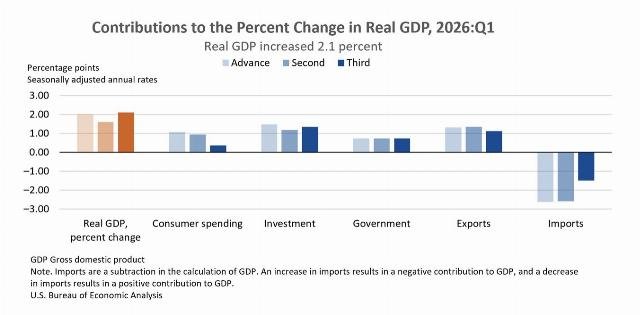
The Bureau of Economic Analysis has closed the books on the second quarter of 2026, and the final number came in hotter than the two that preceded it. According to American Thinker, the agency’s third estimate put real GDP growth — economic output with inflation stripped out — at 2.2 percent, a meaningful upgrade over its earlier calculations for the April-through-June period.
That revision is getting attention not just for the size of the number but for the comparison that comes with it: the United States, on this reading, is expanding faster than the world’s other major economies.
Why three bites at the same apple
The BEA, an arm of the U.S. Department of Commerce, doesn’t publish one GDP figure per quarter and call it a day. It issues three estimates roughly a month apart, each one drawing on a fuller set of data than the last. The first is a preliminary read, the second incorporates more complete source material, and the third — the one just released for Q2 2026 — is the most refined of the trio.
That means the upward revision isn’t a surprise in the sense of a forecasting miss. It’s the predictable result of statisticians replacing partial data with better data. Still, the direction and magnitude of the change matter: the economy performed better than the government’s own initial snapshot suggested.
How the U.S. stacks up against other large economies
Richman, the American Thinker writer behind the piece, pairs the BEA’s finding with a comparison of growth rates across the world’s biggest economies. His conclusion is blunt — the United States is outpacing the rest of the field.
The source material doesn’t lay out a country-by-country table in prose, but the claim is straightforward: on current growth, America sits at the front of the pack among large economies. That’s a notable position for a country that spent much of the post-pandemic period being told its momentum was about to stall.
The policy explanation Richman offers
Richman attributes the performance, at least in part, to business investment flowing into the United States — and he ties that investment to Trump’s approach to business taxes, business regulation, and tariffs. The argument is a familiar one in supply-side and pro-business commentary: lower tax burdens and a lighter regulatory hand raise the expected return on capital, and capital follows the return.
It’s worth being precise about what Richman is claiming. He isn’t asserting that a single policy lever produced the 2.2 percent figure, nor that the revision itself can be traced to any one decision in Washington. He’s offering an interpretive frame: strong business investment, encouraged by the administration’s economic posture, is a driver of the growth the BEA just confirmed.
That frame is contestable, as any policy attribution in economics tends to be. A quarterly GDP revision reflects dozens of moving parts — consumer spending, inventories, trade flows, government outlays — and disentangling any one policy’s contribution from that mix is genuinely difficult. Richman’s piece doesn’t pretend otherwise; it presents the investment-and-policy link as the explanation he finds most persuasive rather than as a settled accounting identity.
From GDP to GDI: the households connection
The more interesting move in the American Thinker piece is the pivot from output to income. Richman invokes the circular flow of the economy — the idea that production and earnings are two views of the same activity. When businesses produce more, they pay out more in wages, salaries, and other compensation. Economists capture this with a parallel measure called Gross Domestic Income, or GDI.
Richman’s framing is that rising real GDP implies rising real GDI for American families, and he specifically names higher wages for middle-class households as part of that chain. This is the crux of his argument: the headline growth number isn’t an abstraction about factories and spreadsheets, it’s a proxy for what lands in household bank accounts.
The circular-flow logic is textbook, and GDI is a real and closely watched statistic. The practical caveat is that GDP and GDI don’t always move in lockstep quarter to quarter, and the gains from growth are not automatically distributed evenly across the income spectrum. Richman’s piece is making the optimistic case — that growth translates into family income — rather than the distributional one. Readers who want the fuller picture would do well to check the GDI release alongside the GDP release, since the two are published together precisely because each helps interpret the other.
What the revision actually tells us
Strip away the policy debate and a few things remain solid. The U.S. economy grew at a 2.2 percent real rate in the second quarter of 2026, per the BEA’s most complete estimate. That figure is higher than the agency’s earlier stabs at the same quarter. And on the international comparison Richman cites, America’s growth rate stands at or near the top among large economies.
For an economy that has repeatedly been pronounced on the verge of slowing, that’s a durable run of upside surprises. Whether you credit tax policy, deregulation, tariffs, business investment, consumer resilience, or some combination, the arithmetic is the arithmetic: the final word on Q2 came in better than the first word did.
Richman’s conclusion follows from that. If the number is right, and if the circular flow holds, then the growth shows up somewhere in American life — and his bet is that it shows up in paychecks. That’s an argument about causation and distribution that economists will keep fighting over. The revision itself, though, is a fact the BEA has now put in print.
For households, the practical question is the one Richman raises but can’t fully answer from a GDP report alone: whether the stronger quarter shows up in their own finances. That answer lives in wage data, in prices, and in the next round of estimates — not in a single upward revision, however welcome it may be.
Source: www.americanthinker.com — https://www.americanthinker.com/blog/2026/10/us-real-gdp-rose-by-2-2-much-faster-than-earlier-estimated/