
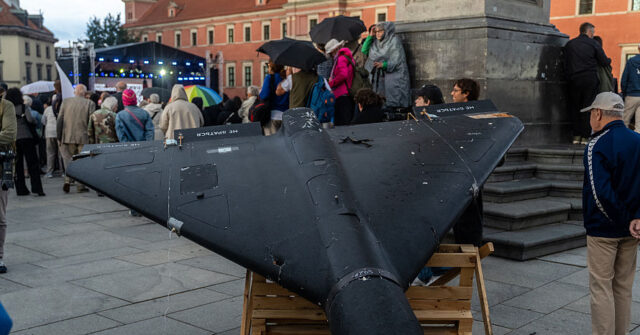
A significant advancement in military technology has emerged from Ukraine, where officials announced the use of a directed energy weapon to successfully shoot down a jet-powered Russian drone. This innovative approach could reshape the landscape of drone warfare, a strategy increasingly adopted on the battlefield.
Serhii Beskrestnov, a senior military adviser to the President of Ukraine, detailed this development on Wednesday, expressing hope that the experimental laser system, dubbed ‘Blysk’, could provide a crucial line of defense against escalating drone attacks. Beskrestnov indicated that this incident represents a “world-first achievement” in utilizing laser technology for air defense.
Details of the Operation
Beskrestnov revealed that the shootdown occurred recently and was aimed at protecting critical infrastructure in Ukraine. Despite this success, he emphasized that the ‘Blysk’ laser system is still under development and is not yet ready for full production. He remarked, “Since laser technologies are highly complex and capital-intensive, it is encouraging to see positive developments in this field.”
The Rise of Drone Warfare
Drone warfare has transformed military strategies since the onset of the conflict in Ukraine, with relatively inexpensive drones proving to be highly effective asymmetrical weapons. Initially, propeller-driven drones posed considerable challenges to interception efforts, leading to costly outcomes for the targeted nations. As Ukraine improved its interception capabilities against Russia’s mass-produced Shahed drones, Moscow adapted by enhancing the drones with jet engines, complicating shootdowns further.
Earlier this year, Ukraine announced the initiation of defensive laser weapon testing, and the ‘Blysk’ system was reportedly deployed around Kyiv. However, conditions such as rainy weather have impacted early operations, as the effectiveness of directed energy weapons can diminish in such circumstances. The ‘Blysk’ is equipped with a relatively modest 4-kilowatt laser, operational up to one kilometer (3,280 feet).
Comparative Technology
In comparison, more powerful systems like the Israeli Iron Beam anti-drone laser operates at around 100 kilowatts with a range of 10 kilometers (approximately 6 miles), while the British Dragonfire laser boasts a capacity of 50 kilowatts. The UK had previously announced plans to deploy the Dragonfire system to Ukraine for testing in a live conflict, but updates on this initiative have been scarce.
This report by Ukraine signifies not only a tactical development against aerial threats but highlights an evolving relationship with advanced technologies in warfare, which may continue to change the dynamics on the battlefield.
Source: www.breitbart.com — https://www.breitbart.com/europe/2026/11/26/ukraine-says-it-has-used-a-laser-to-shoot-down-a-russian-jet-drone/
Source: www.breitbart.com
Related coverage
- Democrats Defy Voters on Trans Rights, Immigration, and Wealth Tax Despite Election Backlash
- Sanders Says H-1B Program Has ‘Been Greatly Abused,’ Backs Crackdown on Visa Use
- Texas GOP Super PAC Spent $7.7 Million a Day Backing Ken Paxton, FEC Filings Show
- DHS Chief Mullin Claims ICE Raids Cut Rents by 6%, Ties Enforcement to Housing Affordability