
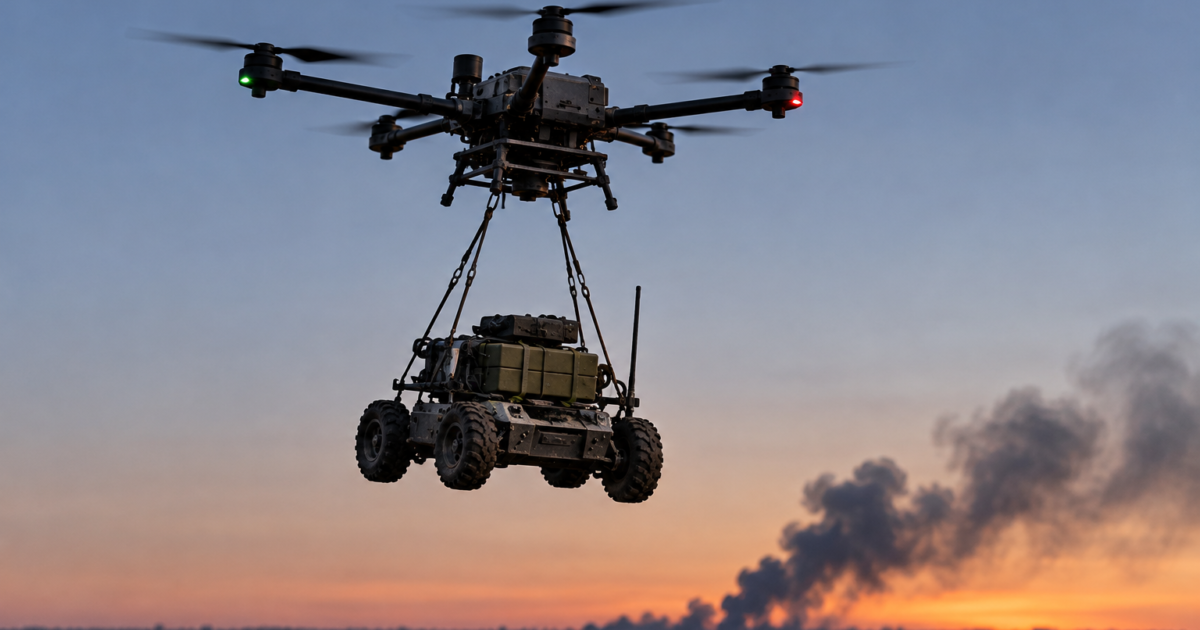
Ukraine is claiming a sweeping battlefield result from a months-long secret operation that, according to reporting by The Telegraph, involved air-dropping small explosive-carrying robots deep behind Russian lines using large drones.
The mission, identified as Operation Vivaldi, was carried out by Ukraine’s 3rd Army Corps, and the unit says it killed roughly 3,000 Russian soldiers over the course of several months while recovering 48 square miles of Russian-occupied territory. The Gateway Pundit’s Ben Kew first flagged the Telegraph report, which includes details of how the unusual tactic was executed.
How the robot drops work
The scheme pairs two pieces of hardware. A large drone lifts a small, wheeled robot loaded with explosives and carries it ten miles or more into Russian-held territory in the Donetsk region before releasing it. From there, remote operators drive the ground unit — known as Gryphon — toward Russian troops who are preparing to ambush Ukrainian forces, and detonate it on target.
According to the Telegraph, the unit’s commander said no other army has previously air-dropped ground robots behind enemy lines, and claimed Ukraine is the first country to use the tactic. Some of the robots reportedly reached as far as 12 miles behind Russian positions.
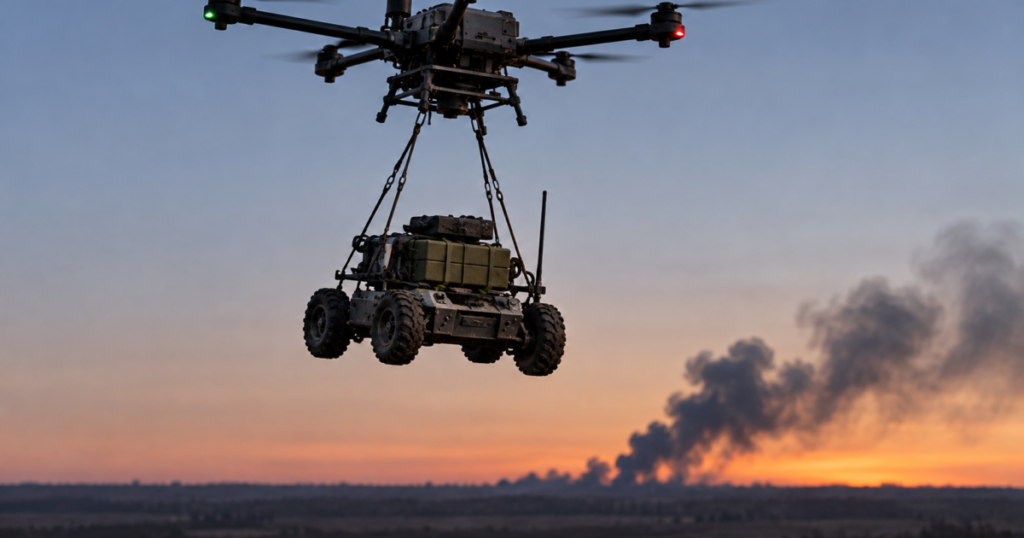
The approach is not without difficulty. The drones carrying the robots are large enough that Russian troops can spot and shoot them down. To improve the odds, Ukrainian forces jam Russian surveillance drones, strike enemy positions with artillery and drones to keep soldiers pinned in place, and fly only at night.
Once a robot strikes, Ukrainian infantry move in on foot to seize the ground, then wait while drones and artillery hit the next target — a sequenced, phased pattern designed to convert the robot detonations into actual territorial gains.
A war increasingly fought by machines
The operation fits into a broader shift in how the war is being fought since Russia’s full-scale invasion in 2022. Both sides now lean heavily on drones and unmanned ground vehicles, and those systems have reshaped battlefield tactics on both sides of the front.
Ukraine has built out its own drone industry and says it manufactures the systems in large quantities. Its forces use small drones for reconnaissance and strikes, sea drones against Russian naval targets, and ground robots for logistical tasks such as carrying supplies and evacuating wounded soldiers.

Ukrainian officials have publicly framed this as a deliberate strategic direction. Mykhailo Fedorov, Ukraine’s digital transformation minister, said in a statement that drones now account for more than 95 percent of battlefield strikes and that the country has more than 700 UAV manufacturers. He described robotization of warfare as the “next technological breakthrough” Ukraine needs. A social media account for Ukraine’s defense apparatus made a similar point earlier in the year, saying that every autonomous system the country deploys is “a life potentially saved.”
Russia, for its part, has also scaled up its drone usage significantly, making unmanned systems a central feature of the conflict on both sides.
Claims come with the usual wartime caveats
The casualty figure of 3,000 Russian soldiers and the 48 square miles of reclaimed land are figures attributed to Ukraine’s 3rd Army Corps and its commander, as reported by The Telegraph. Independent verification of such figures is difficult in an active war zone, and both Russia and Ukraine routinely release battlefield claims that cannot be independently confirmed in real time. The Telegraph’s reporting presents the numbers as the unit’s own accounting, and the details of Operation Vivaldi — its duration, the specific geography of the drops, and the mechanical performance of the Gryphon robots — rest on the accounts of the Ukrainian commander who described the operation.
What is clear is that the tactic, if sustained, adds another layer to a war that has already become a testing ground for remote and autonomous weaponry. The combination of a long-range drone carrier and a disposable ground robot is a relatively new problem for defenders, one that requires layered countermeasures — jamming, artillery suppression, and nighttime flight — to have any chance of success.
The Telegraph published a post on X on September 26 with video footage appearing to show the operation, describing it as a “top secret offensive” that helped Ukraine kill 3,000 Russians “in a matter of months” while recovering 48 square miles of territory.
For now, the story of Operation Vivaldi belongs to the Ukrainian side’s own telling — a unit that says it quietly rewrote part of the playbook of drone warfare while the world’s attention was elsewhere.
Source: www.thegatewaypundit.com — https://www.thegatewaypundit.com/2026/09/ukraine-air-drops-exploding-robots-deep-behind-russian/
Source: www.thegatewaypundit.com