
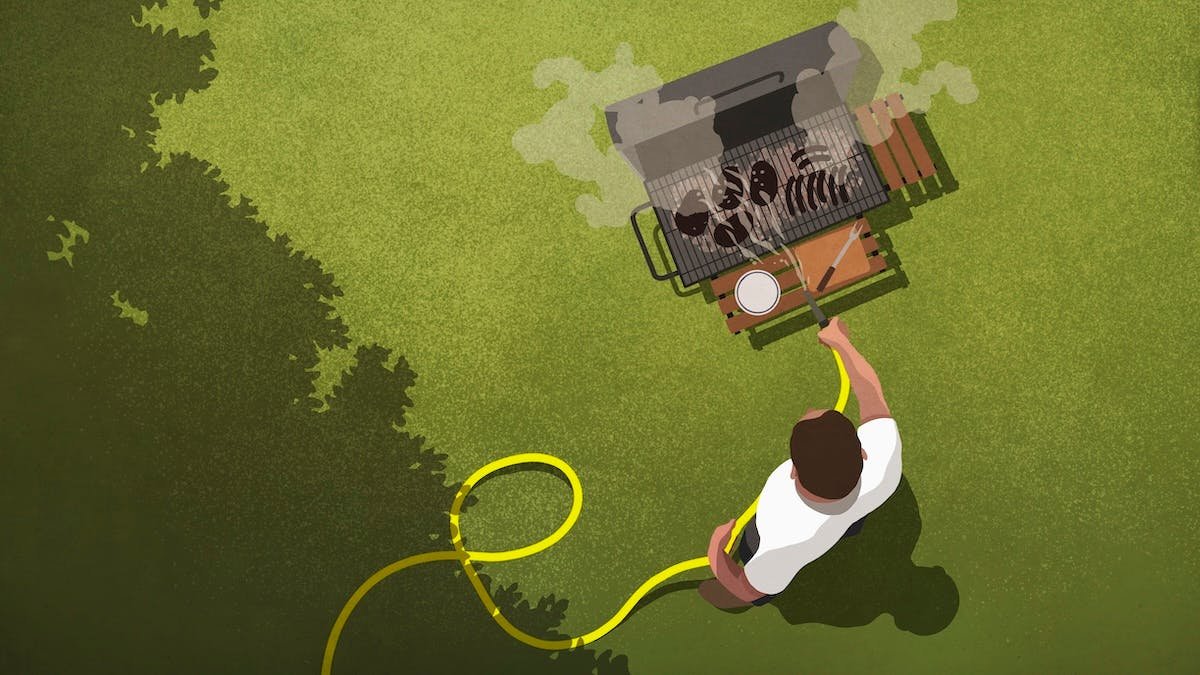
The piercing wail of a government-mandated emergency alert can mean many things: an impending missile strike, a catastrophic weather event, a national emergency. But for millions of Britons on a recent Friday evening, the crisis at hand was, according to officials, the threat of… disposable barbecues.
At precisely 7 p.m. on August 14, the U.K. government sent an unprecedented nationwide alert to every mobile phone in England, Scotland, Wales, and Northern Ireland. The message warned citizens about the heightened fire risk posed by outdoor grilling during an unusually dry summer. The result, as reported by the Daily Wire and echoed across British media, was not calm vigilance but widespread chaos, confusion, and a renewed debate over how far the state should go to police everyday behavior.
In a country where almost everyone owns a smartphone, the simultaneous shriek of millions of devices caused immediate disruption. Drivers on motorways swerved or braked suddenly, startled by the noise. Restaurants emptied as diners assumed a fire had broken out. Concerts were interrupted. One vicar, according to a friend of the author of the Daily Wire piece, saw his congregation flee mid-Mass, convinced the smoke alarm had gone off. Even the BBC was caught off guard.
The message itself was dry and clinical: fire can be dangerous, especially when grass and trees are dry. But it was the indiscriminate, nationwide scope — and the delivery method — that left many questioning the government’s motives. For residents of Wales, the confusion was compounded. In an apparent attempt to accommodate the small minority of Welsh-only speakers, the government sent the text in Welsh alone, leaving the vast majority of English-speaking Welsh residents scrambling for Google Translate to rule out a nuclear strike.
In the hours that followed, emergency services were inundated with calls — not about fires, but about neighbors. Fire and police departments across the U.K. fielded untold numbers of reports from citizens dobbing in their neighbors for holding “safe and completely innocent backyard barbecues,” a behavior the Daily Wire piece likens to the COVID-19-era “snitch lines” that encouraged people to report neighbors for breaching social distancing rules.
Domestic abuse charities also raised alarms of a darker consequence: For those living in secret shelters or relying on silent “lifeline” phones to escape abusers, the sudden, piercing alert could expose their location, putting them in immediate danger.
This was not the first time a government emergency alert system had gone wrong. In 2018, Hawaii residents received a sobering missile warning that was later revealed to be a false alarm. In 2023, Florida accidentally triggered an alert at 4:45 a.m. But unlike those incidents, where officials quickly acknowledged error, the U.K. government defended the barbecue alert as “entirely appropriate.”
The Daily Wire piece suggests the timing may be politically motivated. The alert came just weeks into the tenure of Prime Minister Andy Burnham, who, according to the piece, may be seeking to project strength and decisiveness compared with his “dithering and ineffectual” predecessor, Sir Keir Starmer, who was ousted by his own party. But whatever the political calculus, the effect on the public has been profound — and not in the way the government might have hoped.

In the wake of the alert, countless Brits, including the author of the piece, took to a government website to learn how to disable future alerts. As the author dryly notes, it’s refreshing that tax pounds pay both to trigger frivolous alerts and to teach citizens how to turn them off.
But beyond the practical inconvenience and the memes, the incident has sparked a deeper cultural argument about what the author and several social psychologists call “safetyism” — the creeping belief that safety is the ultimate virtue, overriding all other social goods. Social psychologist Jonathan Haidt, in his book “The Anxious Generation,” describes how overprotecting children from managed risk has warped their emotional development. Among the healthy “risky play” activities Haidt says children need to become functional adults are playing with fire, handling dangerous tools, and rough-and-tumble play. The irony of a government issuing a nationwide alert about the dangers of fire is palpable.
Haidt argues that human brains are calibrated to toggle between “discover mode” (exploration and risk-taking) and “defend mode” (response to danger). A balanced society, he says, encourages people to live in discover mode. “If we want to help young people thrive — at home, in school, and in the workplace — shifting them into discover mode may be the most effective change we can make,” Haidt writes. But the Daily Wire piece accuses the U.K. government of preferring a population stuck in defend mode, constantly on edge and dependent on state warnings for basic risk assessment.
This is not just about barbecues. The state, the piece argues, is exporting overprotective logic to adult citizenship. By deploying apocalyptic alerts to warn against an admittedly mundane activity, the government is training the public to distrust its own judgment. The result is an infantilized society where everyday choices — whether to light a grill on a dry day — require digital permission from a “state nanny.”

Critics also point to the system’s technical sophistication as evidence that the alert was more about muscle-flexing than public safety. The infrastructure is capable of targeting specific geographic areas for localized threats, as was done effectively during flooding in Cumbria in 2024 and Leicestershire in 2025. In the U.S., tornado warnings are routinely confined to the areas most at risk. Yet on August 14, when the actual wildfire risk was confined to a few dry pockets of the U.K., the alert went out to the entire country.
The piece asks a pointed question: What if every American were alerted every time a weather event occurred in a distant state? Frequent exposure to distant threats, over time, could condition people to expect disaster at every turn, eroding the very sense of normalcy that makes daily life bearable.
There is also the risk of over-reliance. If the state becomes the arbiter of all risk, citizens may stop taking precautionary action on their own. The piece cites the devastating Central Texas floods of July 2025, where official warnings either never arrived or came too late for many who were caught in rapidly rising waters. In those moments, people cannot wait for a government push notification; they must rely on their own instincts and local knowledge.
The deeper concern, as articulated in the piece, is that frightening a populace into obedience is a tempting short cut for a government that lacks authority and the trust of its people. Fear works as an immediate lever of control. But the long-term costs are steep: the erosion of social trust, the transformation of neighbors into informants, and the normalization of a permanent baseline of anxiety.
The article draws a cinematic parallel to M. Night Shyamalan’s 2004 film “The Village,” in which a community’s elders manufacture constant dread about monstrous threats in the surrounding woods to keep the population compliant. In the film, the threat is fictional, but the control is real.
By contrast, the piece recalls a different message from a different era: During the early days of World War II, when a German invasion seemed inevitable, the British government’s official advice was “Keep Calm and Carry On.” That sentiment now survives mostly on greetings cards and tea towels.
For those who have already disabled their emergency alerts, the immediate question is moot. But for the wider public, the debate is just beginning. How much safety is too much? Where does legitimate state protection end and psychological manipulation begin? The answer, as the Daily Wire piece suggests, may determine not just how Britons respond to the next alert — but whether they are able to respond at all when a real crisis arrives.
Source: www.dailywire.com — https://www.dailywire.com/news/the-safetyism-trap-americans-must-resist