
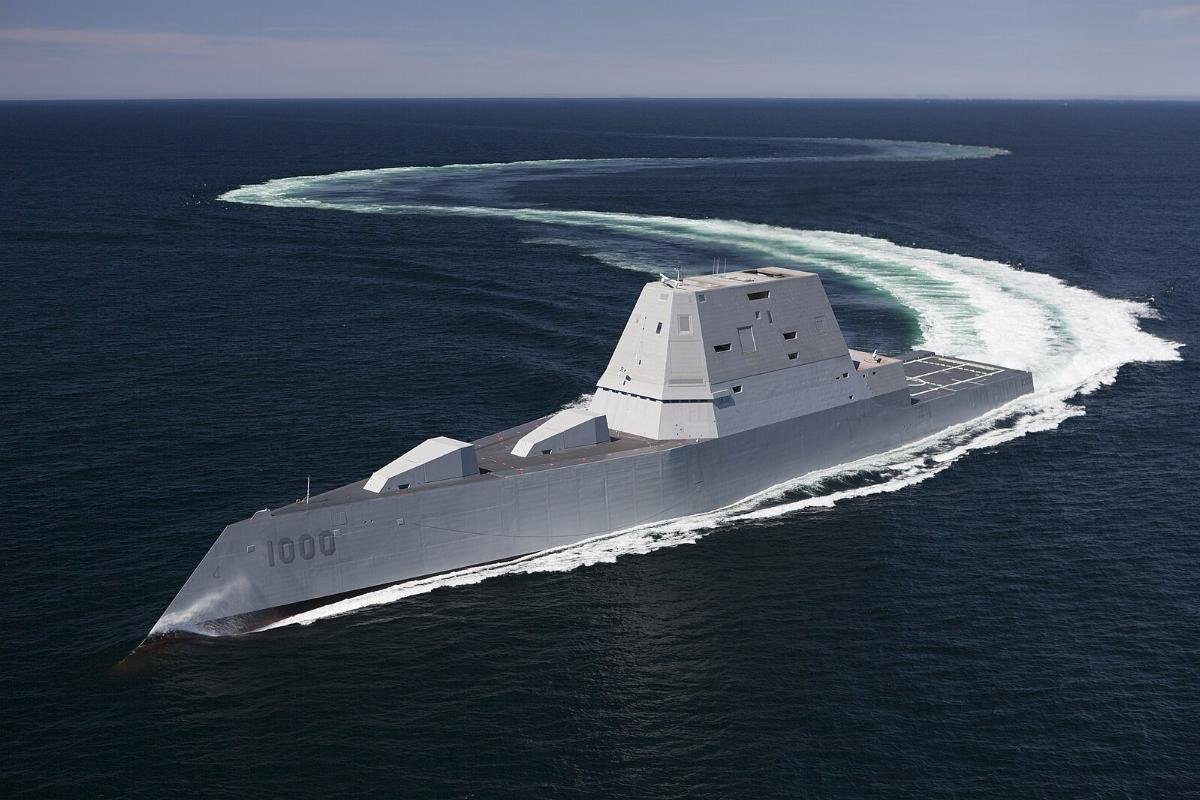
The USS Zumwalt (DDG-1000) has never been an ordinary ship. Launched as the Navy’s first stealth destroyer, it was designed to slip into shallow waters with a radar profile far smaller than its 14,000-ton displacement would suggest. But now, according to a first-person account from the son of the ship’s namesake, the Zumwalt is undergoing a transformation that could redefine its role—and reshape the strategic balance in the Pacific.
James Zumwalt, a retired Marine Corps officer and son of the late Admiral Elmo R. Zumwalt Jr., wrote in American Thinker that after a major refit, the DDG-1000 ‘will ultimately transition into the most formidable maritime threat in the world.’ The ship, he says, is no longer ‘the same old ship anymore.’
The change began in 2023, when the Zumwalt was pulled into drydock for what the Navy described as a major mission change. The ship’s two 155-mm forward guns—capable of providing naval gunfire support for Marines at ranges four times greater than the retired battleships they replaced—were removed. In their place, the Navy is installing a hypersonic missile system that, once complete, will arm the destroyer with twelve Intermediate-Range Conventional Prompt Strike (CPS) missiles, each with a range of approximately 1,700 miles.
According to the account, the CPS is a boost-glide hypersonic weapon that travels at five times the speed of sound or more. Its ‘unpredictable depressed trajectory maneuvering ability,’ the article notes, makes it ‘incapable of being stopped’ by current air defense systems.
A new mission, a new threat
The Zumwalt class was originally conceived as a shore-bombardment and stealth platform, designed to operate in littoral waters where larger destroyers might be vulnerable. But the shift to hypersonic missiles marks a pivot toward a different kind of warfare: striking high-value, time-sensitive targets—like enemy command centers, air defense nodes, or carrier groups—from standoff ranges.
The Navy has called the Zumwalt ‘the Navy’s premier offensive surface combatant’ in its new configuration. And the timing is notable. According to the article, the two other ships of the Zumwalt class will also be armed with hypersonic missiles by 2029. Together, the three ships could become a major concern for China, particularly if Beijing were to attempt an invasion of Taiwan.
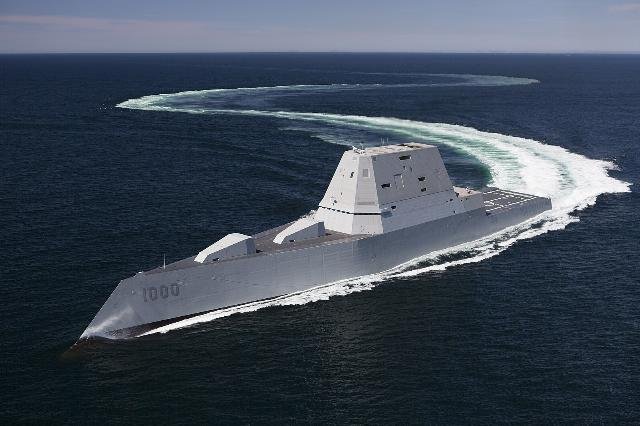
James Zumwalt writes that China ‘will be challenged to locate these ships’ because their tumblehome wave-piercing hull design gives them the radar profile of a much smaller platform, despite their massive displacement. That stealth capability, combined with the speed and maneuverability of hypersonic weapons, could make the Zumwalt class uniquely difficult to counter.
‘The three ships will create a major concern for China should it attempt to invade Taiwan,’ he wrote.
A legacy reborn
For James Zumwalt, the refit carries personal meaning. His father, Admiral Elmo R. Zumwalt Jr., served as Chief of Naval Operations from 1970 to 1974—the youngest in Navy history. He was known as the ‘Sailor’s Admiral’ for his efforts to improve life for enlisted personnel, issuing 121 changes known as Z-grams that helped triple reenlistment rates. He also modernized the Navy by retiring older ships and reallocating maintenance funds to research and development.
Now, 52 years after his father’s tenure, the Navy is again confronting aging vessels and the need for modernization. The Zumwalt’s refit, James Zumwalt suggests, is part of that ongoing evolution.
The ship’s power systems, he notes, offer twice the electrical capacity of other destroyers, which could allow for directed-energy weapons to be added later. That would extend the Zumwalt’s role beyond hypersonic strikes into the realm of laser-based defense, potentially making it a true multi-domain threat.
From guns to missiles: a controversial trade-off
The removal of the Zumwalt’s guns was not without cost. The Marines lost a dedicated naval gunfire support capability that the ship was originally built to provide. But the trade-off, according to the Navy’s reasoning, is a far more potent offensive punch. The hypersonic missiles give the Zumwalt a reach and lethality that no naval gun could match, and they position the class as a central piece of the Navy’s long-range strike architecture.
The ship is expected to return to sea ‘in the months ahead’ once the missile system installation is complete, according to the article. When it does, James Zumwalt writes, it will be ‘marveled as such by friendly nations just as much as she will be feared by unfriendly ones.’
A strategic signal
The Zumwalt’s refit comes at a time of heightened tension in the Indo-Pacific, with the U.S. military increasingly focused on deterring Chinese aggression. Hypersonic weapons—traveling at speeds of Mach 5 or higher and maneuvering unpredictably—are seen as a key capability to penetrate Chinese air defenses that have grown increasingly sophisticated.
But the Zumwalt’s value may also be symbolic. As the lead ship of a class that was once criticized for cost overruns and mission ambiguity, its transformation into a hypersonic strike platform signals that the Navy is willing to adapt even its most unconventional vessels to meet new threats. For adversaries, the message is clear: a ship that was already hard to see is now getting a weapon that is hard to stop.
As James Zumwalt put it, ‘DDG-1000 will ultimately transition into the most formidable maritime threat in the world.’ That’s a bold claim, but one that the ship’s new capabilities—and the strategic environment it will sail into—may well justify.
Source: www.americanthinker.com — https://www.americanthinker.com/blog/2026/08/not-the-same-old-ship-anymore/