
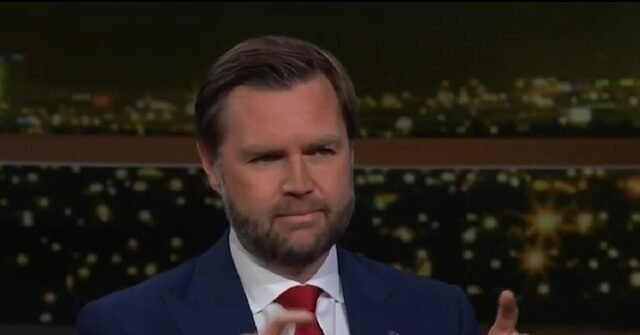
Vice President JD Vance said Thursday that the Trump administration is not focused on how long Iran can withstand current economic pressure, stressing instead that the core objective remains preventing Tehran from ever rebuilding its nuclear weapons program — a mission he indicated would demand sustained diplomatic and military attention.
In an interview that aired on Newsmax TV’s Carl Higbie Frontline, Vance was asked by host Carl Higbie how long Iran could realistically survive under the economic strain the U.S. and its allies have applied. Vance responded that predicting a timeline is difficult and, more importantly, not the administration’s central concern.
“It’s always tough to predict that. And that’s honestly not really our focus,” Vance said. “They’re under a ton of pressure. That pressure is conducive to our goal of ensuring they don’t have a nuclear weapon. Whether they can survive a couple of weeks or a couple of months or possibly longer, so long as they don’t have a nuclear weapon, that’s what we’re focused on.”
The vice president went on to credit President Donald Trump with having already achieved the primary objective of dismantling Iran’s nuclear capability, but he warned that the job is not finished.
“That’s what the president, frankly, has already accomplished,” Vance said. “We’re just trying to ensure they don’t try to rebuild that program, and that’s going to require some consistent engagement.”
Vance did not specify what form that engagement would take — whether diplomatic, economic, or military — but his remarks signal that the administration intends to maintain pressure on Tehran rather than declare a final victory and withdraw attention.
The interview also touched on Iranian attempts to disrupt shipping through the Strait of Hormuz, a critical chokepoint for global oil supplies. Vance said the administration is making Iran “pay” for those efforts, though he did not offer specifics on the costs being imposed.
Consistent Engagement vs. Short-Term Pressure
The vice president’s comments draw a sharp distinction between short-term economic pain and long-term strategic assurance. While the administration has touted the effect of sanctions and other financial measures on Iran’s economy, Vance made clear that the measure of success is not how quickly Tehran capitulates economically, but whether it can permanently forgo nuclear weapons.
Analysts have noted that economic pressure alone rarely guarantees permanent policy change in adversarial regimes, which is why Vance’s emphasis on “consistent engagement” stands out. The phrase suggests an ongoing, perhaps indefinite, commitment to monitoring and countering any Iranian attempts to reconstitute its nuclear program.
This approach aligns with the administration’s broader posture toward Tehran, which has combined maximum pressure campaigns with occasional offers of negotiation. Vance’s remarks, however, suggest that any future deal would be secondary to the guarantee — verified through sustained presence and oversight — that Iran does not pick up where it left off.
Strait of Hormuz Tensions
The discussion of the Strait of Hormuz reflects the persistent flashpoint in the region. Iran has periodically threatened to close or disrupt the strait, through which roughly a fifth of global oil consumption passes. Vance’s insistence that Tehran is “paying” for such attempts indicates the administration views these actions as unacceptable and is responding with consequences, though the nature of those consequences was not detailed.
The combination of nuclear nonproliferation and freedom of navigation has long been central to U.S. policy in the Middle East, and Vance’s remarks tie the two together: economic pressure serves the nuclear goal, while the strait issue is a separate but related arena of confrontation.
Vance did not provide a timeline for when the administration might consider its Iran policy successful, but his framing suggests the effort is open-ended. “Consistent engagement” implies a marathon, not a sprint — with the finish line defined not by Iran’s economic exhaustion, but by a verifiable and durable end to its nuclear ambitions.
Source: www.breitbart.com — https://www.breitbart.com/clips/2026/08/21/vance-how-long-iran-can-survive-econ-pressure-isnt-focus-ensuring-iran-doesnt-rebuild-nuke-program-will-require-some-consistent-engagement/