
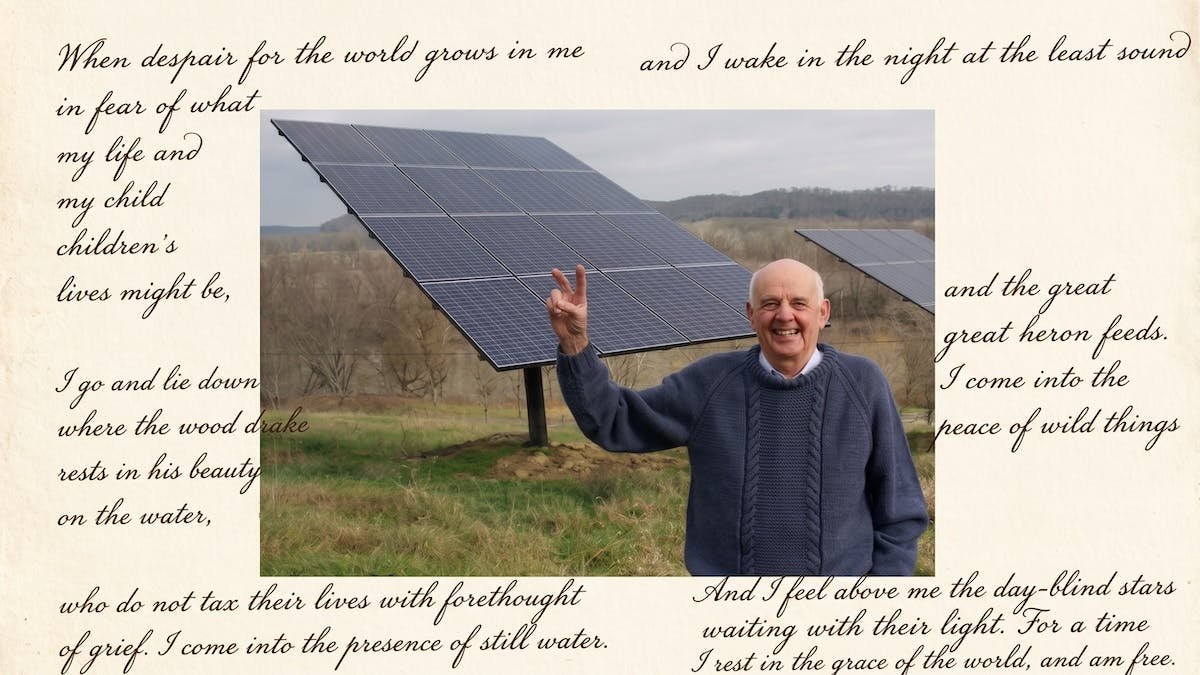
Wendell Berry, the Kentucky novelist, poet, and essayist who spent decades warning that America’s relentless pursuit of progress was leaving us spiritually and culturally homeless, has died at the age of 92. His death Monday marks the end of a singular career—one that made him beloved by agrarians, environmentalists, and literary traditionalists alike, even as his ideas rankled partisans across the spectrum.
Berry’s work, set almost entirely in the fictional town of Port William, Kentucky, traced the slow unraveling of rural community life across the 20th century. His central theme was deceptively simple: modern economic and social pressures have severed us from our ancestors, our land, and ultimately from ourselves. In a nation increasingly defined by mobility and rootlessness, his voice has only grown more resonant.
A Voice for the ‘Stickers’
In his landmark essay collection “The Unsettling of America,” Berry drew a famous distinction between “boomers” and “stickers.” Boomers, he argued, will uproot themselves from everything they know in pursuit of opportunity—jetting off to the “cement canyons of New York City or the arid hills of Los Angeles.” Stickers, by contrast, refuse to leave the places that formed them.
Berry spent his career explaining the stickers, and his fictional Port William is a testament to their virtues and their struggles. Families like the Feltners, the Coulters, the Beechums, and the Catletts arrived generations ago, worked the land, and built lives of quiet dignity. But over time, technology and opportunity broke the chains that bound them to their home ground.
Nowhere is that tragedy more movingly rendered than in his short novel “Hannah Coulter,” which one reader describes as “a jewel of a book.” The title character and her husband pour their lives into reviving a forlorn farm, only to see their children leave for college and never return. A daughter becomes a schoolteacher in Louisville, an agriculture-minded son becomes a professor instead of a farmer, and another son lands as a technology executive in California.
Hannah wanted her children to have more education than she did, but in gaining that education, she lost them. When they come home, they no longer slip into the old rhythms of hard work and shared rest. Her grandchildren scroll on iPads. No one comes back to take over the farm, and Hannah spends her final years alone in a dilapidating house, sifting through memories.
The Tragedy of Upward Mobility
The story of Hannah Coulter, one reader notes, is “the story of 20th century America in miniature.” Your grandparents or great-grandparents likely lived off the land and maintained a deep bond with their home. They paid down mortgages as fast as they could, feared debt, and made do with what they had. They scrimped and saved to educate their children—and once those children were educated, they lost them to the future.
For anyone from a small town, the pull toward opportunity is hard to resist. As the saying goes, if you really want upward mobility, you can’t go home again.

This dynamic has produced what Berry called a “placeless” America—a population of educated professionals disconnected from the very facts and places that made their existence possible. It is a critique that resonates in an era of remote work, corporate relocations, and the steady hollowing out of rural communities.
One Man’s Attempt to ‘Stick’
Berry’s writing has inspired more than reflection. One reader, writing for The Daily Wire, recounts how a college seminar on Berry’s “Jayber Crow” and “Life Is a Miracle” led him to skip track practice for a chance to hear Berry speak at the University of Louisville. The gamble cost him his spot on the team, but it set him on a path of near-obsessive reading.
So taken was he by “The Unsettling of America” that he spent a college summer as a farmhand, earning about $2 an hour, sleeping on an enclosed porch without a fan, and learning to weed, harvest, milk cows, and feed pigs. He even earned what he calls a “farmer’s tramp stamp”—a deep sunburn on his lower back from a shirt riding up during hours of stooped labor.
The experience gave him a taste of Port William’s rhythms: sunlight defining the days, cool water tasting better than ever, and sleep coming like the dead. He celebrated harvests with other farmhands, eating blackberries until sick and hosting “snap pea picking parties.” The fruits of their labor went to Ann Arbor’s “crunchy elite” at weekly markets.

But even a true believer couldn’t fully stick. “I had to finish my degree, get married, then move from big city to big city for ever bigger and better journalism jobs,” he writes. “Even if you’ve read all of Berry, his vision is hard to live out.”
Hope Amid Decline
For all his elegiac themes, Berry’s vision was not without hope. Hannah Coulter—one of literature’s “most tender voices”—faces the decline of her farm and her family’s dispersal with a simple prayer: “Thy will be done.” She and the other stickers of Port William would prefer the circle remain unbroken, but they see some divine providence in the passing of things.
Berry’s writing touched on woodlots and ponds, strip mining and erosion, the moral demands of good farming, and the beauty of marriage. But for many readers, his most enduring subject was the family—and the fear that one’s grandchildren will be a plane ticket away rather than a short car ride.
“When I think about Berry’s writing,” the Daily Wire essayist concludes, “I think about my children, who will come of age into a world so unlike this one, full of new temptations and struggles. I worry about the places they will make their homes.” Yet he takes comfort in Hannah’s refrain that God is at work in the world—a reminder he owes to “the great author of the miniature and profound.”
Berry’s legacy is now in the hands of the boomers and stickers he wrote about with such compassion. His voice may be silent, but his prophecy echoes on in a nation still learning, often painfully, what it means to be placeless—and what it might mean to find a home again.
Source: www.dailywire.com — https://www.dailywire.com/news/wendell-berrys-prophetic-voice-echoes-in-a-placeless-america