
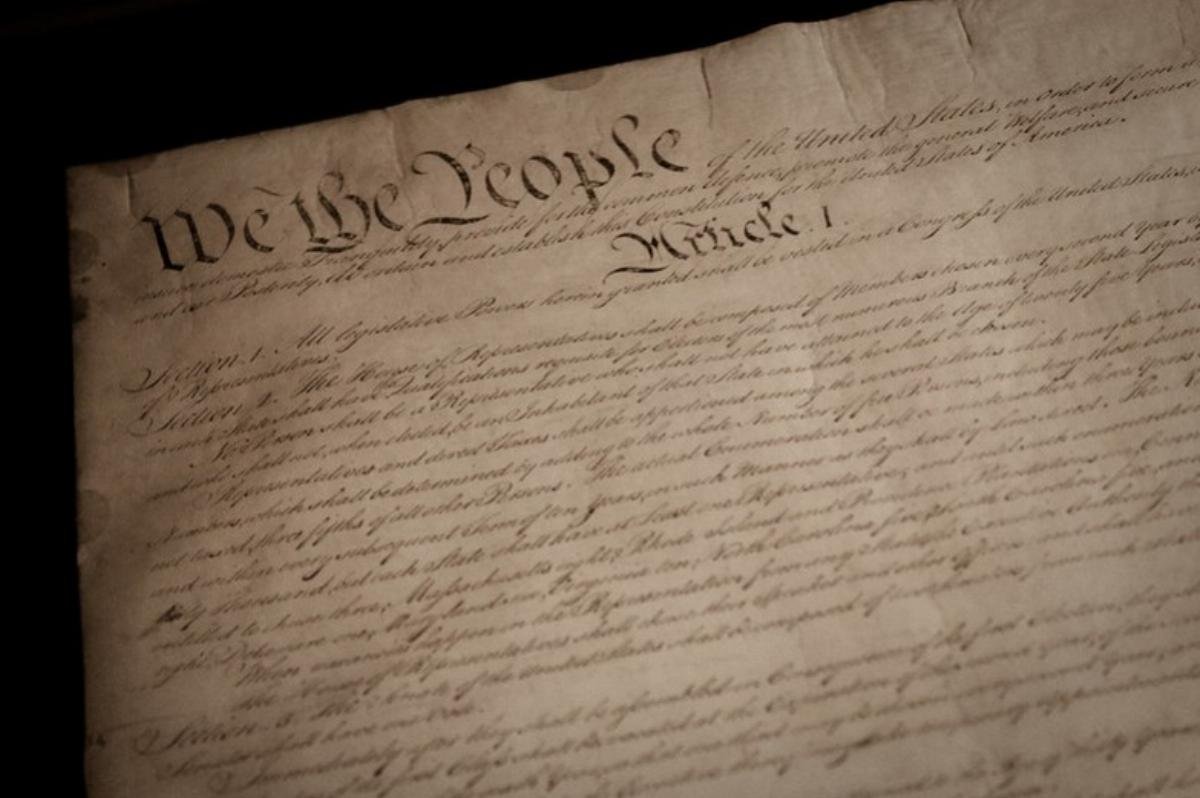
When demonstrators take to the streets against ICE or gather outside Jewish-owned businesses and synagogues, they often invoke the First Amendment as their shield. But according to a recent essay in American Thinker by E. Jeffrey Ludwig, those protests are not peaceable assemblies—they are hostile, chaotic gatherings filled with verbal abuse, shoving, and threats, bearing little resemblance to the rights the Founders enshrined.
Ludwig draws a direct line from today’s campus encampments and street riots back to the Declaration of Independence, arguing that the Founders’ language about equality and unalienable rights was never a cynical slogan. Instead, he contends, it was a serious philosophical commitment rooted in natural law and a transcendent Creator—values he says today’s leftist protesters have abandoned.
The Right to Assemble vs. The Right to Riot
Ludwig is blunt about the nature of the current demonstrations. He points to the anti-Israel fervor that erupted after Hamas’s October 7, 2023, massacre of more than 1,200 civilians in Israel and Israel’s subsequent invasion of Gaza. On campuses across the country, protesters set up tents to condemn Israel’s self-defense, blocked Jewish students from attending class, and vilified Israelis and Jews. The victims of mass murder, he writes, were recast as instigators of their own suffering.
The same playbook, Ludwig argues, is now being applied to ICE. Left-wing groups—he names BLM, Antifa, Democratic Socialists, and CAIR among them—portray immigration enforcement as fascist oppression. They reject the Statue of Liberty’s call to the tired and poor, calling it hypocrisy. Instead, they cast ICE agents as racists and white supremacists.
But the Founders, Ludwig insists, would not recognize these protests as legitimate exercises of constitutional rights. The First Amendment protects peaceable assembly, not riots, looting, or the blocking of public thoroughfares. The demonstrations against ICE and Jews, he writes, are antisocial and violent—they do not reflect the values of law and order or religious freedom.
Natural Rights, Not Grievance Politics
Ludwig returns to the Declaration’s first principles to make his case. The colonists’ claim to independence, he notes, was grounded in “the separate and equal station to which the Laws of Nature and of Nature’s God entitle them.” That is not the language of victimhood or class struggle. It is a rational, ordered vision of the universe, rooted in both nature and divinity.
He reminds readers that Thomas Jefferson, the Declaration’s primary author, was deeply influenced by John Locke, who believed natural rights derived from biblical teachings. In Locke’s The Reasonableness of Christianity, Ludwig finds the theological foundation: humanity’s imperfections are bridged by faith and God’s mercy. Without that transcendent dimension, the American experiment would not have been plausible.
“All men are created equal” is the phrase the modern left loves to mock as hypocrisy. Ludwig takes that critique head-on. He acknowledges that Jefferson and George Washington held slaves, but he notes that both believed the institution would eventually be phased out. Jefferson’s original draft of the Declaration even denounced slavery, but he removed the passage to maintain Southern unity in the fight against Britain.
The phrase became a rallying cry for abolitionists, Ludwig argues, and its eventual fulfillment cost hundreds of thousands of lives—including Lincoln’s—before slavery was abolished. “All men are created equal” was never a self-serving phrase; it was a promise that, through painful history, the nation worked to keep.
Beard’s Shadow Over the Left
Ludwig traces the modern hostility toward the Founders to historian Charles Beard, whose 1913 An Economic Interpretation of the Constitution and later The Rise of American Civilization (1927, with Mary Beard) argued that the nation was founded on self-interest and profit motive. That economic determinism, Ludwig says, became the left’s mantra: The Founders were hypocrites, and the Declaration was a cover for greed.
But Ludwig rejects that reductionism. The Founders operated from a rational, ordered understanding of life and the universe—not from a “hissy fit” or “foot-stomping despair,” as he puts it. Their grievances were real, but their justifications were philosophical. They claimed rights not because they felt marginalized, but because those rights were grounded in nature and God.
What It Means Today
Ludwig closes with a challenge to politicians. Those who do not unequivocally denounce Hamas and support Israel—he names Mike Huckabee as a contrast—and those who do not passionately back ICE’s enforcement of the law—he cites Markwayne Mullin—are betraying the voters who elected the president. For Ludwig, the battle is not just about policy; it is about preserving the rational and transcendent foundations of the republic.
His essay is a defense of the Founders’ vision against what he sees as the nihilism of the current moment. The protesters accusing ICE and Israel of injustice, he argues, are not advancing America’s fundamental values—they are rejecting them. The Declaration’s promise of equality, rooted in the laws of nature and nature’s God, remains the standard by which all claims to liberty must be measured.
Whether or not one agrees with Ludwig’s political conclusions, his essay highlights a deeper question: Are today’s rights claims grounded in anything more than grievance? For the Founders, at least, the answer was clear—they looked to nature and its Creator, not to the shifting winds of public opinion.
Source: www.americanthinker.com — https://www.americanthinker.com/articles/2026/08/woke-hostility-to-the-usa-founders-authority/