
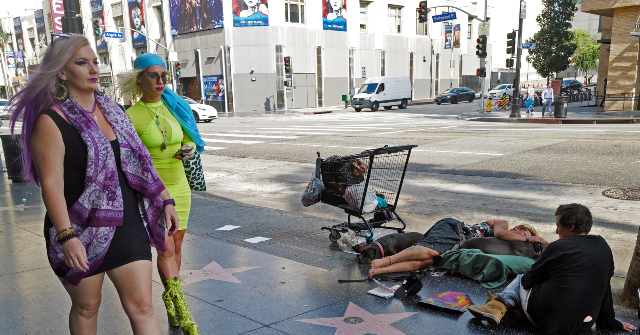
If Los Angeles and other troubled U.S. cities collapse into dystopian hellscapes, it may not come with a bang but with a series of whimpers — like a city garbage truck driver tossing a small bag of dog waste onto a resident’s lawn and saying, “It’s not my job.”
That’s the argument screenwriter Lowell Cauffiel makes in a new essay for Breitbart, in which he describes watching a city sanitation worker peel a bag of dog excrement off his truck and fling it onto Cauffiel’s property in a west Los Angeles neighborhood populated by UCLA students, retirees, and young families. When Cauffiel confronted him, the driver shrugged: “It’s not my job.”
Cauffiel, who moved to L.A. in 2003 and lost his home in the Pacific Palisades fire of 2025, says the city he once knew — clean streets, enforced littering fines, glamorous Hollywood nights — has deteriorated into something resembling the dystopian film Escape From L.A. He argues that the exodus of more than a million people from California since the 2020 census is often blamed on high taxes and burdensome regulations, but the real culprit may be simpler: city officials have stopped enforcing the “small stuff” of daily urban life.
Litter, Vagrants, and a City That Doesn’t Answer
In his piece, Cauffiel catalogs a litany of quality-of-life complaints: mornings spent picking up Modelo beer cans, food containers, and clothing from his street and landscaping; groups of transients drinking and blasting Latin music outside his building (one told him to “fuck off” and yelled “Viva Mexico” when he asked them to turn it down); and a nearby World Market engaged in a losing battle with a tent encampment that lines its entire exterior.
He also cites reports of an “armada of rats” and the return of “medieval diseases” like typhus and typhoid, as well as an increase in open drug use and discarded syringes.
But for Cauffiel, the most frustrating part is the city’s unresponsiveness. He says he no longer calls the LAPD about vagrants, even those who threaten him or female students in his building. A call to 911, he writes, gets routed to a “non-emergency” dispatcher, where he has spent an hour or two on hold before hanging up. “Statutes on the books outlawing litter, loitering, and open use of intoxicants,” he writes, “are no longer enforced in the city of Los Angeles.”
The result, he says, is that good neighborhoods can be destroyed quickly. He has seen three moving crews on his street in the past two weeks alone.
Traffic Enforcement Crumbles
Cauffiel’s second major grievance is the near-total disappearance of traffic enforcement. He says he has not seen a single traffic stop in Los Angeles in nearly five years — and he claims to have found the reason in an investigative report by the Substack publication L.A. Reported.
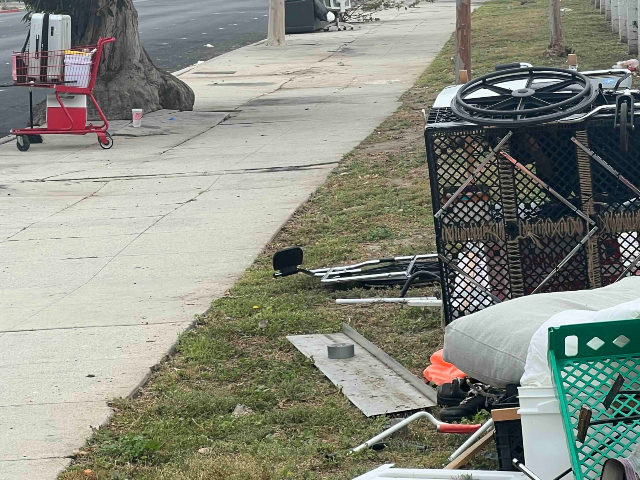
According to that report, which Cauffiel cites, LAPD’s Central Traffic Division has lost half its officers since 2020 — dropping from 40 to 20. Citywide, citations for moving violations fell from more than 213,000 in 2019 to just 79,000 in 2025, a 63 percent decline. Speeding tickets dropped roughly 40 percent over the same period.
The report also notes the 2023 Freedom to Walk Act, which decriminalized jaywalking in California. Officers quoted in the investigation say they simply lack the resources to engage in proactive patrols. “You seldom get time to do traffic enforcement specifically against speeding and right-of-way violations,” Sgt. Doug Panameno told the publication. “We definitely don’t have the resources to make a dent in making the city safer.”
Cauffiel, a lifelong motorcyclist, says he is constantly on alert for cars running red lights and stop signs, and routinely sees Ferraris and Lamborghinis hitting speeds of a hundred miles per hour on city streets.
A City Transformed — or Abandoned
Cauffiel’s essay is a personal lament, but it taps into a broader narrative about urban governance and public safety that has become a flashpoint in American politics. He contrasts the Los Angeles he found in the early 2000s — when Mayor Antonio Villaraigosa, an “unabashed progressive” who governed toward the center, pushed for more police and school reform — with the city under Mayor Karen Bass and her city council, though he acknowledges previous administrations share the blame.
He recalls the HBO series Entourage as a symbol of that era’s glamour, when real-life Hollywood personalities and iconic venues like the Whisky a Go Go defined L.A.’s public image. “The areas of Los Angeles in the early 2000s where I spent much of my time were not only postcard perfect,” he writes, “they were very clean.” Signs declaring “Littering $500 Fine” and “Keep L.A. Clean” were visible everywhere. They still are, he says, but they are “meaningless now, a threat from a bygone era.”
Cauffiel, who first came to L.A. to adapt a true-crime book for film and later worked with actors like David Schwimmer and Michael Douglas, says he left Detroit after two decades reporting on that city’s decline — only to watch another one go downhill.
“Angelinos are intransigent residents,” he writes. “They will tolerate wildfires, earthquakes, mudslides, traffic congestion, long lines, and a high cost of living, all in exchange for 10 months of sunshine, a Mediterranean climate, and topography that can have you surfing in the Pacific in the morning and hitting the snowy ski slopes by late afternoon.”
But even those trade-offs, he argues, lose their appeal when “quality of life and flagrant lawlessness begin to resemble something out of John Carpenter’s Escape From L.A.“
Whether that grim assessment is shared by most Angelenos is unclear — but the essay has already ignited debate, with critics likely to dismiss it as anecdotal and defenders pointing to it as evidence of failed liberal governance. What is not disputed is the data on traffic enforcement: a 63 percent drop in moving-violation citations is a stark statistic, regardless of how one interprets it.
Source: www.breitbart.com — https://www.breitbart.com/entertainment/2026/08/20/cauffiel-no-enforcement-of-the-small-stuff-is-turning-karen-basss-los-angeles-into-a-third-world-hellscape/