
Saudi Arabia and Yemen’s Iran-backed Houthi movement traded another round of cross-border drone, missile, and aircraft strikes on Thursday, as the human cost of the renewed fighting continued to mount and international condemnation of the Houthis widened.
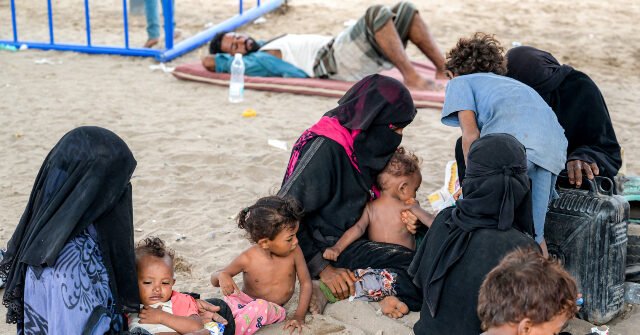
The International Organization for Migration (IOM) said at least 112,000 Yemeni civilians have been displaced inside the country over the past two weeks. Another 3,000 have taken boats across the Gulf of Aden to Djibouti, according to the agency’s Friday assessment, a crossing that officials have long described as perilous.
Djibouti’s government said it is bracing for as many as 10,000 refugees from the conflict, a surge its healthcare system and other social services would struggle to absorb. Somaliland and Puntland, the two semi-autonomous regions of Somalia, have each reported receiving a few hundred Yemeni arrivals.
Deadly drone intercept over Taif
The latest violence reached deep into Saudi territory. Civil defense officials said a Yemeni national living in the kingdom was killed by falling debris after Saudi forces intercepted a Houthi drone over the city of Taif. Two other people were injured during the intercept, according to the same account.
The Taif strike followed a Houthi drone attack on Mecca earlier in the week, an incident that drew unusually broad condemnation from across the Muslim world. Kuwait, Jordan, and Bahrain were among the governments that denounced both episodes. Bahrain renewed its call for the U.N. Security Council to take action against the Houthis, and the Arab League issued a statement saying it “strongly condemned” the Taif attack.
From Brussels, the European Union declared “full solidarity with Saudi Arabia” on Thursday and urged the Houthis to “cease all military action.” In a statement, EU officials said the targeting of civilians and civilian infrastructure is “unacceptable” and argued that Houthi attacks undermine prospects for a non-military solution of the conflict in Yemen and further undermine regional security.
Houthi leader denies Mecca strike, defends targeting energy sites
Abdul-Malik al-Houthi, the movement’s leader, used a televised speech Thursday to insist that Saudi civilian energy infrastructure remains a legitimate target. He said attacks would continue for as long as Saudi and Yemeni government forces keep up military operations inside Yemen.
Al-Houthi denied that his forces deliberately target civilians, and rejected responsibility for the Mecca drone attack, calling that account a “fabrication.” He framed the campaign as a response to what he described as a Saudi blockade and occupation.
“We want the Saudis to cease their blockade and occupation of our country, and to stop their aggression against us. This is our demand!” he said, speaking from behind a banner bearing the Houthi slogan: “Death to America, death to Israel, a curse upon the Jews, victory for Islam.”
The Houthis, for their part, claimed that “three children were killed and several Yemeni nationals were injured in strikes by the Saudi-backed mercenaries” in the Yemeni towns of Taiz and Abs. The word “mercenaries” is a derogatory reference to forces loyal to Yemen’s internationally recognized government, which is backed by a Saudi-led coalition.
The competing claims could not be independently verified, and casualty figures from both sides of the conflict have repeatedly diverged over the course of the war.
Diplomatic pressure builds as displacement grows
The renewed exchanges have put the Houthis at odds with a growing list of regional governments, including several that have historically been reluctant to align themselves publicly with Saudi Arabia’s military campaign. The joint condemnations from Kuwait, Jordan, Bahrain, and the Arab League reflect concern that strikes on Saudi civilian sites — particularly those near the holy city of Mecca — carry political and religious resonance well beyond the battlefield.
For its part, the EU’s language stopped short of announcing any new punitive measures, but its call for the Houthis to halt military action marked a clear diplomatic setback for the movement, which has sought to present itself as a defender of Yemeni sovereignty against foreign intervention.
The IOM’s displacement figures cover only the past two weeks and are likely to rise if the pace of strikes continues. Aid organizations operating in Yemen have warned for years that the country’s infrastructure is already stretched thin, and the new wave of internal displacement adds pressure to areas that have absorbed repeated waves of people fleeing front lines.
The Red Sea crossings to Djibouti present their own dangers. Migrants and refugees have long used the Gulf of Aden route in overcrowded, often unseaworthy vessels, and the 3,000 arrivals recorded so far represent only those who have completed the journey. Djibouti’s expectation of up to 10,000 refugees signals that officials there anticipate the flow will continue.
Thursday’s strikes, the displacement figures, and the widening diplomatic reaction together suggest a conflict that is once again intensifying rather than winding down. With al-Houthi vowing to continue attacks on Saudi energy infrastructure and the kingdom maintaining its military operations in Yemen, the conditions driving civilians from their homes show little sign of easing.
Source: www.breitbart.com — https://www.breitbart.com/middle-east/2026/09/18/yemeni-civilians-flee-houthi-saudi-conflict-continues/