
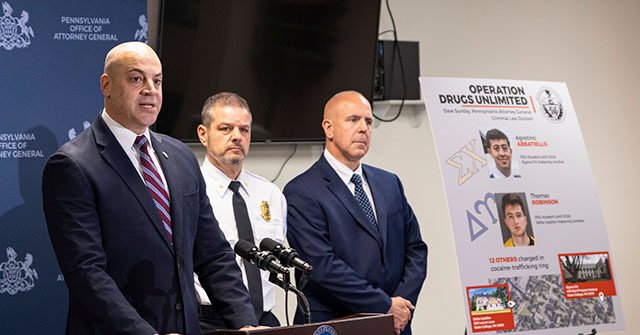
Pennsylvania authorities have charged 14 people in connection with a cocaine-trafficking ring that operated out of two Penn State University fraternity houses, according to the state attorney general’s office. The case, which spans alleged activity from 2023 to 2024, has put a spotlight on what officials describe as a sophisticated drug operation embedded within campus life.
The charges stem from an investigation into the Delta Upsilon and Sigma Chi fraternity houses, where authorities say cocaine was cut, packaged, and distributed primarily to Penn State students. Thirteen of the accused were students at the time of the alleged trafficking, and the fourteenth suspect is the father of a student who allegedly tried to hide evidence and obstruct the investigation.
In a press release, Attorney General Dave Sunday’s office identified Agostino Abbatiello and Thomas Robinson as the alleged suppliers, saying the two made trips to Philadelphia and New York to pick up large quantities of cocaine. The drugs were then reportedly brought back to the fraternity houses, where they were processed before being sold.
Charges range from felonies to misdemeanors
The charges hit the accused at different levels of severity. Abbatiello, Robinson, and two others—Mohammed Hurabi and Lars Zeepvat—face felony counts of corrupt organizations, conspiracy, dealing in proceeds of unlawful activity, and related offenses. A fifth person, Robert Zanolla, is charged with felony conspiracy and criminal use of a communication facility, along with related misdemeanors.
The remaining eight student-aged defendants face misdemeanor charges of possession and drug paraphernalia. The arraignment of all 14 defendants took place on Monday, with the case drawing attention to the scale of the alleged operation.
Attorney General Sunday did not mince words when describing the seriousness of the accusations. “This is very serious criminal conduct,” he said in comments reported by CBS News. “There was nothing junior or child-like about this conduct—this was an upper-level trafficking organization for this region of Pennsylvania.”
Investigation tactics and payment methods
According to the attorney general’s office, investigators used a variety of tactics to track the suspects, including surveillance of how they obtained the drugs, packaged them, and sold them. Officials noted that most payments for the cocaine were made in cash or via payment apps, a detail that may complicate financial tracing but also reflects the organized nature of the operation.
The case highlights the dangers of cocaine, an addictive stimulant that increases the risk of heart attack, stroke, and overdose. The Cleveland Clinic’s website warns that cocaine use can lead to elevated blood pressure and heart rate, as well as behavioral changes like spending sprees, anger, or paranoia. Perhaps most significantly, the site notes, “the most significant effect is how cocaine use changes people’s brains, setting the stage for cocaine addiction.”
While the investigation has concluded with charges, the legal process is just beginning. The defendants will face a court system that will weigh the evidence against the severity of the allegations. For Penn State, the case raises questions about campus safety and the role of fraternities in fostering environments where such activity could flourish.
As the case unfolds, observers will be watching to see how the university responds and whether any institutional changes follow. For now, the focus remains on the individual defendants and the serious charges they face.
Source: www.breitbart.com — https://www.breitbart.com/education/2026/08/18/video-14-charged-in-penn-state-fraternity-cocaine-trafficking-ring-bust-serious-criminal-conduct/