
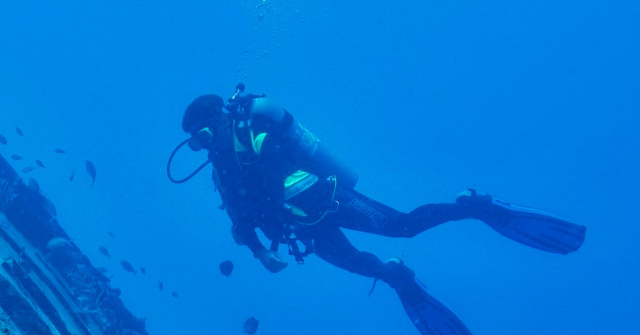
Divers exploring the waters off a Greek island in the Cyclades have stumbled upon a 2,400-year-old shipwreck loaded with hundreds of ancient shipping jars, according to Greece’s Ministry of Culture. The find, which occurred at a depth of between 128 and 144 feet, has been hailed as a significant addition to knowledge of maritime trade in the Late Classical period.
The ministry announced that a private individual tipped off divers to the wreck’s location, leading to its discovery. On the sea floor, the debris field revealed a sprawling heap of pointed-bottom commercial amphorae—the standard transport containers of the ancient world, typically used to carry olive oil, wine, and other goods. Preliminary counts suggest between 600 and 650 of these ceramic vessels are present at the site.
Archaeologists have already identified three distinct types of amphorae at the wreck: Mende, Peparethos, and Solokha 2. Each type originates from a different production center, offering potential clues about the ship’s trading routes and ports of call. One of each type has been retrieved for sampling and further analysis.
The chronological framework for these amphorae falls between the late 5th and early 4th centuries BC, a period marked by intense commercial activity across the Greek world. In addition to the amphorae, divers discovered part of a lead anchor stock and a small number of stones that may have served as ballast to stabilize the vessel during its final voyage.
A Window into Ancient Commerce
In a translated statement, the Greek Ministry of Culture said the find ‘enriches our knowledge of trade and navigation during the Late Classical period.’ The ministry added that ‘further study of the find will obviously yield additional interesting information regarding both its cargo and its origin.’ While the exact contents of the amphorae remain unclear, the sheer volume of containers points to a merchant ship of considerable size, engaged in large-scale distribution of goods.
The discovery comes on the heels of another recent shipwreck find off the coast of Sicily, where divers also encountered hundreds of clay amphorae. That site, while separate, underscores the ongoing richness of underwater archaeological exploration in the Mediterranean—a region that served as the beating heart of ancient trade networks.
Fox News reported that archaeologists identified the three amphora types and took samples, and that the lead anchor stock and ballast stones were also recovered. The site, resting at a depth accessible to technical divers, has been left largely intact, offering researchers a rare chance to study a complete cargo assemblage.
Experts note that pointed-bottom amphorae were designed to be stacked efficiently in a ship’s hold, maximizing space for valuable liquids like wine and olive oil. The specific types at this wreck—Mende, Peparethos, and Solokha 2—are well-known in archaeological circles, each named after its likely place of manufacture.
Potential Origin and Routes
The mix of different amphora types suggests the ship may have picked up cargo from multiple locations, a common practice in the Late Classical period when merchant vessels often followed complex routes that linked the Aegean islands with mainland Greece, the Black Sea, and beyond.
While it is too early to pinpoint the vessel’s home port or final destination, researchers hope that further study of the sampled amphorae—including residue analysis of any surviving contents—will reveal the nature of the cargo, be it fine olive oil from Attica, aromatic wines from island vineyards, or other perishable commodities that rarely survive in the archaeological record.
The Greek Ministry of Culture has not yet announced plans for a full excavation, but underwater archaeologists are expected to conduct detailed mapping of the site in the coming months. The wreck’s relatively shallow depth could make it feasible for scientific divers to document the site thoroughly, potentially recovering additional artifacts that may include ceramics, coins, or personal items belonging to the crew.
This discovery adds to a growing list of ancient shipwrecks found in Greek waters in recent years, many of them revealed by technological advances such as side-scan sonar and remotely operated vehicles. Still, the latest find stands out for its scale and age, promising to shed light on the economic networks that connected the Greek world at a time of political and cultural transformation.
For now, the amphorae rest where they have lain for two and half millennia, waiting for researchers to unlock their secrets. As the ministry noted, ‘This particularly interesting find’ is only the beginning of what may be a long and fruitful investigation.
Source: www.breitbart.com — https://www.breitbart.com/pre-viral/2026/08/27/divers-discover-2400-year-old-shipwreck-off-coast-of-greek-island/