
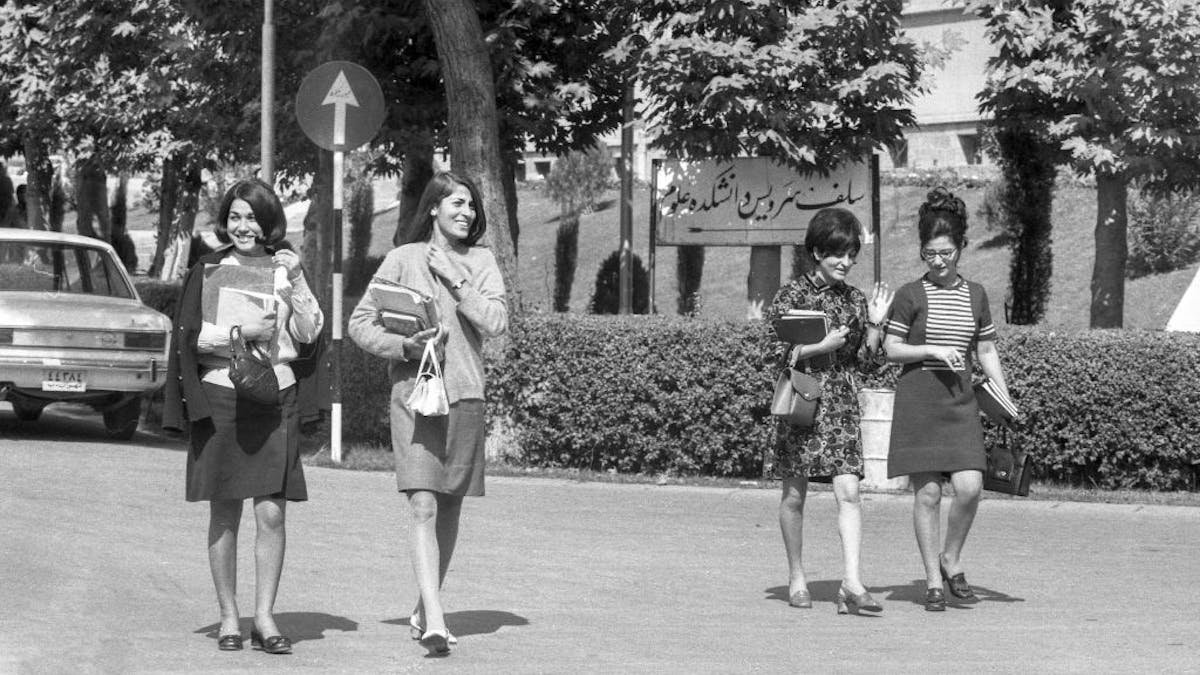
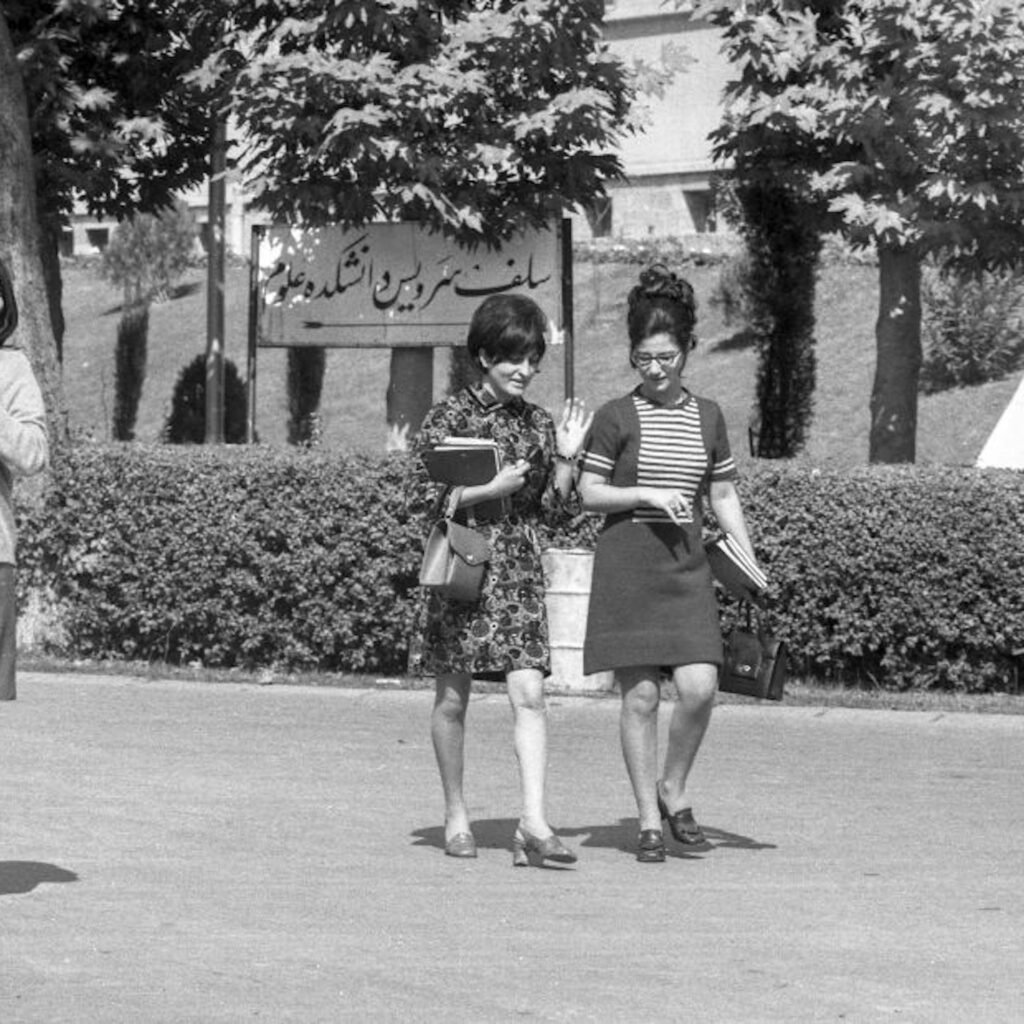
If you’ve spent any time on social media in the past decade, you’ve seen the posts: side-by-side photos of Tehran before and after the 1979 Islamic Revolution. In the ‘before’ images, women in miniskirts and sunglasses carry books and Western records, roller-skating down tree-lined streets. The ‘after’ images show a dour, veiled Islamic Republic.
That contrast went viral again at the onset of the current Iran conflict, when hope briefly flickered that Iran might return to its pre-revolutionary ways. But as the war dragged on, the internet turned the meme into a joke. Now, the phrase “Iran before the Islamic Revolution” is just as likely to accompany a photo of the Sopranos cast or Ryan Gosling.
In a new essay published by The Daily Wire, a writer reflects on that meme and on a friend’s quip that “one day people will be posting like that about Tysons Corner” — the affluent Northern Virginia suburb increasingly home to traditional Muslim communities. The comment, offered half in jest, sparked a longer meditation on how radically Islam has crept into American society — and how few people noticed until it was too late.
A Quiet Cultural Defeat
The essay argues that between regime change and outright cultural defeat lies a vast, quiet space — one that’s far more common and considerably less noisy. “The latter is much more common and considerably less noisy, which is why it so often goes unnoticed until too much has changed,” the author writes.
It’s popular, the piece notes, to point out that Islam has always been a fact of American life — Thomas Jefferson owned a Koran, after all. But the author argues that before 9/11, Islam was only tangentially relevant to most Americans. As recently as 1993, journalist Robert Kaplan still used the term “Moslems,” a word that now sounds as dated as “Boer” or “Hottentot.”
Then came September 11, 2001 — and the collision between Islam and America. What followed, the essay argues, was a “speedrun” of radical Islam’s mainstreaming in the United States. It’s a peculiar historical irony: an Islamic terror attack on American soil led to the rapid acceptance of even the most un-American forms of Islam. The liberal obsession with fighting “Islamophobia” during the War on Terror, an arguably good intention, paved the way for figures like Abdul El-Sayed, the physician and progressive activist who has been outspoken in his criticism of Israel and sympathy for Hamas.
The Ground Zero Mosque Moment
The essay points to a telling barometer: the controversy over the proposed Islamic community center near Ground Zero in 2010. Dubbed the “Ground Zero Mosque,” the project was almost universally condemned at the time. Howard Dean called it “a real affront to people who lost their lives” on 9/11. Then-Senate Majority Leader Harry Reid urged the builders to pick a different site.
But even then, the author notes, things had already gotten away from us. Both Reid and Dean broke with President Barack Obama, who defended the project. “Obama may not be a secret Kenyan Muslim,” the essay says, “but he sure did his best to make criticizing Islam socially unacceptable.”
Now, as the 25th anniversary of 9/11 approaches, the author wonders whether any Democrat would react the way Reid and Dean did. “It’s hard to imagine Democrats reacting that way now,” the essay laments, “and that’s a problem.”

The Slow Boil
The essay draws on Michel Houellebecq’s 2015 novel Submission, which imagines an Islamist party taking over France. Critics accused Houellebecq of Islamophobia — of depicting a Muslim-run country as a dystopia. But the book’s real point, the author argues, is how the takeover happens: slowly at first, then all at once, while no one wants to fight back.
Houellebecq’s protagonists, the essay suggests, are like frogs being slowly boiled alive — except they decide the water’s nice and just kick back.
The rise of figures like El-Sayed — described by the essay as “Hamas-loving, America-hating radical Muslim leftists” — has shaken conservative readers out of their own amphibian stupor. But what comes next, the author warns, depends entirely on how seriously we take the threat.
“Will we get serious about what we want this country to be, and the threat posed by certain ideologies?” the essay asks. “Or will we let the moment pass, ease back into the status quo, and one day find ourselves reminiscing about how good we used to have it?”
The essay stops short of predicting an Islamic takeover of the United States — the author says he doesn’t believe that’s imminent, nor does he think Muslims are “ruining” Tysons Corner. But he argues that even those paying attention don’t appreciate how quickly the cultural landscape has shifted. The problem, he writes, is not just a lack of awareness — it’s that even the aware haven’t fully grasped the speed of the change.
Source: www.dailywire.com — https://www.dailywire.com/news/america-before-the-islamic-revolution