

The most talked-about wedding of the year featured a bride earning at least four times as much as her groom. Taylor Swift’s fortune dwarfs Travis Kelce’s, a celebrity mismatch that mirrors a much broader shift in American households: marriages where the wife outearns the husband have tripled since 1972, from about 5% of couples to roughly 16% today.
For decades, sociologists predicted this economic transformation would erode the traditional male-breadwinner norm—and with it, the historic instability seen in female-breadwinner unions. A widely discussed 2016 study seemed to confirm that optimism, finding that while wives’ higher earnings raised divorce risk among couples married in the 1960s and ’70s, the effect had vanished among more recent cohorts. The paper argued that shifting gender norms had weakened the pull of the traditional ideal.
Now one of that study’s own authors has revisited the question with far bigger data—and reached a starkly different conclusion.

What the New Research Found
Sociologist Pilar Gonalons-Pons, co-author of the 2016 paper, teamed up with Allison Dunatchik to analyze high-quality survey data on 544,911 married and cohabiting couples across 29 affluent countries from 2004 to 2020. Their findings, published via the Institute for Family Studies, strongly contradict the earlier optimism: in every country except Hungary and Cyprus, couples where the woman earns more than 60% of total income were more likely to separate than comparable male-breadwinner couples.
The magnitude of the effect varies by nation. In the Netherlands and Spain, female-breadwinner couples were roughly twice as likely to split over a four-year window as male-breadwinner couples. In Estonia and Bulgaria, the gap was minimal; Poland and Slovenia showed only a modest increase in risk. And the association, though weaker among younger cohorts, has not disappeared.
Even after controlling for education, parenthood, homeownership, and marital status, female-breadwinner couples were 36% more likely to separate than their male-breadwinner counterparts. Equal-earner couples faced a smaller but still elevated risk of about 6%.

The Explanations That Didn’t Hold Up
The researchers tested a host of commonly cited explanations—and found little support for any of them. The effect wasn’t driven by women’s greater financial independence, by wives earning more in anticipation of divorce, by husbands’ unemployment, or by financial hardship within the household.
Most strikingly, national attitudes didn’t matter. Whether the country’s residents endorsed the belief that “a man’s primary role is to be the breadwinner,” supported dual-earner marriages, worried that children suffer when mothers work, or believed working mothers can bond just as warmly with their kids—the pattern held. Female-breadwinner couples were just as likely to separate in gender-egalitarian societies as in traditional ones. Broader measures like the prevalence of female breadwinning, the gender wage gap, or women’s educational advantage over men also failed to explain the finding.
Children Made It Worse
One factor did stand out: parenthood. Among couples with dependent children, female-breadwinner couples were 49% more likely to separate than male-breadwinner couples—more than double the 23% higher risk seen among childless couples. The authors suggest work-family conflict may play a role, but they caution it doesn’t fully explain the pattern, since even couples without kids face elevated risk.
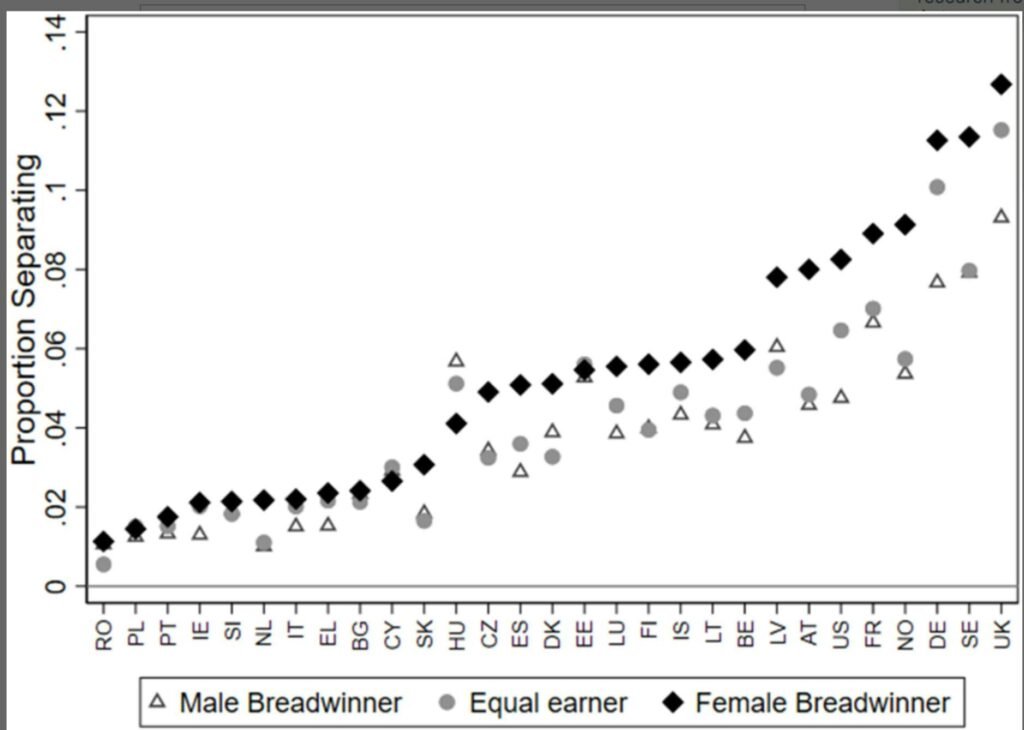
The study’s authors conclude that existing sociological theories are insufficient to explain the persistence of relationship instability among female-breadwinner couples, and call for further research into the underlying causes.
Why This Matters
The findings land like a cold shower on the assumption that the female-breadwinner penalty would fade as societies became more egalitarian. Despite dramatic gains in women’s education, labor-force participation, and earnings over the past half-century, the link between female breadwinning and separation has proven stubbornly durable.
Evolutionary psychologists offer one explanation: sex differences in mate preferences, shaped over deep evolutionary history, may continue to influence modern relationships in ways that social norms can’t fully override. From that view, the pattern reflects enduring psychological predispositions rather than merely outdated cultural expectations.
As the authors themselves note, “existing theories are insufficient”—and the phenomenon is unlikely to disappear simply because societies become more gender-equal. Whether that’s due to biology, unmeasured social pressures, or something else remains an open question. But for the millions of couples now living in female-breadwinner households, the study offers a cautionary note wrapped in a headline: money, it seems, can’t buy relationship stability—at least not when it upends who brings home the bigger paycheck.
Source: www.dailywire.com — https://www.dailywire.com/news/why-more-money-for-wives-can-mean-less-marriage