
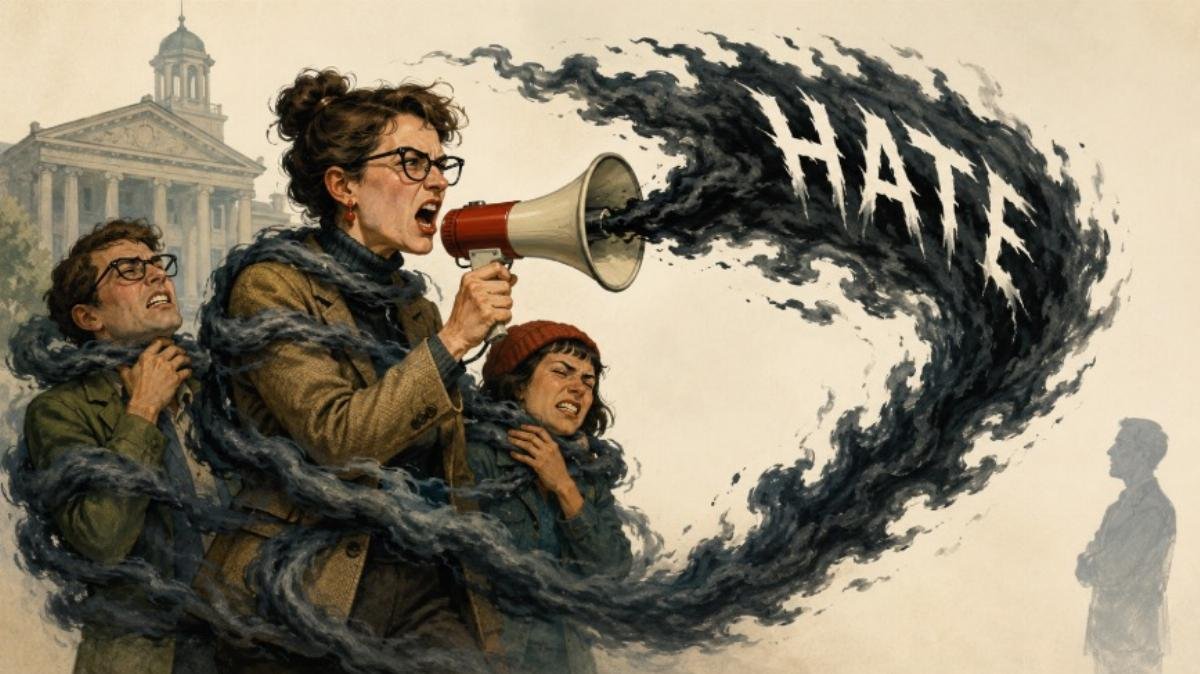
What turns a nation of prosperity into a nation of rage? According to a recent essay in American Thinker, the answer is complicated—but the trend is unmistakable. The piece, by Susan Quinn, argues that hatred is not a passing mood but a learned response that has become increasingly visible in American political life, with no clear end in sight.
Quinn begins with a sobering observation: America is a prosperous country, and prosperity is often assumed to bring happiness. Yet the past several years have been defined by riots, attacks on federal agents, and a steady stream of verbal assaults—particularly from the left—that seem to grow both in frequency and intensity. The question she poses is not whether hate exists—that’s beyond dispute—but why it has become so prominent, and whether there’s any way to reverse it.
What Is Hate, Exactly?
To answer that, Quinn compiles definitions from multiple sources, and they are not entirely in agreement. One definition frames hate not as an emotion but as a learned response fueled by fear, anger, and stress. Another describes it as something that flourishes on division and misinformation, but insists it can be unlearned. A third defines hate as an intense, lasting hostility toward someone or something, often accompanied by a desire to harm, devalue, or exclude the target.
Though these definitions conflict, Quinn extracts three common threads: hate is learned, it arises when we feel threatened, and it can become a lasting posture toward the world. That working definition, she suggests, can help us understand when hate appears in politics—and perhaps find a way to moderate it.
The Role of Fear and Scapegoating
One of the primary drivers of hate, Quinn writes, is fear of the unfamiliar. The uncomfortable sensation of encountering something new or different can cultivate hostility. When people feel powerless, overwhelmed, or frustrated, they search for something to blame. Hate gives them a way to direct negative emotions outward—often through scapegoating, where a specific group is held responsible for economic hardship, crime, or societal decline.
That’s a familiar pattern. But Quinn also points to a less discussed consequence: hate harms the hater. Research, she notes, shows that clinging to hate leads to higher stress, anxiety, and even physical health problems. It consumes energy and distorts reality. Those who indulge in hatred may feel empowered, but they are also undermining their own well-being. When the left demonizes the right, Quinn argues, its members may not realize that their sense of empowerment comes with a self-destructive cost.
Belonging vs. Rejection
Why would anyone choose such a path? Quinn suggests that hate often begins with a search for belonging. Joining a political group can reduce loneliness and isolation—but problems arise when belonging to “us” depends on rejecting “them.” Announcing who you’re against draws a bright line around a group, bonding its members as tightly as any shared love could. That provides a deep psychological reward: the feeling of being connected.
For those who are insecure, hate also offers a sense of moral superiority. It can justify whatever harm comes from their positions, and group members reinforce one another’s belief in their own righteousness. In that way, hate becomes a self-sustaining cycle—each act of hostility strengthens the group’s internal bond, even as it deepens division with the outside world.
Evidence From the Left
Quinn doesn’t limit her analysis to abstract theory. She points to concrete incidents that, in her view, illustrate how far-left hatred has spread into everyday institutions. In Chicago, an elementary school teacher named Lucy Martinez was caught on video reacting to an image of the late Justice Antonin Scalia by mimicking a shot to the neck—a reference to his assassination. At Wilbur Wright College, an administrator named Moises Bernal reportedly told a crowd that “ICE agents gotta get shot and wiped out,” adding, “You gotta grab a gun!” and “We gotta turn around the guns on this fascist system!”
These are not isolated examples, Quinn argues. Faculty across the country have thrilled audiences by talking about “detonating white people,” calling for Republicans to suffer, strangling police officers, celebrating the deaths of conservatives, and supporting the murder of Trump supporters. Even school board members, she notes, have referred to taking faculty “to the slaughterhouse” for questioning diversity, equity, and inclusion policies.
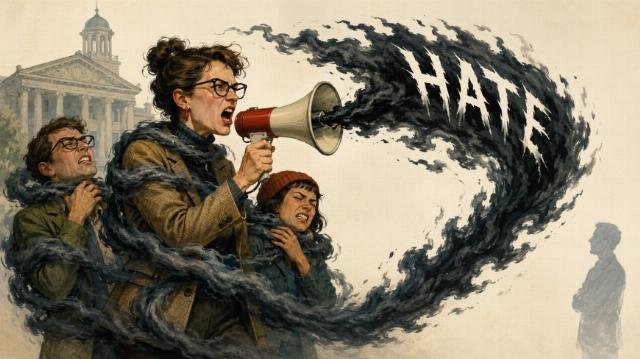
In her view, this represents a pattern of institutionalized hatred—one that has become a fixture of left-wing political culture.
The Danger of Governmental Rage
But Quinn draws an important distinction: the greater threat may not be the mob, but the state. She references Jonathan Turley’s book The Indispensable Right: Free Speech in an Age of Rage, in which Turley argues that we have far more to fear from governmental rage than from popular rage. Government anger, he contends, often begets popular rage, creating martyrs and driving speech underground where it cannot be countered. Turley also opposes elevating political speech above other types of speech—all are conducive to human flourishing, he says.
That’s a crucial point. If the government itself begins to mirror the hatred it claims to oppose, it risks legitimizing the very forces it seeks to control. Quinn seems to share Turley’s concern, suggesting that state-sponsored rage is a cycle that perpetuates itself.
Can Hate Be Stopped?
Quinn is not hopeful. Hatred is addictive, she argues. It empowers those who indulge it, providing a comforting haven within the group while alienating outsiders. That makes it nearly impossible to eliminate—or even moderate.
She poses the question directly: Will these incidents merely reflect a temporary period that will eventually fade? Is there any sign that the political climate is becoming more temperate? Will enough people come to their senses and realize that hatred is a destructive political strategy?
Her answer is blunt: “I’m not optimistic. And I see no strategy that will calm the waters.”
For now, the best defense, she suggests, is the freedom to speak our minds. The republic we cherish depends on that ability, perhaps now more than ever. Whether that freedom will be enough to counter the forces of hatred—only time will tell.
Source: www.americanthinker.com — https://www.americanthinker.com/blog/2026/08/why-do-people-hate/