
BISHKEK, Kyrgyzstan — The annual summit of the Shanghai Cooperation Organization (SCO) in Bishkek was expected to be a stage for Russia and China to rally behind Iran against American sanctions. But when Iranian President Masoud Pezeshkian finally met with Chinese leader Xi Jinping, the encounter was anything but a show of unity.
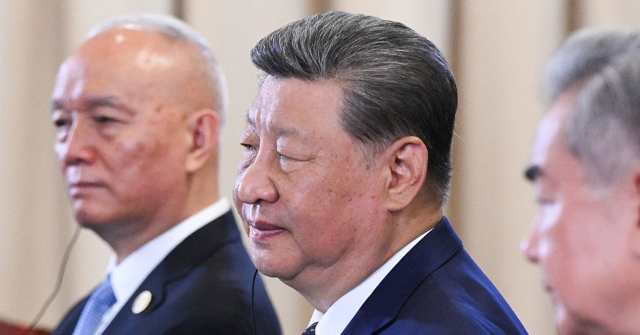
According to Iranian state media, the two presidents held a “brief meeting on the sidelines” of the summit on Tuesday, with no details released about what was discussed. A photo published by Iranian outlets captures a dour-looking Xi, standing beside Chinese Foreign Minister Wang Yi, appearing to grab at his own throat as Pezeshkian and his delegation approach in a hallway. The image suggests a leader caught off guard, not one eager to engage.
China’s state media, notably the Xinhua News Agency, has so far not reported the meeting at all. Instead, Xinhua prominently features Xi’s scheduled bilateral meetings with the presidents of Kyrgyzstan and Uzbekistan, as well as a separate sit-down with Russian President Vladimir Putin, all photographed in front of national flags. Xi’s departure from the summit on Tuesday for Egypt received more coverage than his interaction with Pezeshkian.
The contrast with India’s Prime Minister Narendra Modi is striking. Modi, an avid social media user, enthusiastically posted photos with Pezeshkian, suggesting a desire to expand trade with Iran. Xi’s reserved demeanor, by contrast, signals a possible recalibration of China’s relationship with Tehran.
“According to the Iranian presidency, the two presidents met on Tuesday during the summit’s programs and held talks for several minutes,” the Islamic Republic News Agency (IRNA) reported. “No further details were released about the content of their conversation.”
Iran’s Mehr News agency offered little more, stating that “during the meeting, the two presidents discussed the bilateral ties in line with strengthening relations between Tehran and Beijing.” Iranian Foreign Minister Abbas Araghchi, who confirmed his attendance at the summit, described on social media “talks with Eurasian, Chinese, and South Asian dignitaries” to argue Iran’s case in its conflict with America, but did not specifically mention any meeting with Xi.
China’s Balancing Act
China has long been a close ally of Iran, relying heavily on Iranian oil imports, but its geopolitical position has become increasingly complicated. Washington’s sanctions on Iran, combined with disruptions in shipping through the Strait of Hormuz, have reportedly led to a dramatic decline in Iranian oil shipments to China. The Chinese Foreign Ministry has repeatedly called for an end to the conflict and urged Iran to stop disrupting global shipping—pleas that have so far yielded little change.
The SCO, a Central Asian security coalition, has been used by Russia and China as a tool to bolster their influence. Iran is a member, and the summit was seen as a platform for anti-American powers to show support for Tehran. But the expected bold display of solidarity failed to materialize, with Xi’s meeting with Pezeshkian appearing perfunctory at best.
Diplomatic Moves Beyond Iran
Xi’s subsequent trip to Egypt underscores a broader strategic shift. On Tuesday, Xi arrived in Cairo for meetings with President Abdel Fattah al-Sisi, potentially expanding Chinese business interests in the country. The talks are also likely to address how Iran’s belligerence has affected Egypt’s economy. In a pre-visit editorial published in Egyptian media, Xi emphasized a desire for closer ties: “Today, China and Egypt have shared goals and common aspirations in upholding international order, championing fairness and justice, and practicing multilateralism. We need to enhance mutual trust and serve as a model in carrying forward friendship.”
Last week, Xi welcomed King Abdullah II of Jordan, a country Iran has repeatedly bombed, to Beijing. The two signed multiple trade agreements, with Abdullah inviting Chinese companies to invest in Jordan. These moves suggest Xi is actively courting other Middle Eastern nations, potentially at Iran’s expense, as China seeks to rebuild its diplomatic clout in the region.
Analysts had predicted that Putin and Xi would use the SCO summit to offer Iran public support against American sanctions and military pressure. While both leaders did meet with Pezeshkian, along with Modi and other Central Asian leaders, the grand gesture never materialized. The only recorded evidence of the Xi-Pezeshkian meeting is a grainy hallway photo from Iranian state media, a far cry from the flag-draped official receptions China typically showcases.
Iran’s relationship with China remains economically significant, but the frosty optics of this encounter, combined with Beijing’s growing engagement with Iran’s rivals, suggest that the “strategic partnership” may be cooling. For Pezeshkian, who is seen as subservient to the missing “supreme leader” Mojtaba Khamenei, the cold reception in Bishkek may be a warning that Tehran cannot take Beijing’s support for granted.
Source: www.breitbart.com — https://www.breitbart.com/asia/2026/09/01/xi-jinping-gives-iran-president-cold-reception-at-shanghai-cooperation-org-summit/