
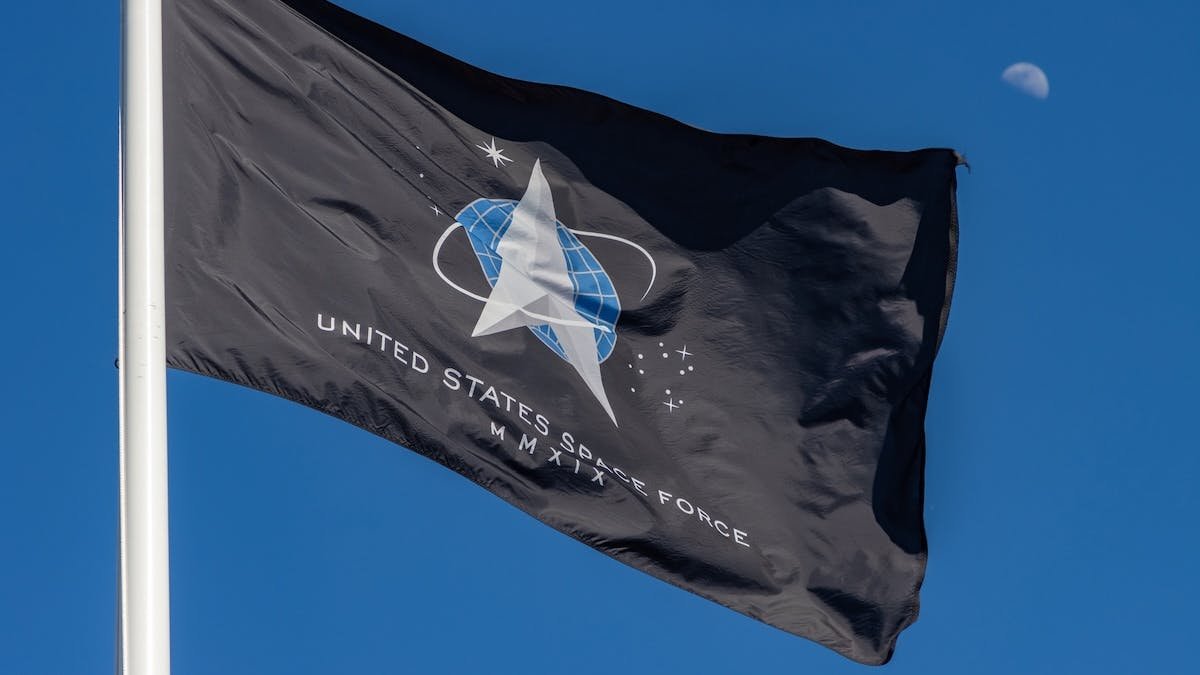
The final frontier is shaping up to be the next battlefield, with the United States and China locked in an accelerating race to deploy orbital weapons, clandestine spaceplanes, and so-called “hunter” satellites designed to cripple enemy assets hundreds of miles above the Earth, according to Reuters.
Experts warn that a successful strike on American satellites could paralyze U.S. ground forces, blinding everything from missile defense systems to military communications. The stakes are existential for modern warfare, which leans heavily on space-based intelligence, navigation, and targeting.
Chinese Spaceplane Stirs Tensions
Tensions skyrocketed after a secretive, unmanned Chinese spaceplane released a rogue mini-satellite high above the planet, as Reuters reported. The mini-satellite then looped around another Chinese spacecraft in what some analysts interpreted as a dress rehearsal for orbital combat maneuvers.
That activity aligns with a broader push by China’s military-linked researchers, who are aggressively filing patents for a range of space-warfare technologies. Those patents reportedly include pursuit satellites equipped with nets to capture enemy spacecraft, autonomous dogfighting capabilities, and in-space refueling systems that could keep killer satellites operational indefinitely.
The signal from Beijing, analysts say, is clear: China intends to be able to deny the U.S. its orbital advantages in any future conflict.
Washington’s Quiet Response
The United States is not standing idle. Last year, the U.S. Space Force and British allies conducted a covert maneuver of their own, buzzing a British satellite past a passing Chinese spy satellite. The intent was to send a message to Beijing not to interfere with American assets in orbit, according to Reuters.
On the hardware side, the U.S. military is rolling out ground-based jamming weapons designed to disrupt enemy satellites. Military leaders are also pushing for the development of “orbital interceptors” that could physically destroy hostile spacecraft in orbit.
Pentagon Warns of ‘Jaw-Dropping’ Chinese Speed
The U.S. military is publicly warning that Beijing is moving to dominate space ahead of a potential clash over Taiwan, and the language from top commanders is increasingly urgent.
Gen. Stephen Whiting, head of U.S. Space Command, said China has “accelerated their terrestrial and on-orbit space weapons, expanded their space-enabled kill chains and are moving at breathtaking speed. In fact, I now say they’re moving at jaw-dropping speed.”
Whiting’s warnings underscore a broader concern that a conflict in space would not be a contained affair but rather an integrated extension of terrestrial fighting, where the first salvos could come from orbit or be aimed at it.

Complexity Proliferating
In 2024 remarks, Whiting laid out the growing complexity of the threat environment, citing recent missile barrages as evidence of what modern warfare now looks like.
“A fight in space is going to be complex, and it’s only gaining in complexity, and so we have to get command and control right now,” Whiting said. He pointed to Iranian missile attacks on Israel involving “triple digit number of threat missiles that are incoming,” and described the broader threat landscape as one where threats are “proliferating. They’re democratizing and getting much more challenging.”
Whiting specifically flagged the Chinese fractional orbital bomb system and a new Russian missile system tested in recent weeks as state-actor threats the U.S. missile warning and defense architecture must adapt to counter.
“We must be well-prepared for conflict in space,” he cautioned. “And if deterrence fails, we will fight and win.”
What the Rogue Satellite Means
The specifics of the Chinese spaceplane’s satellite release remain classified and contested, but the pattern of behavior is what has Western analysts concerned. The ability to maneuver a small satellite into close proximity with another spacecraft is the foundational skill set for a range of missions—from inspection and refueling to outright attack.

In that sense, even a “dress rehearsal” maneuver carries strategic weight. It demonstrates that China has the orbital mechanics, tracking, and control capabilities to conduct rendezvous and proximity operations in a contested environment.
The U.S. counter-move of flying a satellite next to a Chinese spy satellite was an equally pointed signal—that the U.S. can track and shadow Chinese assets just as easily.
A New Arms Race in Orbit
Both nations are now investing heavily in capabilities that would have seemed like science fiction a generation ago. On the drawing boards or in early deployment are ground-based jammers, space-based interceptors, net-firing pursuit satellites, and spaceplanes that can be reconfigured for different mission profiles on the fly.
Perhaps most concerning to strategists is the prospect of in-space refueling for satellites. An orbital vehicle that can refuel is no longer limited by its initial fuel load; it can loiter, maneuver, and reposition continuously, making it a persistent threat rather than a fixed asset that can be tracked and avoided.
The patent filings from China’s military-linked researchers for autonomous dogfighting maneuvers similarly point toward a future where satellites engage in aerial combat-style duels in orbit, likely with minimal human intervention given the communication delays involved at orbital distances.
Preparing for the Fight
For the U.S. Space Command, the priority is now command and control—the ability to manage a complex orbital battlefield in real time while coordinating with terrestrial forces. Whiting’s emphasis on getting “command and control right now” speaks to a recognition that space warfare will be fast, confusing, and unforgiving of slow decision-making.
The immediate risk, as described by U.S. officials, is not so much a bolt-from-the-blue conflict in space, but a crisis elsewhere—likely over Taiwan—that escalates into an attempt to blind the U.S. military by taking out its satellites. That scenario is why Whiting and others have been so vocal about the need for robust missile warning and defense architectures, not just for ballistic missile threats but for the anti-satellite weapons that could precede them.
For now, the superpowers are engaged in a high-stakes game of orbital chicken, signaling capabilities and intent while preparing for the possibility that deterrence fails. As Whiting put it, the military’s posture is clear: be ready, and if it comes to conflict, be prepared to win.
Source: www.dailywire.com — https://www.dailywire.com/news/u-s-and-china-prepare-to-battle-on-the-final-frontier