
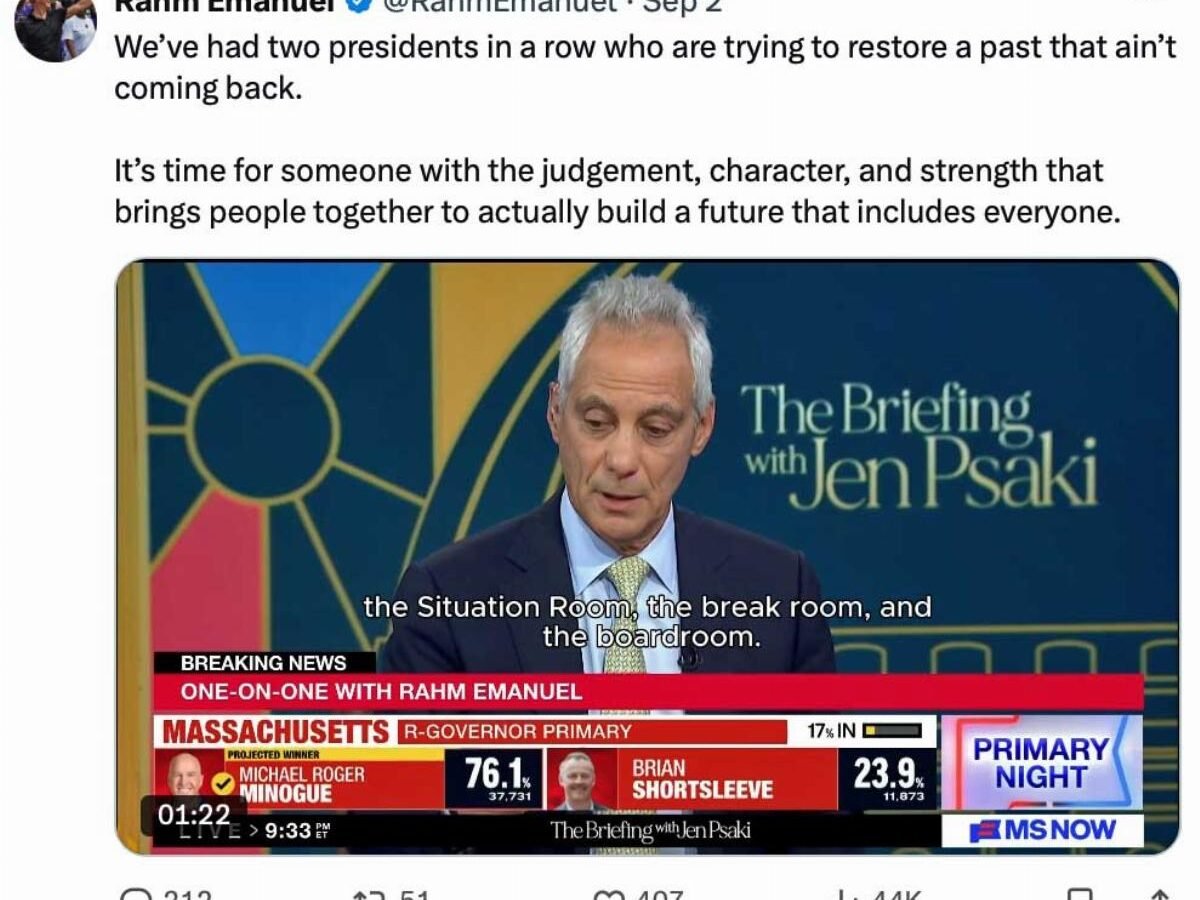
Rahm Emanuel, the former Chicago mayor and one-time White House chief of staff, has been on a writing tear. His latest Wall Street Journal op-ed, headlined “Lessons from Clinton to Cut Child Poverty,” appeared on September 4, 2026, marking his 20th such piece for the paper in recent months, according to an analysis published by American Thinker.
The op-ed itself reads smoothly, as American Thinker’s John L. Smith concedes, spinning the Clinton-era welfare reform as a model worth revisiting. But Smith’s commentary uses Emanuel’s prolific output as a springboard for a broader, more pointed question: what exactly is Emanuel running for, and on whose behalf?
A Crisis Opportunist’s Playbook
Smith doesn’t mince words, calling Emanuel “one of Obama’s crisis opportunists,” a reference to the former chief of staff’s famous November 2008 remark during a Wall Street Journal meeting: “You never want a serious crisis to go to waste. And what I mean by that is it’s an opportunity to do things that you think you could not do before.”
That quote, now more than a decade and a half old, retains its resonance in Smith’s telling. He suggests that crises, whether economic, political, or geopolitical, have a way of producing “wheels within wheels, concealed agendas, and October surprises before critical elections.” With November 2026 midterms looming and November 2028 already visible on the horizon, Smith wonders aloud whether another October surprise or two might be in store.
Term Limits and the Ghost of Clinton
Smith’s piece wanders, by his own admission, through a thicket of grievances and observations. One thread involves presidential term limits, a subject Emanuel’s op-ed reportedly touches on in the context of welfare reform’s durability. The Clinton-era reforms might have continued in the right direction, Smith muses, if the American people hadn’t “kept tinkering with our Constitution,” a sardonic nod to the 22nd Amendment’s two-term limit.
Smith then poses a rhetorical question about George W. Bush: “Was ‘W’ really an improvement over what could have been slick Willy’s 3rd term?” He lists Medicare Part D, Big Pharma, and the “shock and awe” Iraq invasion among the W/Cheney-era “fiascoes” that have shaped the present moment—for better or worse.
The digression is intentional, a way of illustrating how policy threads tangle across administrations, parties, and decades. Smith’s larger point: nothing is clean, and no single figure—least of all Emanuel—offers an easy answer.
Free Trade’s Unintended Consequences
The column shifts to global trade, tracing the container ship’s role in expanding commerce. Adam Smith’s original theories, written when nations were “just variants on oligopoly,” have given way to a more complicated reality. The twentieth-century evolution, as Smith describes it, led to a bargain: “let’s get cheaper goods from fewer free peoples and hope that makes them more free.”
That bargain, he argues, hasn’t delivered as promised. Instead, it has produced unintended consequences, including the spread of invasive species like the emerald ash borer, which likely arrived in the U.S. via wood packing material and has since devastated urban shade trees across the country. More significantly, Smith contends, cheap-labor nations have crippled American industries—textiles, furniture, and others—under both Democratic and Republican administrations.
The so-called “free trade” debate, he writes, was never really about freedom. It was about shifting labor to countries unburdened by American workers’ compensation, Social Security, and other entitlements that U.S. legislators, who “so often claim to be fighting for us,” have passed into law. “Fighting against us” might be more accurate, Smith says.
Are We Still One People?
Underlying all of this is Smith’s central anxiety: “Who are ‘we the people’ anymore? Are we any longer one people, indivisible, with liberty and justice for all?”
He points to rising calls among “new-new lefty Dems” for more government-provided benefits, funded by higher taxes on Americans. The so-called developed world, he adds, ignores sound economic principles while government borrowings pile up at home and abroad.
It’s a stark picture, and Smith doesn’t pretend to have solutions. Instead, he ends with a question: “Is Rahm Emanuel the man to answer that question?”
The answer, from Smith’s perspective, is far from clear. Emanuel’s op-ed output suggests a man with ambition and ideas, someone positioning himself for a role in the national conversation. But whether that role is for the Democratic Party, the country, or himself remains an open question.
What is clear is that Emanuel’s voice is not going away. Twenty Wall Street Journal op-eds in recent months is no accident; it’s a campaign—though for what office, or what cause, only Emanuel and his inner circle know for sure.
As the 2026 midterms approach and the 2028 presidential race begins to take shape, the former mayor and chief of staff’s prolific writing suggests he intends to be part of the conversation, whatever comes next. Whether that’s a return to public office, a role as an elder statesman, or something else entirely remains to be seen.
For now, Smith’s column serves as a reminder that in American politics, the written word often precedes the announcement. And with a crisis always seemingly around the corner, Emanuel’s own advice about not wasting a good crisis may prove prophetic once again.
Source: www.americanthinker.com — https://www.americanthinker.com/blog/2026/09/run-rham-run-but-for-whom/