

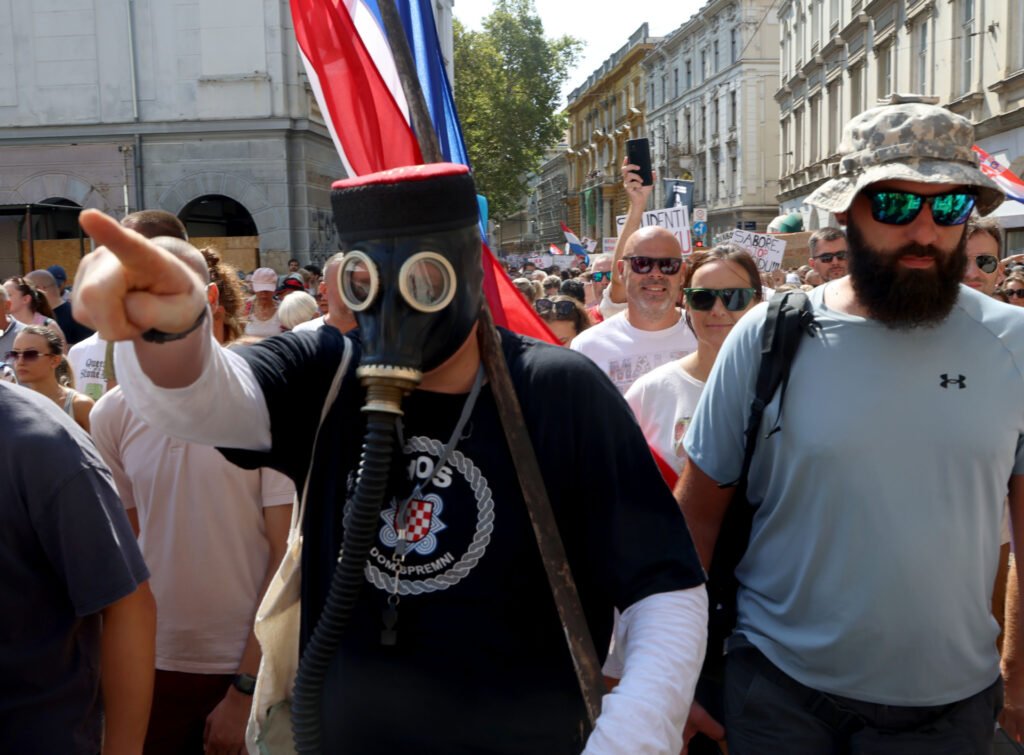
Tens of thousands of people gathered in Croatia’s capital on Saturday, venting their fury over the government’s failure to clear a massive pile of illegally dumped hazardous waste that has raised fears of serious environmental damage in the EU member state.
The protest in Zagreb, organized under the slogan “Walk for Lika, Walk for Croatia,” centered on the central town of Gospic, where roughly 37,000 metric tons (40,000 U.S. tons) of toxic waste has been sitting at an abandoned industrial site for more than a year, mostly buried underground. The scandal has heaped political pressure on conservative Prime Minister Andrej Plenkovic, who faces growing public anger as the standoff drags on.
Origin of the Crisis
Authorities first uncovered the illegal dumping operation last February, when Croatian police and Europol, the EU’s law enforcement agency, arrested 13 people suspected of illegally importing and disposing of hazardous waste. Europol said at the time that the suspects had raked in at least 4 million euros ($4.2 million) in illegal profits.
Despite the arrests, residents of Gospic — a town of about 12,000 people in a region known for its forests, lakes, and rivers — say the waste remains a looming threat to their health and the environment. The discarded materials include remnants of electronic equipment, plastics, construction debris, and medical waste.
An expert report released last month by USKOK, Croatia’s anti-corruption agency, found elevated metal concentrations in the soil at the site. The report also detected PFAS compounds — commonly known as “forever chemicals” — in groundwater, deepening concerns about potential contamination of the surrounding karst terrain and rivers that flow toward the Adriatic Sea.
Protesters Demand Action
Saturday’s demonstrators demanded that authorities present a clear plan to remediate the polluted sites promptly and completely, with defined deadlines. They also called for an immediate ban on waste imports.
Speaking at the rally, Vjekoslav Busic, from the “Gospic Is Our Home” initiative behind the protest, said residents had been reporting suspected illegal activity since 2023. He underscored the lack of progress.
“The result to date: Not a single kilogram of hazardous waste has been removed from Gospic,” Busic said.
Fellow protester Ivan Rittinger went further, rejecting any framing of the situation as an unforeseen disaster. “They are talking about this as if it were a tragedy, as if it just happened out of nowhere,” he said. “Someone made money out of it and someone was paid to look the other way. It was planned. This is not a tragedy. This is a crime.”
Zeljka Sikic, another Gospic resident, thanked the crowd for showing up, saying, “It takes courage nowadays.” She added, “We have been handed over to eco-mafia.”
Government Response and Criticism
The government maintains that the investigation is ongoing and that efforts to clear the area are underway. Officials have pointed to multiple water and soil tests in Gospic that came back negative for contamination, and they have pledged to temporarily cover the site to protect it from rainwater. One company has reportedly been selected to begin removing some of the waste while a longer-term strategy is developed.
Prime Minister Plenkovic, however, has accused his political opponents of fueling panic for their own gain.
But critics argue the government’s response has been too slow and insufficient. The protesters in Zagreb’s main square waved national flags and carried banners reading “When if not now” and “The lungs of Croatia have trouble breathing,” as they chanted “Croatia, Croatia.”
USKOK has said it is investigating a Croatian company suspected of burying illegal toxic waste at several locations across the country, with the largest amount found in Gospic. The initial Europol report indicated that much of the waste was imported from other EU nations, including Italy, Slovenia, and Germany.
Zagreb resident Suzane Maria Flander framed the issue in universal terms: “It’s a basic human right to have clean soil, clean water and clean air.”
Experts caution that while the immediate damage is localized, the region’s porous karst terrain and river systems could carry pollutants far beyond the abandoned site, potentially reaching the Adriatic Sea.
As the political standoff continues, residents and activists say they will keep pressing for tangible action, not just promises.
Source: www.breitbart.com — https://www.breitbart.com/europe/2026/09/05/thousands-rally-in-croatia-demanding-urgent-cleanup-of-tonnes-of-toxic-waste-from-town/