
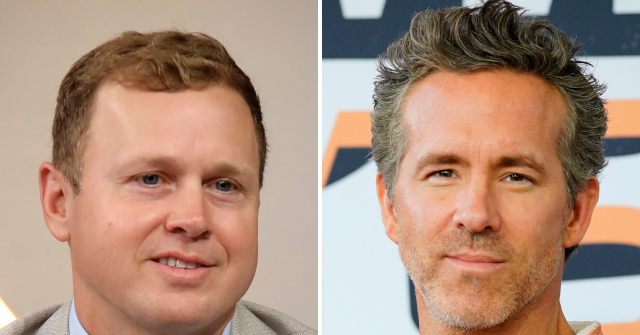
A single decade, two radically different memories — and a fight that says more about America in 2026 than it does about the Reagan era.
The latest flashpoint in the nation’s culture war came courtesy of an unlikely pairing: former reality TV star Spencer Pratt and actor Ryan Reynolds. Their dispute, which played out on social media and has since been amplified by conservative outlets, centers on a deceptively simple question: What were the 1980s really like?
In one corner stands Reynolds, the wisecracking star of the Deadpool franchise, who recently called the decade “brutal” and “a fucking mess” while promoting his Cold War-era film Mayday at its New York premiere. In the other corner is Pratt, a self-described Republican and failed Los Angeles mayoral candidate, who fired back with a defense of the decade as a time of clarity, heroism, and cultural sanity.
Their exchange, first reported by Variety and later covered by Fox News and Breitbart, has become a miniature case study in how deeply polarized American perceptions of history — and of pop culture’s moral compass — have become.
The Spark: A Red Carpet Remark
The controversy began innocuously enough. In a red carpet interview with Variety, Reynolds was asked about the era in which his new film is set. His answer was less nostalgic than some might expect.
“When you get far enough away from a time period that’s quite distinct, there’s always a lovely feeling associated with it, almost like you pave over all the trauma with puppy dogs and ice cream,” Reynolds said. “The ’80s was a brutal, brutal time for people. It was a fucking mess, and people forget that.”
For many who lived through the decade — marked by the tail end of the Cold War, the Reagan presidency, an economic boom after the malaise of the late 1970s, and a surge of patriotic sentiment — that characterization landed poorly. For Pratt, it was a bridge too far.
Pratt, best known for his stint on The Hills and his 2025 independent bid for Los Angeles mayor, responded on X with a message that cast Reynolds’s comments as emblematic of a generational and ideological blind spot.
Pratt’s Rebuttal: Heroes vs. Antiheroes
“It makes perfect sense that Ryan Reynolds’ view of the 80s is the inverse of what normal people think,” Pratt wrote. “In 80s movies, bad guys were villains. Today, the bad guys are the heroes. Hollywood now bends over backwards to redeem wickedness and mental illness.”
Pratt went on to invoke one of the defining cultural artifacts of the decade — Top Gun — and its star, Tom Cruise, whom he described as representative of a “hero generation of cinema.”
“Top Gun and St Thomas of Cruise represent the hero generation of cinema,” he wrote. “Reynolds represents the antihero generation, and they are both byproducts of their own creations. Choose your path carefully, young man.”
The jab at Reynolds’s own filmography was direct. Reynolds has built much of his modern career on playing Deadpool, a wisecracking mercenary who routinely breaks the fourth wall of the Marvel universe and operates far outside the moral boundaries of a traditional superhero. For Pratt, that archetype is not just a matter of entertainment — it’s a symptom of something larger.
What the Age Gap Says
One notable wrinkle in the spat: neither man experienced the 1980s as an adult. Reynolds was born in 1976, turning just 14 as the decade closed. Pratt, born in 1983, was not even a teenager when the Berlin Wall fell.
The age detail has led some observers to note that both men are arguing about a decade they never fully lived through as grown-ups — which, in some ways, makes their disagreement all the more revealing. It suggests the fight is less about historical accuracy and more about competing narratives of what America is and should be.
For Pratt and his allies, the 1980s represent a time when American culture was more legible: villainy was villainy, heroism was heroism, and patriotism was not a subject for irony. That framing aligns with a broader conservative cultural critique that has gained traction in recent years — one that mourns the loss of a shared moral vocabulary and blames Hollywood for eroding it.
A Cultural Critic Weighs In
Christian Toto, an award-winning film critic who spoke with Fox News about the exchange, said Pratt’s comments point to a “very real fissure in American culture” — one that extends well beyond celebrity squabbles.
“Spencer Pratt’s hot take suggests a sobering reality,” Toto told the outlet. “Has pop culture’s infatuation with antiheroes had real-world implications? It’s one thing to follow Tony Soprano or Walter White, but modern films and TV shows are replete with villains we’re asked to cheer on.”
Toto cited a litany of recent films that blur the line between hero and villain — Bullet Train, Hit Man, the John Wick saga, and indie titles like Emily the Criminal and Carolina Caroline — as evidence that Hollywood has increasingly turned criminals and morally compromised figures into protagonists audiences are meant to root for.
“Consider how many recent movies have given us hit men with hearts of gold,” he said. “Indie films like ‘Emily the Criminal’ and ‘Carolina Caroline’ also turn villains into quasi-heroes.”
Toto concluded: “Has that had a corrosive effect on the culture? Pratt’s question is worth exploring.”
A Decade of Contrasts — and a Nation Divided
Behind the celebrity back-and-forth lies a more consequential political reality. The 1980s are remembered by many conservatives as a decade of renewal — a time when Ronald Reagan’s election in 1980 signaled a revival of patriotism, prosperity, and traditional values after a period of national drift. For many on the left, the decade is recalled less fondly — a time of inequality, foreign policy adventurism, social conservatism, and, yes, plenty of trauma for marginalized communities.
Neither memory is complete, but each is potent. And in a moment when Americans are already deeply divided over questions of history, identity, and culture, a debate over how to remember the 1980s can function as a proxy for much larger arguments about who gets to define the country’s narrative.
The spat between Pratt and Reynolds also reflects a broader shift in how political conversations unfold. A throwaway red carpet comment — the kind that would once have been ignored or quickly forgotten — can now become a national news cycle unto itself, amplified by social media algorithms and ideologically aligned outlets on both sides.
For his part, Pratt has positioned himself in recent years as a conservative culture warrior, using his platform to critique Hollywood’s perceived excesses and to champion a return to older forms of storytelling and moral clarity. His mayoral campaign, while unsuccessful, gave him a taste of political relevance beyond reality TV — and this exchange suggests he intends to keep leaning into that role.
What Comes Next
Whether Reynolds will respond remains unclear. The actor, who is known for his own quick wit and engagement with fans online, has not publicly addressed Pratt’s broadside in the days since. His representatives did not respond to requests for comment.
But the question the exchange raises is unlikely to disappear anytime soon. As Toto suggested, the debate over whether Hollywood’s embrace of antiheroes has reshaped American values — for better or worse — is one that cultural conservatives have been pressing with increasing urgency. Pratt’s comments give that argument a fresh, celebrity-driven hook.
Lowell Cauffiel, a Breitbart contributor and best-selling crime novelist who covered Reagan’s 1980 landslide for the Detroit News, lent historical weight to the discussion. His reporting from that era captured a country in transition — one that would go on to define much of what the 1980s are remembered for today.
In the end, the fight over the 1980s may be less about the decade itself and more about the present moment — a time when even shared memories of the relatively recent past have become contested terrain.
As Pratt put it in his post, with a characteristic blend of grandiosity and earnestness: “Choose your path carefully.” Whether Americans will choose the path of the hero or the antihero — or simply agree to remember the 1980s differently — remains to be seen.
Source: www.breitbart.com — https://www.breitbart.com/politics/2026/09/05/american-divide-spencer-pratt-takes-on-ryan-reynolds-over-what-the-1980s-were-really-like/