
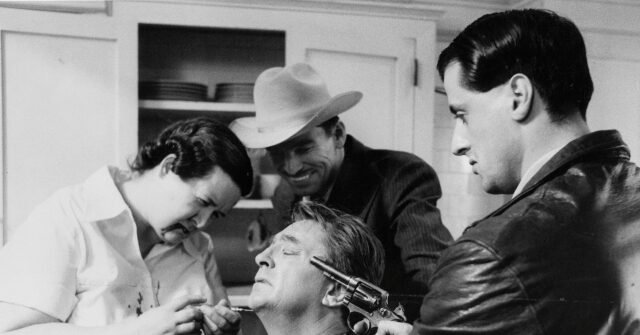
Robert Mitchum’s portrayal of Philip Marlowe in the 1970s remains one of the most debated performances in film noir history — a fascinating mix of hard-boiled grit and frustrating inconsistency. A recent deep dive by Breitbart’s John Nolte highlights why the actor’s take on Raymond Chandler’s iconic detective continues to captivate audiences half a century later.
The two films — 1975’s Farewell, My Lovely and 1978’s The Big Sleep — were both directed by Michael Winner, and both cast Mitchum as the cynical, world-weary private eye. Nolte’s analysis frames these performances as a study in contradictions: Mitchum, at 57 and 60 respectively, brought a grizzled authenticity to a character typically portrayed as younger and more athletic, yet his sheer physicality and laconic delivery also created a Marlowe who felt both more real and more remote than his predecessors.
A Noir Icon at the Wrong Age?
Mitchum’s age was arguably the most striking feature of his Marlowe. Chandler’s novels often described Marlowe as being in his late 30s or early 40s — a man still capable of throwing a punch and attracting romantic interest. By the mid-1970s, Mitchum was a silver-haired veteran of Hollywood, and Winner chose to lean into that aging process rather than hide it. In Farewell, My Lovely, set in 1941 Los Angeles, Marlowe is seen getting winded during a scuffle, and his face bears the lines of a man who has seen too much corruption. Nolte suggests this was a deliberate choice, aligning Marlowe more closely with Chandler’s own cynical worldview — a detective who has been around long enough to know the city’s seedy underbelly intimately.
Yet that same age became a source of frustration for some viewers. When Mitcum shared the screen with younger stars like Charlotte Rampling or Candy Clark, the romantic tension felt less like chemistry and more like a generational mismatch. In The Big Sleep, Marlowe’s flirtations with Vivian Sternwood (played by Sarah Miles) lacked the electric spark that Humphrey Bogart’s 1946 version had with Lauren Bacall. Instead, Mitchum’s Marlowe seemed more paternal than passionate, which undercut some of the source material’s smoldering subtext.
The Hard-Boiled Charm and Its Limits
What made Mitchum’s Marlowe successful, according to Nolte, was his innate believability as a tough guy. Mitchum possessed a natural menace that few actors of his era could match — a quality that made his Marlowe seem genuinely dangerous, not just a well-dressed man quipping his way through mysteries. In Farewell, My Lovely, his scenes with the hulking Moose Malloy (played with chilling simplicity by Jack O’Halloran) carry real weight, as Marlowe navigates a world where violence can erupt at any moment.
But the frustrations were equally notable. Both films suffered from uneven pacing and scripts that sometimes meandered, failing to capture the tight narrative grip of Chandler’s plotting. The Big Sleep, in particular, is notoriously convoluted — even the original 1946 film had to patch over plot holes — but Winner’s 1978 version, which shifted the setting to 1970s England, added an odd fish-out-of-water element that confused rather than enhanced the story. Mitchum’s Marlowe seemed less in his element amid British rain-slicked streets, and his performance occasionally drifted toward autopilot, as if he was merely going through the motions between moments of genuine inspiration.
A Contradictory Legacy
Nolte’s piece ultimately argues that these flaws are inseparable from what makes the performances interesting. Unlike Bogart’s definitive take or Elliott Gould’s more irreverent 1973 version in The Long Goodbye, Mitchum’s Marlowe lacks a single, cohesive interpretation. He alternates between being fully committed and visibly weary of the genre’s conventions — a reflection of an actor who never fully embraced the detective role, yet could not escape its pull.
For fans of noir, that ambiguity is precisely the appeal. You are never quite sure whether you are watching a great performance or a flawed one — or a little of both. It is a gamble every time the film unspools, but it keeps the viewer engaged in a way that more polished productions often fail to do.
As Nolte points out, there is also a meta-narrative at play: Mitchum, like Marlowe, was a figure of masculine mystery, someone who seemed tired of the world’s pretensions but still showed up to do the job. Whether that job was cracking wise or cracking heads, he did it with a shrug that suggested he had seen it all before — and that may be the most faithful rendition of Chandler’s hero ever captured on screen.
In an era when every classic character gets reimagined for modern audiences, the Mitchum Marlowe films stand as a reminder that not all reinterpretations need to be clean or comfortable. They are messy, contradictory, and at times maddening — but they are never boring. And for a detective who once mused about the mean streets of Los Angeles, that may be more than enough.
This article is based on reporting from Breitbart’s John Nolte, published September 6, 2026.
Source: www.breitbart.com — https://www.breitbart.com/entertainment/2026/09/06/nolte-the-fascinating-and-frustrating-times-when-robert-mitchum-played-philip-marlowe/