
A newly released consultant study has revived the long-simmering debate over passenger rail in Texas, concluding that a commuter train service between Austin and San Antonio is “feasible.” But the price tag attached to that verdict — $13.5 billion in capital spending for just 80 miles of track, plus $190 million a year in operating costs — has already drawn sharp criticism from fiscal conservatives who see the proposal as the latest in a string of taxpayer-funded rail boondoggles.
The study, conducted by the consulting firm HNTB, stops short of predicting ridership or fare revenue. Instead, it assumes eight round trips per day between the two cities, a figure that critics say would do little to offset the project’s staggering costs.
Writing for American Thinker, columnist Mike McDaniel crunched the numbers and found the economics don’t add up. Based on the study’s assumptions — 500 seats per train, 50 percent occupancy, and fares starting around the $15 Amtrak already charges on its single daily run between the cities — annual fare revenue would come to roughly $22 million. Against $190 million in yearly operating costs, that would leave a shortfall of around $168 million per year before even accounting for interest payments on borrowed capital.
And those interest payments are substantial. McDaniel notes that if state and local taxpayers fronted $3.5 billion in cash and the remaining $10 billion were financed through bonds at 4 percent interest, the annual debt service alone would approach $400 million.
“I’m sure Texans will be delighted to fork over more in taxes to pay around a half-billion more in unnecessary, wasteful government spending,” McDaniel wrote.
A familiar pattern
The Texas proposal comes on the heels of similar Democratic-led rail pushes elsewhere. McDaniel previously highlighted a Colorado plan to build a rail line from Fort Collins to Denver — a distance of roughly 60 miles — that would similarly require billions in public funding while offering little time savings over the existing eight-lane I-25 corridor.
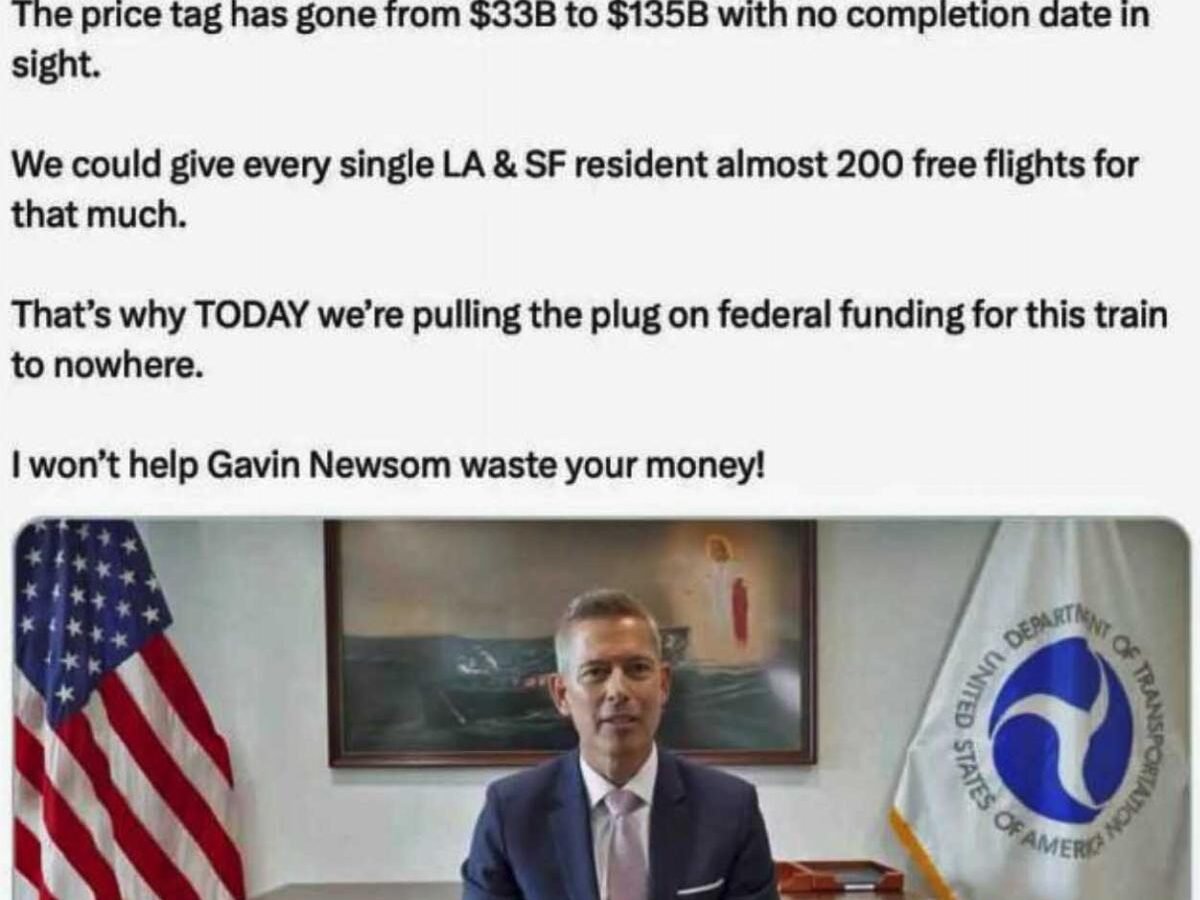
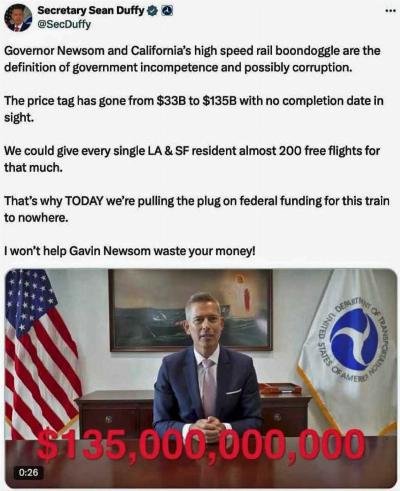
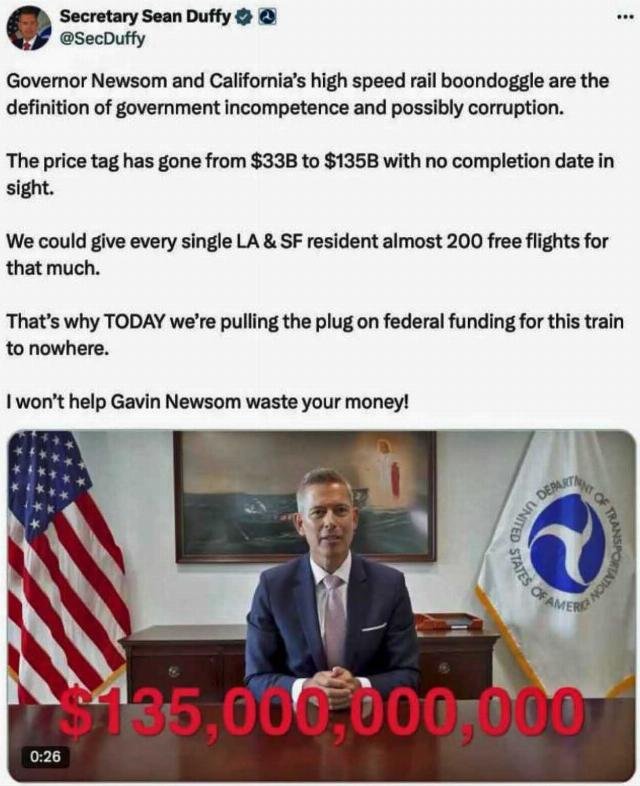
California’s high-speed rail project, long a favorite target of rail critics, has also faced funding cutoffs at the federal level. Transportation Secretary Sean Duffy has moved to block taxpayer money from flowing to the state’s troubled bullet train, which has been dogged by cost overruns and delays for years.
The Texas study’s “feasible” determination is likely to fuel further calls for federal and state investment, but opponents argue that the fundamental problem with such projects is that they build rail where adequate highways already exist. I-35 already connects Austin and San Antonio, and rail passengers still need ground transportation at both ends of their journey — a factor that often makes driving cheaper and more convenient.
The economics of rail vs. road
McDaniel argues that the “last mile” problem is one of the most significant obstacles to making intercity rail viable in Texas. Unlike air travel, which often requires a car or taxi at both airports, commuter rail stations are typically located in city centers. But for passengers whose destinations aren’t within walking distance of a station, the added cost of a cab or rideshare can quickly eat up any savings from choosing the train.
“In many cases, even direct airline flights will be cheaper,” McDaniel wrote.
The fundamental issue, he argues, is that train fares can never be raised high enough to make such projects profitable — or even to break even. That means taxpayers are on the hook in perpetuity for operating subsidies, maintenance, and debt service, a financial burden that could persist for decades.
“That’s why taxpayers are going to be soaked in perpetuity to finance trains,” he wrote.
A political battle ahead
The Texas proposal is still in its early stages — the HNTB study is a feasibility assessment, not a construction plan. But its release sets up a political fight in a state where Republicans control the governorship and both chambers of the legislature.
Rail advocates will likely point to the study’s conclusion that the project can be built, and to the potential for economic development along the corridor. Opponents will counter with the cost figures, the projected operating losses, and the existence of a perfectly serviceable highway connecting the two cities.
McDaniel’s skepticism reflects a broader conservative critique of large-scale rail projects, which he characterizes as vote-buying schemes that funnel taxpayer money to favored constituencies. He notes that with the shutdown of USAID and other programs that conservatives viewed as vehicles for distributing federal dollars, Democrats may be looking for new ways to spread cash around.
“Not because the public is clamoring for it. Not because it will save anyone time and money, but because Democrats have likely discovered that since USAID and other Democrat money-laundering and dispersal scams have been obliterated, they need new ways to spread taxpayer cash around to buy votes,” he wrote.
Whether that argument resonates in Texas remains to be seen. But with $13.5 billion on the line — and hundreds of millions more in projected annual losses — the debate over the Austin–San Antonio rail line is likely to be a lengthy one.
Source: www.americanthinker.com — https://www.americanthinker.com/blog/2026/09/democrats-want-to-build-a-passenger-train-in-texas/