
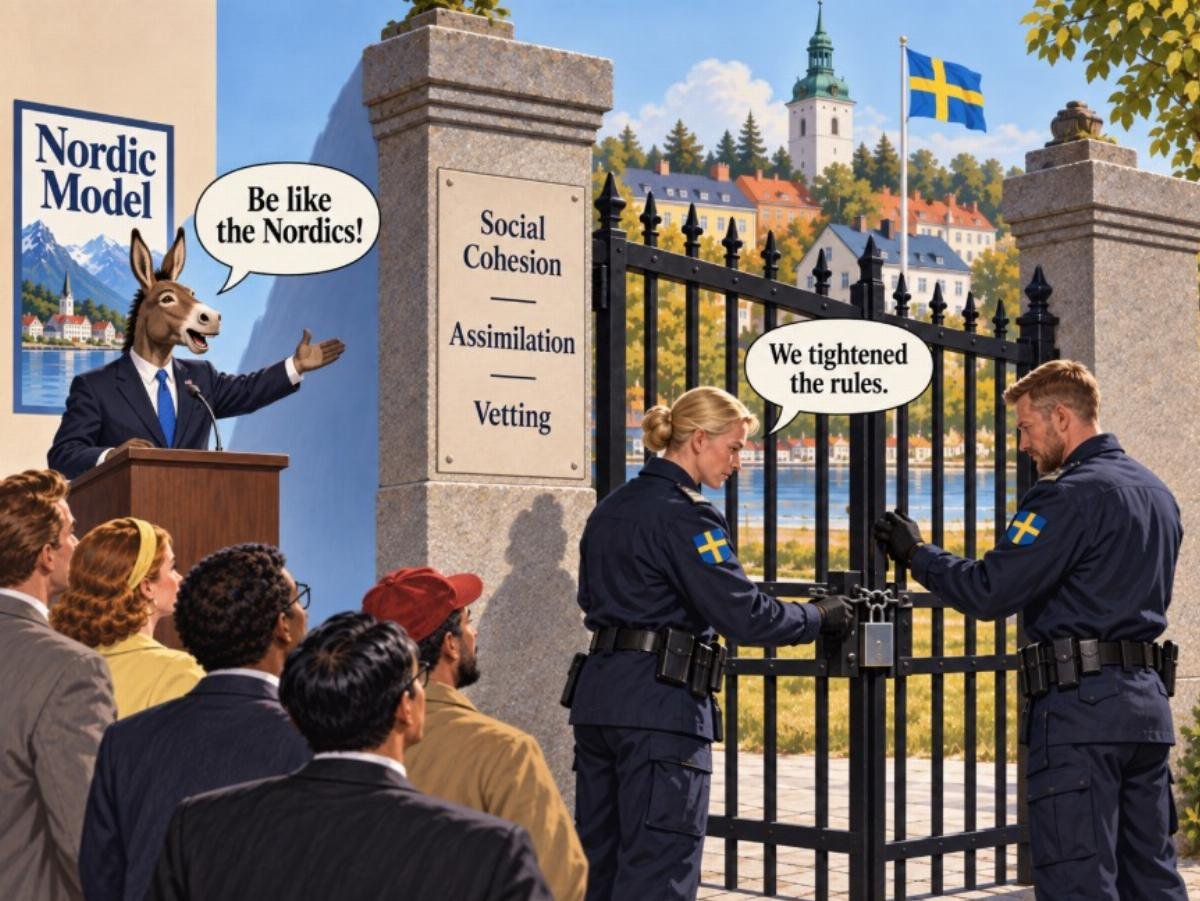
American progressives have spent years holding up Denmark, Sweden, Norway, Finland, and Iceland as proof that generous welfare states, high taxes, and muscular government can produce happier, healthier societies. According to a commentary published in American Thinker by Christian Vezilj, those same voices simultaneously insist that “diversity is our strength” and lean on that slogan to justify looser immigration enforcement at home. Vezilj’s argument is that the two positions cannot comfortably coexist, because the Nordic countries themselves have spent the past two decades discovering the limits of the diversity narrative they are credited with inspiring.
The piece, published September 15, opens by noting how frequently Nordic social democracy is invoked in American debates — as a model for welfare policy and as moral cover for relaxed attitudes toward illegal immigration. Vezilj does not dispute that the Nordic states built successful welfare systems. He argues instead that those systems rested on preconditions American advocates rarely mention: high social cohesion, shared civic expectations, low corruption, and deep trust in institutions.
Sweden as the cautionary case
Vezilj points to Sweden as the clearest example of what happens when those foundations are tested. Over roughly twenty years, he writes, Sweden opened its borders to large-scale, unvetted immigration on the assumption that newcomers would assimilate into Nordic civic culture, adopt local norms, and enrich society through multiculturalism. The expectation, in his telling, was rooted in optimism and a desire to demonstrate moral leadership rather than in any serious assessment of how integration would actually unfold.

The results, he argues, were messier than the slogans allowed for. Once celebrated as the world’s most generous welfare state, Sweden confronted rising crime, strained social services, and growing cultural fragmentation, with neighborhoods stable for generations changing rapidly while integration programs struggled to keep pace. Vezilj writes that Swedish leaders have since begun acknowledging openly that the country moved too quickly, accepted too many unvetted migrants, and underestimated the difficulty of assimilation — a concession that undercuts the assumption that integration happens on its own.
Denmark, Finland, Norway — and a smaller Iceland
The commentary describes Denmark as responding even more decisively than Sweden. After experimenting with multicultural policies, Danish leaders reversed course and enacted some of the strictest immigration laws in Europe, emphasizing cultural compatibility, civic responsibility, and the preservation of Danish social norms. Finland and Norway are said to have followed similar paths, tightening asylum rules, raising vetting requirements, and reinforcing expectations around integration and language proficiency. Iceland, though smaller, kept strict controls in place to protect its social stability.
Vezilj’s conclusion from this survey is blunt: the Nordic countries American progressives celebrate have, in practice, walked away from the very diversity narrative those progressives promote. They have decided, he writes, that diversity is not automatically a strength — that social cohesion, shared norms, and cultural alignment are what allow welfare states to function at all. Without them, he contends, welfare systems strain, crime rises, and trust in institutions erodes.
The mismatch with American conditions
The essay then turns to the United States, where, in Vezilj’s account, “diversity is our strength” has become a catch-all phrase used to justify policies that minimize enforcement, blur legal distinctions, and treat assimilation as automatic. He notes that the United States has roughly 330 million people, enormous cultural variation, differing civic expectations, and a politics defined by polarization and declining institutional trust — conditions that do not resemble the small, homogeneous Nordic societies whose welfare structures are being invoked. Treating the two as interchangeable, he suggests, is a category error.
The contradiction he identifies is selective borrowing. If the Nordic countries are genuinely the ideal, then their emphasis on social cohesion, selective immigration, and cultural alignment should be part of the lesson. Those elements, he argues, are seldom mentioned precisely because they conflict with the premise that diversity — particularly diversity produced by unregulated immigration — is inherently good. The Nordic model gets used as a logo rather than as a blueprint.
Vezilj draws a distinction between immigration generally and illegal immigration specifically. The United States, he writes, has always been shaped by immigration, but historically that immigration was organized around assimilation, shared civic values, and a common national identity, with a legal system designed to evaluate individuals for suitability and long-term integration. Illegal immigration, in his framing, bypasses those safeguards entirely, bringing in people whose backgrounds, education, and civic expectations are unknown, while adding pressure to schools, hospitals, and local governments — the same cohesion-dependent institutions he says Nordic welfare states rely on.
His closing argument is less about any single policy than about the terms of the conversation. The United States, he writes, would benefit from a frank discussion of social cohesion, cultural expectations, and immigration policy rather than a debate that hides those questions behind an attractive but contradictory slogan. Suppressing the facts, he concludes, does not spare the country from the problems; it only prevents an honest reckoning with what might realistically work in a nation as large and varied as this one.
The piece is an opinion essay, and its claims about Nordic policy shifts and their consequences are the author’s interpretation of recent European experience rather than new reporting. Still, it captures a tension that has been moving through American politics for several election cycles: the gap between how the Nordic countries are marketed in U.S. debates and what those countries have actually chosen to do about immigration and integration. Whether or not one accepts Vezilj’s causal story, the question he raises — which parts of the Nordic experience are worth copying, and which are quietly skipped — is one that advocates on both sides of the immigration argument will have to answer on their own terms.
Source: www.americanthinker.com — https://www.americanthinker.com/blog/2026/09/the-nordic-model-and-the-american-diversity-paradox/