
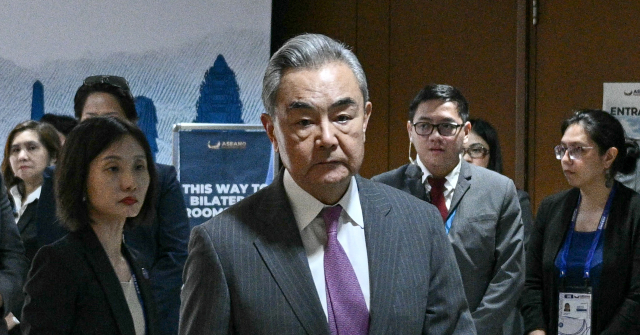
Chinese Foreign Minister Wang Yi used a Wednesday meeting in Beijing with his Iranian counterpart, Abbas Araghchi, to press Tehran to reopen the Strait of Hormuz and return to the June memorandum of understanding it signed with the United States, according to a readout from China’s Foreign Ministry reported by Breitbart News.
“We urge all parties to take effective measures to reopen the Strait of Hormuz at an early date,” Wang said, while calling on both Washington and Tehran to “engage in substantive consultations on issues of mutual concern” and to “exercise restraint.”
Beijing framed the remarks as consistent with its long-standing position on the strait conflict, though the ministry acknowledged a “dash of additional urgency” — a nod to the Houthis in Yemen, whom the report describes as Iranian proxies, now attacking Saudi Arabia and threatening Red Sea shipping.
Iran Says It Wants a Deal, But Keeps Attacking Ships
Araghchi told Chinese state media that Iran still considers the MOU with the U.S. to be in force. “Iran is not interested in continuing the conflict, hopes to return to a diplomatic path toward a settlement and at the same time intends to firmly defend its rights and interests,” he said. “The Iranian side believes that the memorandum of understanding between the US and Iran remains in force.”
Breitbart’s report noted that Iran has repeatedly violated the agreement by launching attacks on civilian vessels in the strait, raising questions about how much weight the Iranian foreign minister’s statement carries.
On the same day as the Beijing meeting, U.S. Energy Secretary Chris Wright said the Strait of Hormuz had been reopened “for all intents and purposes” under American protection. Oil flows reached 18 million barrels for the day, which Wright described as a return to “basically pre-conflict levels.”
Those shipments are moving through Oman’s coastal waters. Muscat has proven reluctant to join what the report characterized as an Iranian scheme to extort ransoms from international shipping transiting the strait.
A Pipeline Hit and a Six-Week Question
Wright on Tuesday addressed the Houthi attack on Saudi Arabia’s East-West Pipeline, which temporarily halted Riyadh’s efforts to bypass the Strait of Hormuz by moving oil through the Red Sea. Speaking to CNBC, Wright called the pipeline disruption a “brief and temporary interruption” that “will be measured in days.”
Saudi Arabia has been hesitant to publish official repair projections. Some independent analysts have estimated the work could take as long as six weeks — a gap between the American timeline and outside assessments that leaves the Red Sea route’s near-term reliability uncertain.
According to Wright, the Saudis are compensating by sending more supertankers through the Strait of Hormuz along the Omani coast. CNBC noted that Iranian forces have attacked at least two ships in the strait since Saturday, so the threat has not disappeared. Still, the report concluded that Tehran no longer appears capable of halting oil shipments outright.
Diplomatic Frustration From Cairo to New Delhi
Araghchi did not secure the new deal he was seeking at the BRICS summit in New Delhi over the weekend — a gathering whose joint statement omitted the condemnation of American and Israeli strikes on Iran that he had pushed for. Breitbart’s report suggested one reason: Iran’s own missile and drone attacks on several other BRICS members.
Iran may also have crossed a threshold when its Houthi proxies allegedly struck the Muslim holy city of Mecca with a drone on Tuesday. Condemnation came quickly and from across the region, including a sharp statement from the 57-member Organization of Islamic Cooperation.
The reported strike followed a Houthi offensive that captured stretches of Yemen’s coastline and the Bab el-Mandeb Strait as Saudi and Yemeni government forces pulled back. The advance appeared, at least briefly, to reward Iran’s strategy of using the Houthis to damage Saudi oil infrastructure, shut down the Red Sea route, and drive up global oil prices as economic pressure on Washington.
Other regional governments responded by canceling a planned summit with Iran over the Houthi attacks on Saudi Arabia. Araghchi nonetheless posted to Telegram two days later that Iran wants “the return of peace to the region and friendly and peaceful relations with our neighbors,” adding that Tehran has started dialogue with regional countries.
What Wang Actually Gave Iran
The most concrete commitment Araghchi received from Wang was a promise to “strengthen dialogue and cooperation with Iran, and safeguard Iran’s legitimate rights and interests” — a formulation that leaves undefined exactly what Beijing considers those rights to be.
Wang’s simultaneous demand for open and safe transit through the strait suggests China does not count Iran’s protection-racketeering scheme among them. Araghchi’s public response was notably less belligerent than Tehran’s previous rhetoric — though, as the report observed, it was also less belligerent than Iran’s current actions on the water.
Source: www.breitbart.com — https://www.breitbart.com/middle-east/2026/09/16/china-pressures-iran-to-open-strait-of-hormuz-as-foreign-minister-visits-beijing/