
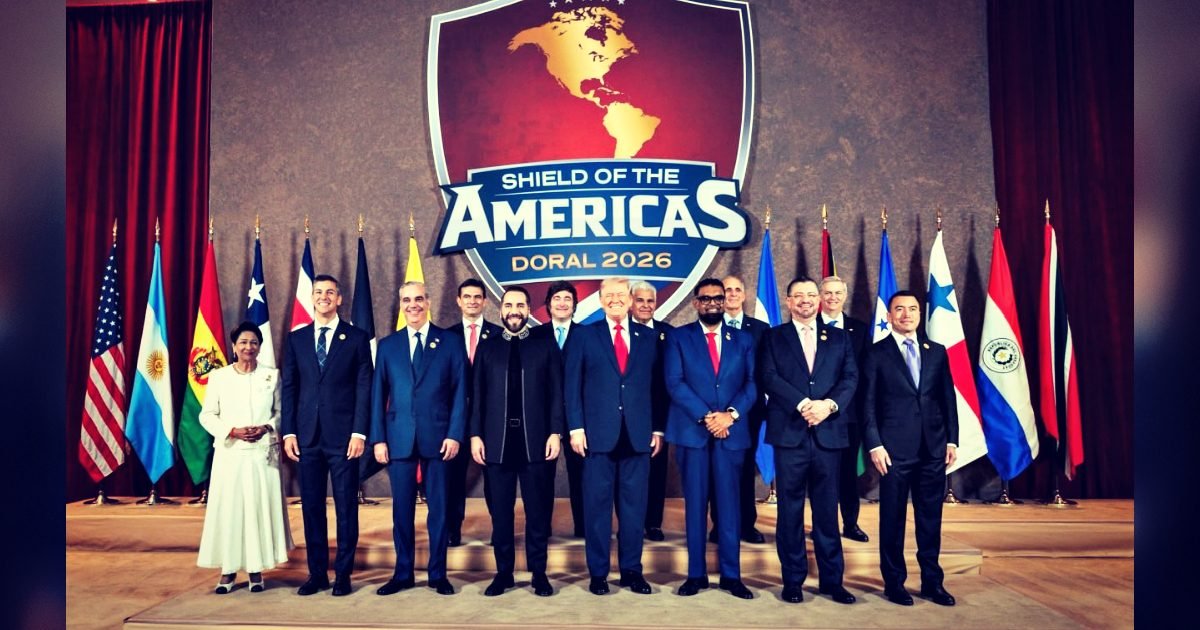
The Trump administration is moving $52 million in U.S. military assistance away from partners in Europe and the Middle East and toward four allied governments in Latin America, according to reporting first surfaced by the Associated Press and confirmed in a State Department notification to Congress.
The funds will be diverted from Iraq, Tunisia, and the NATO members Slovakia and North Macedonia, and redirected to Colombia, Ecuador, Peru and Panama. The State Department notified lawmakers of the shift on Tuesday, per the AP, which broke the story on September 15, 2026.
What the State Department says the money is for
In its message to Congress, the department framed the reallocation as a course correction rooted in the administration’s view of where American security interests now sit. The money, it said, is meant to combat “narcoterrorism in our backyard,” help “continue to secure the Panama Canal,” and “prevent adversaries from establishing strategic footholds in our hemisphere.”
Secretary of State Marco Rubio traveled to South America the previous week, meeting with the conservative leaders of Peru, Colombia and Ecuador to pledge deeper support and cooperation, according to the AP’s account. The State Department’s notice to Congress followed that trip.
A decade of funding skew, and a reversal
Part of the administration’s stated rationale is arithmetic. The State Department pointed out that over the past decade, Congress allocated roughly 80 percent of foreign military financing funds to the Middle East — a distribution the department said no longer matches a foreign policy that now labels Latin America as the region of greatest interest to U.S. national security.
Officials also argued the new funding stream will let recipient governments reduce their reliance on military equipment supplied by U.S. adversaries.
All four recipient countries have agreed to join the operational framework of the Shield of the Americas, described as an alliance of conservative-led states that the administration intends to use to fight organized crime and, above all, drug trafficking in the region. Reporting on the arrangement suggests the program could extend to joint military operations on member territories, modeled in part on an operation conducted with Ecuadorian forces last spring.

A hemisphere-first posture, and a Europe-first retreat
The reallocation fits a broader pattern that has taken shape over the past year. The administration has pressed a hemisphere-first security agenda, from strikes on alleged drug-trafficking vessels to the capture of former Venezuelan leader Nicolás Maduro. The message, as the Gateway Pundit’s Paul Serran put it, is that there is a new sheriff on the continent.
At the same time, the White House has made no secret of its desire to shrink the American role in Europe. President Trump has repeatedly criticized European NATO allies over their defense spending and has threatened to withdraw U.S. forces from the continent. Shifting military financing away from Slovakia and North Macedonia — both NATO members — and toward the Western Hemisphere is the latest concrete step in that direction.
The Iraqi and Tunisian tranches represent the Middle East and North Africa portion of the cut. Neither country was cited by the State Department in connection with any specific failure or dispute; they appear to be casualties of the broader reordering rather than targets of a policy penalty.
Congressional notification sets up a familiar fight
Redirecting previously appropriated foreign military financing typically triggers a notification process with congressional committees, which can raise objections, seek briefings, or move to block the transfer. The State Department’s notice went to Capitol Hill on Tuesday. Neither the department nor the four incoming recipients have publicly detailed a timeline for disbursement, nor have they specified which weapons systems, training programs or maintenance contracts the $52 million will cover.
The four Latin American governments have not issued a joint statement on the arrangement as of the reporting. Nor has there been public comment from Iraq, Tunisia, Slovakia or North Macedonia on the loss of the funds.
The shift is relatively small in dollar terms — $52 million is a rounding error against the roughly 80 percent of regional military financing the Middle East has absorbed over the past decade. But the symbolism is harder to miss. Money that once flowed east across the Atlantic and into the Persian Gulf corridor is now being pointed south, and the countries on the losing end include two treaty allies whose governments have spent years being told to do more for their own defense.
Whether Congress lets the transfer proceed untouched is the next question. Foreign military financing reallocations have historically drawn scrutiny from lawmakers with entrenched relationships with the affected partners, and the notification gives them a procedural opening to slow or reshape the package. For now, the administration has made its priority plain: secure the backyard first, and let the old map of American military aid redraw itself accordingly.
Source: www.thegatewaypundit.com — https://www.thegatewaypundit.com/2026/09/protect-americas-trump-redirects-52-million-military-aid/