
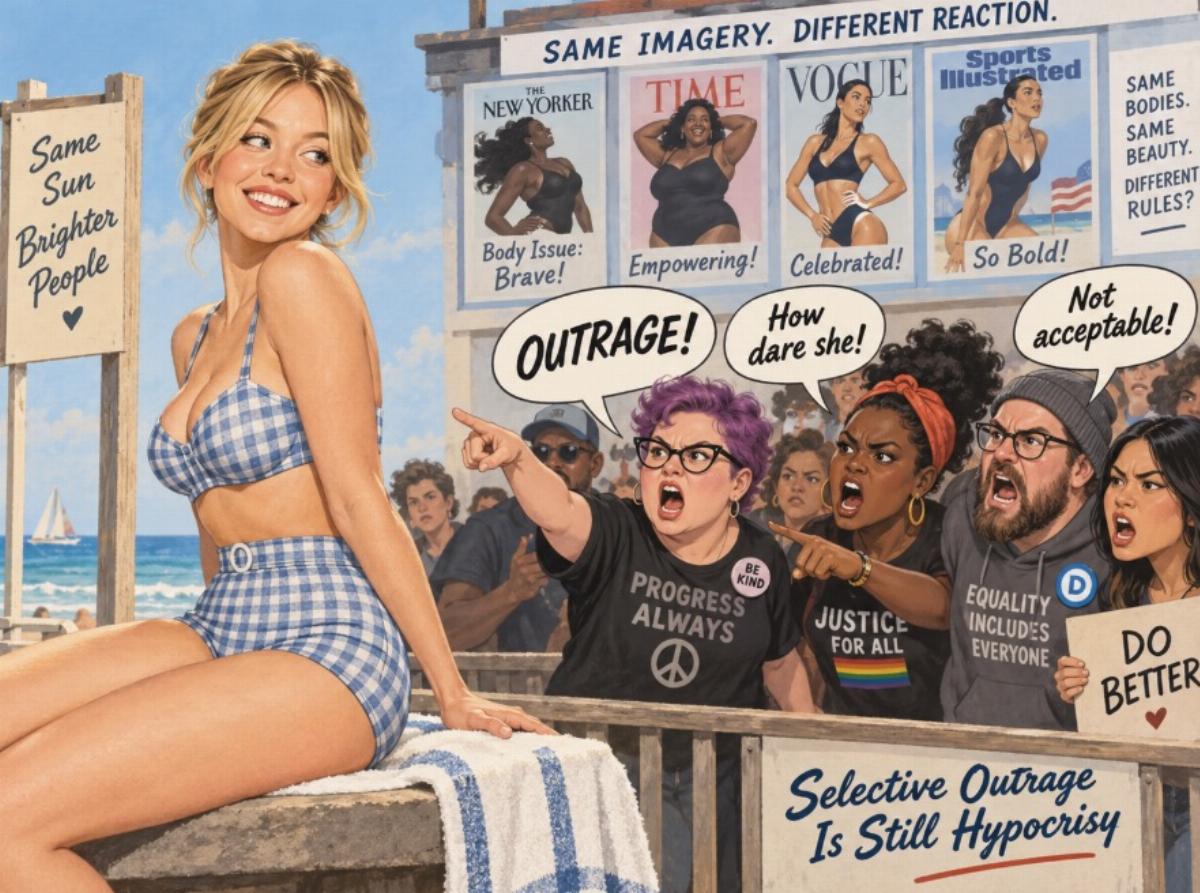
The latest culture-war flare-up revolves around Sydney Sweeney and a sports betting app. In a piece for American Thinker, columnist Andrea Widburg argues that the backlash to Sweeney’s cheeky advertisement for Novig isn’t about protecting women or sports — it’s about which women the left has decided are allowed to be sexy.
Widburg opens with a blunt assessment: the outrage industry has found its newest target in an ad she describes as “cheeky (literally)” for the betting platform. The charge from critics, she says, is that Sweeney is sexualizing women in sports. Her counter is that the feminists leading the charge don’t actually object to sexualization in principle. What bothers them, in her telling, is that Sweeney refuses to politicize everything — she treats her sexuality as entertainment rather than as a battleground, more in the mold of a 1950s screen goddess than a knowingly subversive statement.
The road from American Eagle to Novig
This isn’t the first time Sweeney has found herself at the center of a political food fight. Widburg reminds readers of the earlier American Eagle campaign built around Sweeney’s genes — a massively successful spot that, according to the columnist, Democrats insisted was an advertisement for white supremacy. That episode escalated, she writes, when Sweeney declined to apologize and issue what Widburg characterizes as a ritual political denunciation of everything conservative.
Now Sweeney has returned with a new spot that Widburg calls far cheekier and chestier than the last. The columnist flags it with a content warning for readers who don’t care for coyly suggestive material, then moves to the reaction: one woman, identified in a social media post as @megan_feringa, lamenting that the ad sets women back decades — while, in the same breath, recalling having cried uncontrollably over a tampon commercial. Widburg also shares a social media post mocking the “journalists” writing hit pieces on Sweeney, suggesting they lack the star’s old-fashioned sex appeal.
The hypocrisy argument
That’s the setup. The heart of Widburg’s column is a hypocrisy charge, and she builds it historically. There was a time, she writes, when leftists had no problem at all with coyly hidden naughty bits. Her first exhibit is the 1999 film Austin Powers: International Man of Mystery, which ends with Mike Myers and Elizabeth Hurley enjoying their honeymoon. Widburg notes that no clips of the scene are readily available, so she leans on a 2008 Slate piece by Jack Shafer, which she cites at length. Shafer described the sequence in detail: strategically placed pineapples and melons hoisted to chest level just in time, a pink phallic balloon serving double-entendre duty as Myers’ character’s anatomy, the camera framing the newlyweds so the gag lands. People across the political spectrum loved it, Widburg writes.
Nearly a decade later, she continues, the same aesthetic still had fans. She points to an April 2008 New York Times essay about a nude resort, which ran two photos hinting at nudity without showing it. Shafer, she notes, was even more taken with additional Times content that is no longer available online — a section cover photo by Adriana Zehbrauskas that relied on well-placed appendages and props: a foot conveniently positioned here, an arm lifted to block a nipple there, an umbrella pole doing the work of a bikini top, a swoosh of water covering a volleyball player’s backside. Widburg quotes Shafer’s enumeration of the near-misses, including his admission that he had to strain his eyes to spot the one apparent slip.
And leftists loved it, she writes — citing the photographer’s claim, per the Times’ director of photography, that the piece was the most successful online article in the newspaper’s history.
When the athletes did it
Widburg anticipates an objection: perhaps those examples don’t count because they aren’t from the sports world. So she pivots to sports. Her lead example is Megan Rapinoe, whom she describes as an arch feminist and aggressively out lesbian, who posed nude with Sue Bird on the cover of ESPN The Magazine. The reaction then? Celebration, Widburg writes. She shares a social media post making the same point: that the same people losing their minds over Sweeney’s covered Novig ad had no problem when Serena Williams, Ronda Rousey, Megan Rapinoe and Sue Bird posed fully nude for ESPN’s Body Issue. That, the post said, was “celebrating the athletic form.” Sweeney’s spot is “sexualizing women’s sports.”
Even the language of bodily autonomy gets conscripted inconsistently, in Widburg’s reading. She quotes another social media post arguing that “My body, my choice” apparently doesn’t apply to all women, and expressing dismay that feminism would criticize Sweeney while showing no outrage over female athletes who, in that poster’s framing, had to resort to posing nude to get their stories on a cover.
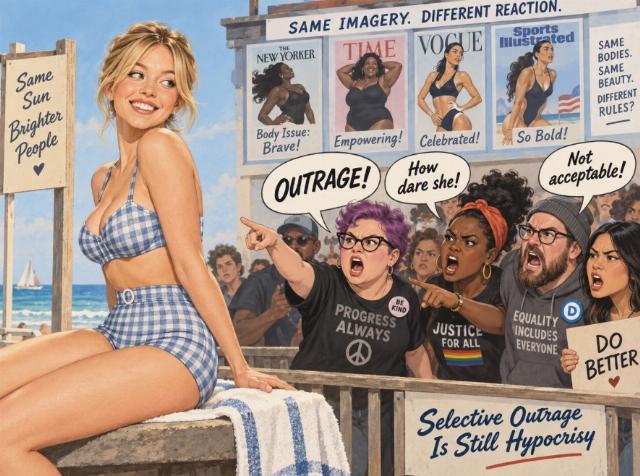
The conclusion Widburg draws is that the objection was never to coy nudity or naked athletes as such. It is, she writes, the perennial Democratic insistence that “it’s different when we do it.”
A fixed principle, or just a tool?
To sharpen the point, Widburg invokes Dan Bongino, whom she credits with a long-running observation: he never finds himself dancing around to defend a Republican for conduct he condemned in a Democrat, because his principles are fixed and apply equally. She quotes him: “I will live by the same rules I ask you to live by.”
For Democrats, she writes, hypocrisy isn’t the tribute vice pays to virtue, as François de La Rochefoucauld once put it. For people whose only fixed principle is state power, hypocrisy is simply another tool in the box. And that, she concludes, is why what’s acceptable for every leftist is somehow not acceptable for Sydney Sweeney.
What the column actually argues
Stripped to its core, Widburg’s piece is a selective-outrage argument with a partisan frame. She isn’t defending suggestive advertising as such, nor is she making a case about gambling apps or the ethics of sports betting marketing. Her claim is narrower and more pointed: that the same cultural gatekeepers who celebrated Austin Powers sight gags, applauded a New York Times photo spread built on strategically placed props, and cheered nude ESPN Body Issue covers from Serena Williams, Ronda Rousey, Megan Rapinoe and Sue Bird have suddenly discovered a moral objection now that the subject is Sweeney.
Readers will bring their own priors to that framing. Some will see a fair hit on inconsistency. Others will note that the column treats “the left” as a single actor with one set of tastes and one strategy, and that the historical examples span different outlets, decades and contexts — an Austin Powers gag, a newspaper feature, a sports magazine institution, and a paid advertisement are not obviously the same category of speech. Whether the comparison lands depends on how much weight one gives to the consistency test Widburg is applying.
What’s not in dispute is the sequence she describes: an American Eagle campaign that became a political controversy, a star who declined to apologize, a new betting-app ad, and a fresh round of criticism. The argument over what that sequence means — principled concern or convenient outrage — is the one Widburg is trying to settle, and the one her critics will keep contesting.
Source: www.americanthinker.com — https://www.americanthinker.com/blog/2026/09/regarding-the-sydney-sweeney-ad-the-left-used-to-like-coyly-selective-nudity/