
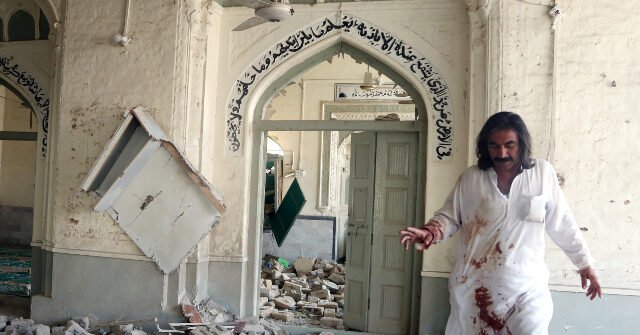
A suicide car bombing at a mosque inside a police compound in northwestern Pakistan killed 27 people on Friday, according to Breitbart News, which reported that six civilians and 15 police officers were among the dead. The attack, in the city of Kohat in Khyber Pakhtunkhwa province, was followed by a gun battle between terrorists and police at the local police station.
The bomber drove a vehicle packed with explosives through the entrance of the mosque attached to police headquarters, roughly 45 miles from the Afghan border. The mosque was full for Friday prayers, and many of those inside were police officers and their relatives.
Local sources told Al Jazeera that at least 75 people were wounded, most of them worshippers. In addition to the civilian and police fatalities, at least six of the attacking gunmen were killed, according to the Breitbart report.
A coordinated assault
After the bomb detonated, a squad of gunmen attacked the police station, where officers returned fire. The sequence—a bombing followed by an armed assault on a security installation—mirrors previous attacks in the region, where militants have targeted police and military sites during times of heightened activity.
Responsibility was claimed by a group calling itself Ittehadul Mujahideen, which has been linked to Tehrik-e-Taliban Pakistan (TTP), the Pakistani Taliban. Both Prime Minister Shehbaz Sharif and President Asif Ali Zardari blamed the TTP itself for the attack.
Zardari said the “complete elimination of Fitna-al-Khawarij, and terrorists operating with foreign backing, is essential for national security,” using a term the Pakistani government employs to describe the TTP. The Interior Ministry added that “the cowardly actions of the Kharijites cannot weaken the nation’s steadfast resolve,” and expressed solidarity with the families of the victims. The phrase “Fitna al-Khawarij” refers to an early Islamic sect known for extreme violence, and is widely understood as a government attempt to brand the TTP as barbaric.
Cross-border tensions flare
Pakistan has accused the Afghan Taliban of harboring—or even assisting—TTP fighters who are seeking to topple the Islamabad government and establish an Islamist “caliphate” modeled on the Taliban’s rule in Afghanistan. Pakistani officials say the rising tempo of attacks in Khyber Pakhtunkhwa is a direct result of that support.
The two sides have clashed sporadically along the border as relations have deteriorated over the past few years. On Friday, Taliban spokesman Zabihullah Mujahid warned Pakistan against launching further military action in response to the mosque bombing.
Mujahid said the TTP and other militant groups have operated in the Pakistani border region for years, and denied that the Afghan Taliban supports them or offers them safe haven on Afghan soil. He threatened immediate retaliation if Pakistan conducts cross-border attacks targeting the TTP, and appealed to Saudi Arabia to help mediate the dispute.
Pattern of violence
Friday’s bombing is the latest in a string of attacks that have shaken Khyber Pakhtunkhwa, a province that borders Afghanistan and has long been a flashpoint for militant activity. Police and military targets have been frequent objectives, and mosques within security compounds have been hit before—making Friday prayers a particularly vulnerable time.
The attack also underscores the complicated web of militant affiliations in the region. While Ittehadul Mujahideen claimed responsibility, Pakistani officials immediately pointed to the TTP, which has waged a years-long insurgency against the state. The TTP’s relationship with the Afghan Taliban has been a persistent source of friction between Islamabad and Kabul.
For now, the immediate aftermath is focused on the dead and wounded, and on whether the Taliban’s warning will deter Pakistan from responding militarily. The appeal to Saudi Arabia suggests both sides may be looking for a way to avoid a wider conflagration, even as the rhetoric remains sharp.
Source: www.breitbart.com — https://www.breitbart.com/asia/2026/09/18/suicide-bomb-attack-pakistan-mosque-kills-27/