
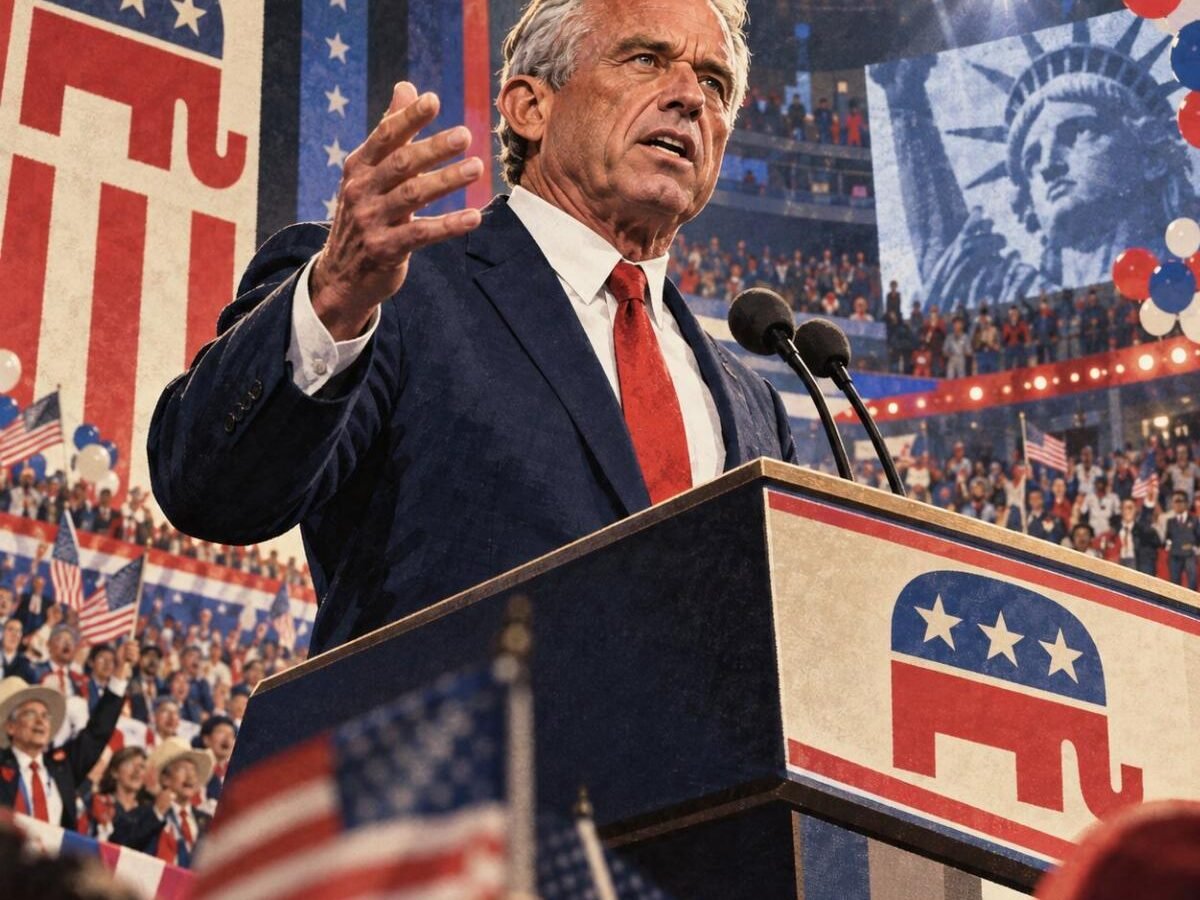
Robert F. Kennedy Jr. never expected to stand at a Republican convention. At 72, the Health and Human Services secretary told the crowd at the first-ever midterm Republican National Convention in Dallas that his first political convention was as a six-year-old at the Democratic gathering in 1960. For decades afterward, he was a fixture at blue events — a natural role for the nephew of President John F. Kennedy and the son of Senator Robert F. Kennedy, both assassinated while in office.
His appearance in Dallas this month is the subject of a new American Thinker commentary by Joseph Ford Cotto, who argues that Kennedy’s speech offers Republicans a template for surviving a midterm cycle that most public indicators currently show tilting against them.
The case Kennedy made
According to Cotto’s account, Kennedy used the speech to catalog what he sees as the Democratic Party’s transformation. He described a party that, during COVID-19, defended ideologically captured “science,” censored doctors, and stripped him of his social-media accounts within hours of President Joe Biden taking office. He pointed to churches locked down while liquor stores stayed open, drug companies shielded from juries, and three million businesses shuttered without due process.
Kennedy also argued that Democrats imposed medical disclosures he considers Fourth Amendment violations, mandated masks and shots that he says mocked the slogan “my body my choice,” and silenced mothers reporting vaccine injuries. In his telling, the party wrecked Title IX, dismissed meritocracy outright, and reduced its platform to what he called a “sociopathic” hatred of Donald Trump — turning government into what Cotto describes as a predatory machine that lost hundreds of billions of dollars and enabled child trafficking.
Neither his father nor his uncle would recognize the modern Democratic Party, Kennedy said. The real divide, in his framing, is sanity versus insanity, common sense versus communism.
From ballot battles to an endorsement
Cotto walks through Kennedy’s path from Democratic presidential candidate to Republican cabinet member. Kennedy launched his Democratic primary bid on April 19, 2023, then quit the party that October after the Democratic National Committee stacked the rules against challengers, in Cotto’s telling. His campaign collapsed, Cotto writes, because Democrats no longer trust their own voters — suing him off ballots, canceling primaries, and rigging the nominating process to install Vice President Kamala Harris.
The pivot point came after the assassination attempt on Trump in Pennsylvania. Kennedy spoke with Trump and, per Cotto’s account, discovered that the hostile media portrait was a lie. They found shared ground on drug prices, farmers, working Americans, law and order, ending corporate capture of regulators, and chronic disease. On August 23, 2024, with help from the late Charlie Kirk, Kennedy endorsed Trump. Harris, Cotto notes, never returned his call.
Two years on, Cotto credits Trump with keeping every promise: real-food sales up 8% in 2025, processed-food consumption down, obesity falling 7% after four decades of increase, and preliminary Centers for Disease Control data showing the 30-year decline in American longevity reversing.
The voters who decide it
The reason the speech matters, Cotto argues, is that it speaks directly to Obama-Trump voters — the Americans who backed Barack Obama and then switched to Trump. Surveys including the American National Election Study and the Cooperative Congressional Election Study put their number between 6.7 million and 9.2 million, accounting for 10% to 14% of Trump’s 62.9 million votes in 2016.
These voters were generally, though far from exclusively, white, working-class, without college degrees, and clustered in Midwestern counties hit hard by industrial job losses. They wanted jobs protected, saw tariff-free trade as a threat, and viewed immigrants as economic competitors. Ten years ago, Cotto writes, 206 pivot counties that twice went for Obama flipped to Trump, producing 51% of the national Democratic popular-vote-margin collapse. Those conversions delivered Michigan, Pennsylvania, and Wisconsin, probably secured Iowa and Ohio, and arguably helped shift Florida red.
But Republicans cannot take them for granted in 2026. Their enthusiasm, Cotto warns, is far stronger for Trump than for the down-ballot GOP ticket, and the same blue-collar, non-college pattern still decides close races. Longtime Republican voters need to understand that courting these less ideologically conservative but electorally essential Americans is not optional. In a razor-thin cycle, Cotto calls it political survival.
A realignment in one person
Kennedy, born January 17, 1954, the third of eleven children of Robert and Ethel Kennedy, grew up steeped in Democratic loyalty. He endorsed Hillary Clinton in 2008, spoke at the 2004 Democratic convention, campaigned for Obama, and backed Clinton again in 2016. After aligning with Trump, some family members called him a betrayer; voters who wanted results, Cotto writes, called him a statesman. His endorsement brought crucial votes to Trump, contributed mightily to Harris’s defeat, and led to his current post.
With the November 3 midterms mere weeks away, Cotto surveys a tight and unforgiving map. Larry Sabato’s Crystal Ball rates the House 210 seats at least leaning Democratic, 203 at least leaning Republican, and 22 toss-ups. The Senate stands 48 at least leaning Republican, 47 at least leaning Democratic, and 5 toss-ups. Eight recent House rating changes all moved toward Democrats, and even some double-digit Trump districts have been downgraded. Generic-ballot averages show Democrats leading well outside the margin of error — though Cotto notes polling grows less accurate over time.
If Democrats capture either chamber, Cotto argues, they will spend two years crippling the Trump administration and kneecapping every Republican running in 2028. He describes the party from city hall to Capitol Hill as captured by young activists who call themselves democratic socialists and carry what he calls an openly anti-Western, anti-white, anti-Semitic current. Their goal, in his rendering, is to bleed America of capital so non-Westerners, especially Muslims, can gratify themselves with collective revenge. Pretense otherwise, he writes, is self-delusion.
The MAHA variable
Cotto sees Kennedy’s Make America Healthy Again movement as already decisive. He points to enthusiasm in Virginia, North Carolina, Tennessee, Kentucky, and Georgia, and to MAHA PAC-endorsed Congresswoman Julia Letlow defeating Senate Health Chairman Bill Cassidy in Louisiana. He also cites Zach Lahn beating a Trump-endorsed rival for the GOP gubernatorial nomination in Iowa while campaigning against pesticide shields and nitrate pollution. MAHA PAC launched a $100 million effort in March.
Nearly all of the Democrats, ex-Democrats, and independents receptive to that message are health-focused crossover voters. Cotto’s argument is that as long as they are addressed with substance, they will likely vote Republican, because health is their top issue and Kennedy’s record is real. His closing appeal is blunt: Republicans of every stripe should vote in November, because lower obesity, longer lives, cheaper drugs, and safer streets are all on the ballot — and all would be targeted for elimination if the other side seizes Congress and key statehouses. Democrats, he concludes, will not govern. They will sabotage.
Source: www.americanthinker.com — https://www.americanthinker.com/articles/2026/09/rfk-jr-shows-how-republicans-can-win-the-midterms/