
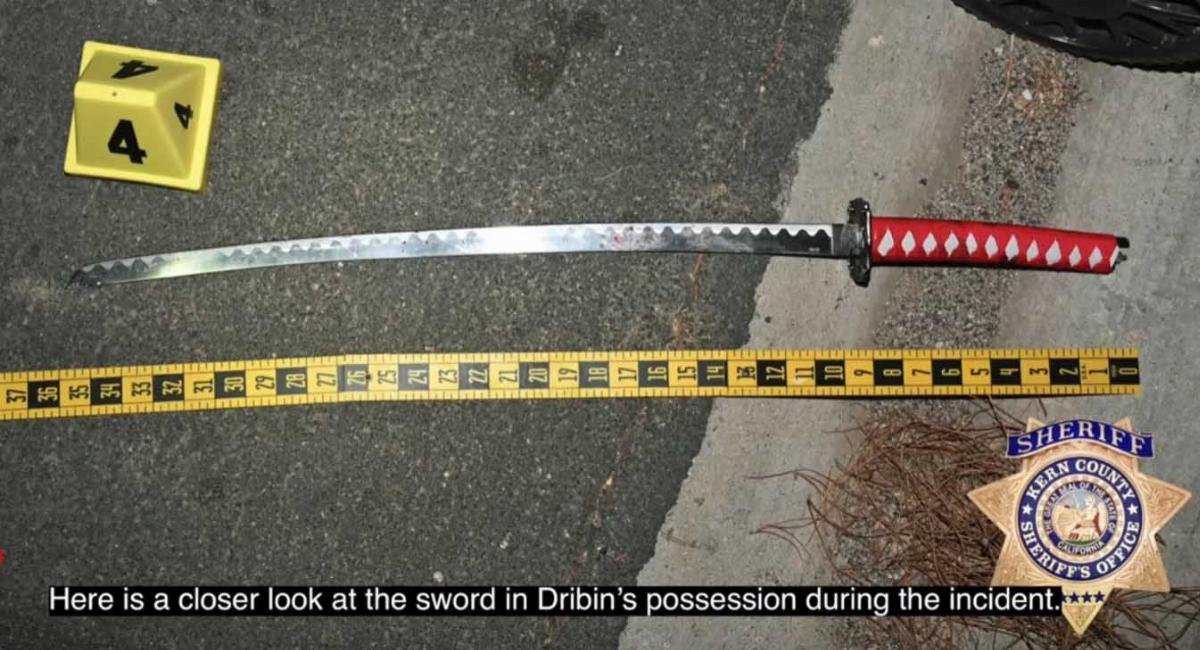
The question that tends to surface whenever an officer shoots someone who wasn’t carrying a firearm is some version of: why lethal force for that? In a blog post for American Thinker, Mike McDaniel uses a recent confrontation in a California desert community to argue that the answer is more straightforward than a lot of people assume — and it has nothing to do with the price tag or the category of the weapon involved.
McDaniel, who writes from the combined vantage points of a retired police officer and a lifelong practitioner of Japanese and European fencing, is upfront that he isn’t a lawyer or a judge. His framing is practical: the lawful use of deadly force hinges on whether a reasonable person would believe they face an imminent threat of serious bodily injury or death, to themselves or to someone else. Notice, he writes, what that standard doesn’t include — a list of approved weapons.
What the footage reportedly shows
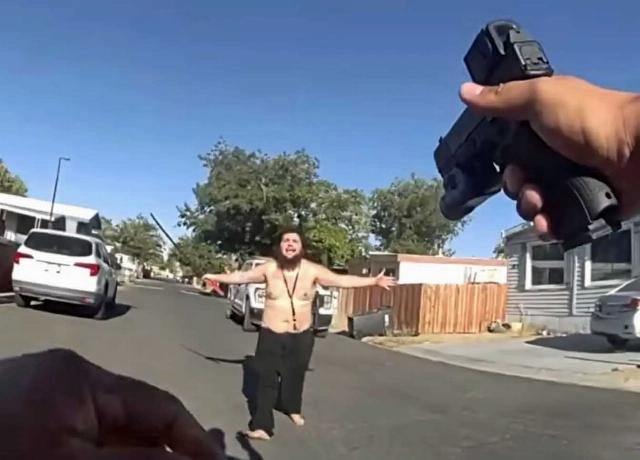
The incident McDaniel describes began as a routine neighbor dispute. A 22-year-old man, identified as Joshua Dribin, was reportedly furious about a neighbor who kept revving his truck while Dribin was trying to sleep. By the time a deputy arrived, Dribin was explaining that he had already asked the neighbor to stop and the noise hadn’t.
The deputy tried to talk him down. It didn’t work. According to the account, Dribin could be heard from inside his house saying he was going to “take care of it,” and the deputy attempted to reassure him that he would speak with the neighbor himself. Instead, the situation escalated, with Dribin reportedly shouting that he was tired of being woken up and that he was “going to go kill him now.”
The deputy radioed that Dribin had a sword. Moments later, Dribin emerged carrying the blade and, per the account, charged at the deputy while yelling at him to shoot. The officer fired. Dribin was wounded and taken to a hospital.
The sword question
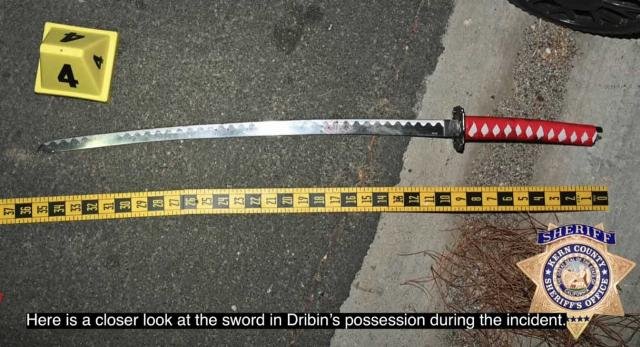
A significant portion of McDaniel’s argument is devoted to dismantling the assumption that a sword is somehow a lesser threat than a gun. The katana in the video, he acknowledges, looks like a cheap one. That detail, he contends, is largely irrelevant. Even an inexpensive sword can produce fatal wounds with a single cut or thrust.
He goes further on the distance question. At the ranges where most gunfights actually happen — closer than many people imagine — McDaniel argues a katana is “easily as deadly as handguns and essentially as fast.” That last claim carries particular weight for anyone accustomed to thinking about edged weapons as a secondary concern. His point is that the comparison isn’t edge versus bullet, but reaction time versus ground covered. And he adds that one doesn’t need to be highly skilled with a sword to inflict lethal damage — a qualification the average observer, watching from the outside, has no way to assess in the moment anyway.
The broader principle he lays out applies well beyond bladed weapons: guns qualify at essentially any range, knives at 21 feet or more, swords at greater distance still. But size, age, gender and strength disparities matter too, as does sheer numbers. He notes that he’s trained and experienced, and that at 72 he would be foolish to take on a 20-year-old bare-handed. A single person with a handgun, meanwhile, can be overwhelmed by multiple unarmed attackers.
Baseball bats, sticks, rocks, screwdrivers, power tools, motor vehicles — anything capable of causing serious bodily injury or death falls into the same analytical bucket, if the person wielding it demonstrates a threat that is happening right now rather than one that might materialize later.
Applied to the Kern County episode, McDaniel walks through the elements as a checklist. Did Dribin demonstrate intent to cause serious bodily injury or death? In McDaniel’s reading, absolutely. Did he have the means? Yes. Was he close enough for that means to be effective? Yes. Would a reasonable person watching the deputy’s body camera conclude Dribin represented an imminent threat? McDaniel’s answer is that there’s no question about it.
Why not a Taser
The most predictable objection to any police shooting — why not something less lethal first? — gets its own treatment. McDaniel points to the video’s timeline, arguing the deputy simply had no time. Tasers and pepper spray, he notes, frequently fail, and pepper spray especially so. Two steps, less than a second, and Dribin would have been within striking distance. Even if the deputy had fired, McDaniel suggests, momentum could plausibly have carried the blade into him anyway.
His one note of criticism, and it is a mild one, is that the deputy arguably let Dribin — who charged twice, according to the account — get too close in the first place.
McDaniel also touches on the avoidance question. It is always preferable to sidestep a confrontation, and if retreat is an option, he advises taking it. But it isn’t always possible or wise, and stand-your-ground principles apply in this context as well.
His conclusion is that the deputy acted fully within both the law and common sense — “the devil is always in the details,” he writes, but in this case the details line up on the officer’s side.
A recurring debate
The piece lands in territory that tends to generate more heat than light whenever a police shooting involves something other than a firearm. Critics of such shootings often proceed from the premise that a gun on one side and anything else on the other represents a mismatch so lopsided that lethal force can’t be warranted. McDaniel’s counter is that this premise misunderstands the standard, which is built around the threat a reasonable person perceives, not around a ranking of weapons by category or cost.
Whether that framing satisfies skeptics of police use of force is another matter. McDaniel isn’t making a case about policy reform, training standards, or departmental accountability. He’s making a narrow legal and practical argument about one incident, using his own background in swordsmanship to supply the part most readers are least equipped to evaluate on their own: what a katana at close range can actually do to a human being.
And on that point, his assessment is unhedged. Cheap or expensive, the weapon in the video was capable of killing, and the man holding it had already said what he intended to do with it.
Source: www.americanthinker.com — https://www.americanthinker.com/blog/2026/09/a-california-deputy-faces-a-katana/