
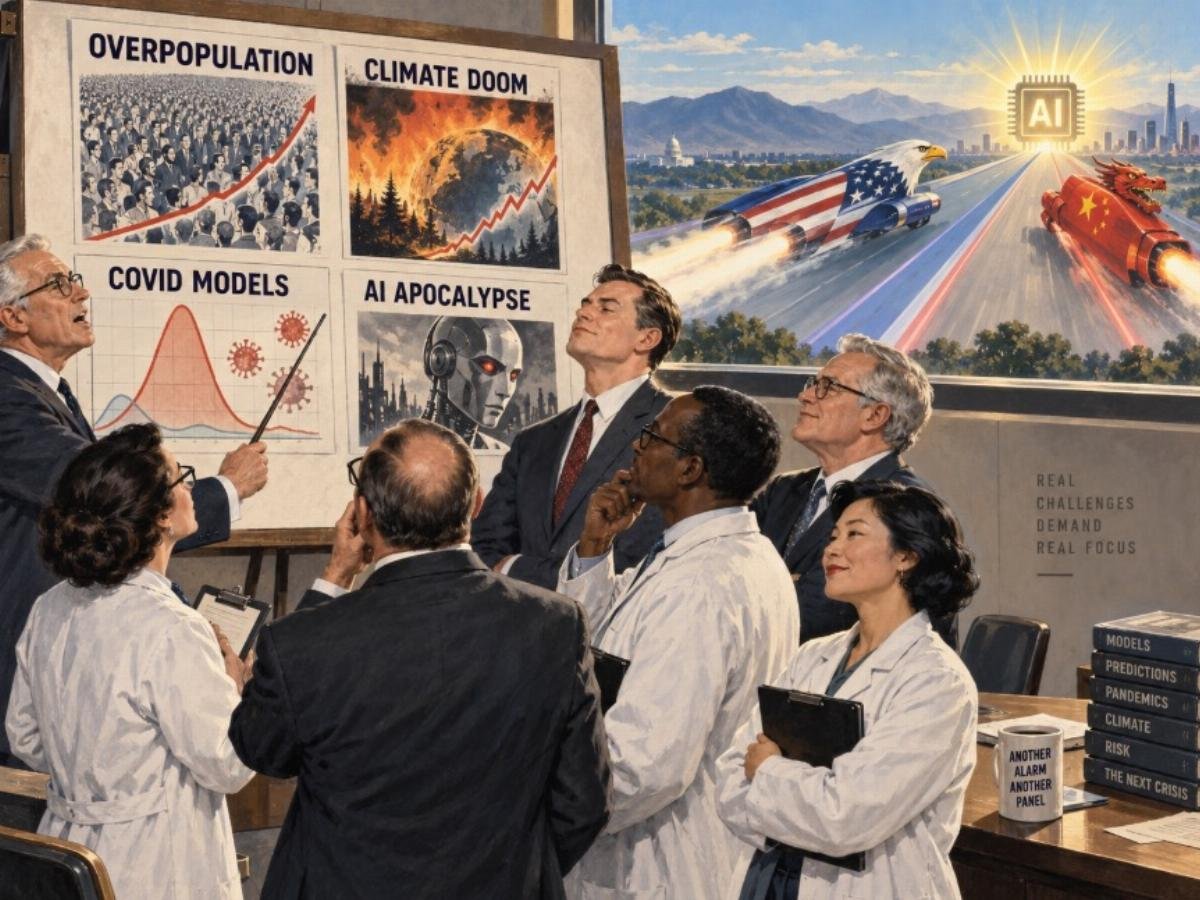
For more than fifty years, self-described experts have told Americans that civilization was about to collapse. The famines never came. The population bomb never detonated. The climate deadlines slipped past. Now, writes Christian Vezilj in a September 19 column for American Thinker, the same pattern is repeating itself — this time aimed at artificial intelligence.
Vezilj’s argument is straightforward: the experts hawking AI extinction have a track record problem, and that track record deserves more scrutiny than it is getting.
A half-century of confident, wrong forecasts
The column walks through several eras of failed prediction. In the 1970s and 1980s, books like The Population Bomb warned of hundreds of millions of deaths, global famine, and civilizational collapse, with governments urged to impose population controls and some experts predicting developing nations would become uninhabitable. None of it happened, Vezilj notes. Agricultural innovation dramatically increased food production, fertility rates fell worldwide as nations modernized, and human ingenuity — not expert panic — shaped the outcome.
Climate predictions get similar treatment. Over the last fifty years, Vezilj writes, experts offered a string of confident timelines that never materialized. He concedes the underlying issue remains important, but argues the catastrophic timelines were “wrong, often shaped more by political urgency than scientific certainty.”
The COVID era, in his telling, produced the most dramatic failures of modern expertise. Models projected millions of U.S. deaths. Experts claimed vaccines would stop transmission entirely — they did not. Others insisted natural immunity did not exist — it did. Predictions about school openings, mask mandates, and economic collapse shifted weekly. These were not minor errors, Vezilj argues, but massive miscalculations delivered with absolute confidence, and the public watched institutions contradict themselves, politicize science, and punish dissent.

His diagnosis: experts fail because they lean on rigid models, political incentives, and emotional narratives instead of humility and logic.
The new apocalypse, same as the old
That history matters, Vezilj writes, because several CEOs and employees from major AI companies have recently warned that artificial intelligence could lead to human extinction within a decade — warning of runaway systems, loss of control, and civilization-ending consequences. In his framing, the warnings are dramatic, emotional, and delivered with the same unearned confidence as every prior round of expert doom.
Which raises the question he puts at the center of the piece: what reassurance is there that these experts are right now, when so many experts were wrong before? His answer — we don’t have any, and skepticism is not just reasonable but responsible.
Vezilj then pivots to geopolitics. Frontier AI development, he argues, is effectively a two-nation race. Only two countries have the resources, capital, and technological infrastructure to lead, and while outliers like Taiwan hold a grip on semiconductors, no other nation has the compute power, semiconductor capacity, or investment ecosystem to compete at the highest level. The United States, he writes, is currently leading.
That matters because of what the two competitors represent. America, in his description, is built on freedom, innovation, and individual rights; China on censorship, surveillance, and state control. The question he poses to readers is simply: whom do you want leading the AI race?
Why the sudden calls to slow down?
Against that backdrop, Vezilj finds the sudden push from some AI CEOs to “slow down” suspicious rather than prudent. If the United States decelerates while China accelerates, the advantage shifts. History, he writes, shows experts can be influenced — by politics, ideology, personal gain, or external pressure.
He points to a split within the industry itself. Some AI leaders warn of extinction. Others, including NVIDIA CEO Jensen Huang, say those predictions are not grounded in reality. President Donald Trump, according to the column, recently said slowing AI development would benefit China and that America must keep advancing to maintain leadership.
Vezilj then raises what he calls geopolitical logic rather than conspiracy theory: whether China benefits from shaping American public opinion. If Americans fear AI, they may support policies that slow development at home, while China — an authoritarian state with no public debate — can accelerate without restraint. A slower America, he concludes, is a stronger China, and experts can be manipulated, influenced, or incentivized to support narratives that benefit foreign powers.
Caution is wise, surrender is not
The column’s closing argument is that AI technology is not going away regardless of how loud the warnings get. It is advancing rapidly, and the nation that leads will shape global power, economics, military capability, and human freedom for the next century. The United States, in Vezilj’s view, must lead rather than retreat — because only America has the values, institutions, and freedoms to ensure AI benefits humanity rather than controls it, an assurance he says China cannot provide.
His final jab is aimed at the doomers themselves: if some CEOs believe in slowing down, they should start with themselves. But America, he argues, must keep moving forward — because only the United States can ensure AI becomes a force for good rather than a tool of tyranny.
Whether or not readers share Vezilj’s geopolitical framing, his piece lands on a durable point about expertise and prediction. The experts have been wrong before, loudly and repeatedly. That does not automatically make them wrong now. But it does mean the burden of proof runs the other way — and in the AI debate, as in the population and pandemic debates before it, that burden is worth watching closely.
Source: www.americanthinker.com — https://www.americanthinker.com/articles/2026/09/ai-doomerism-and-the-experts-uncanny-knack-for-getting-things-wrong/