
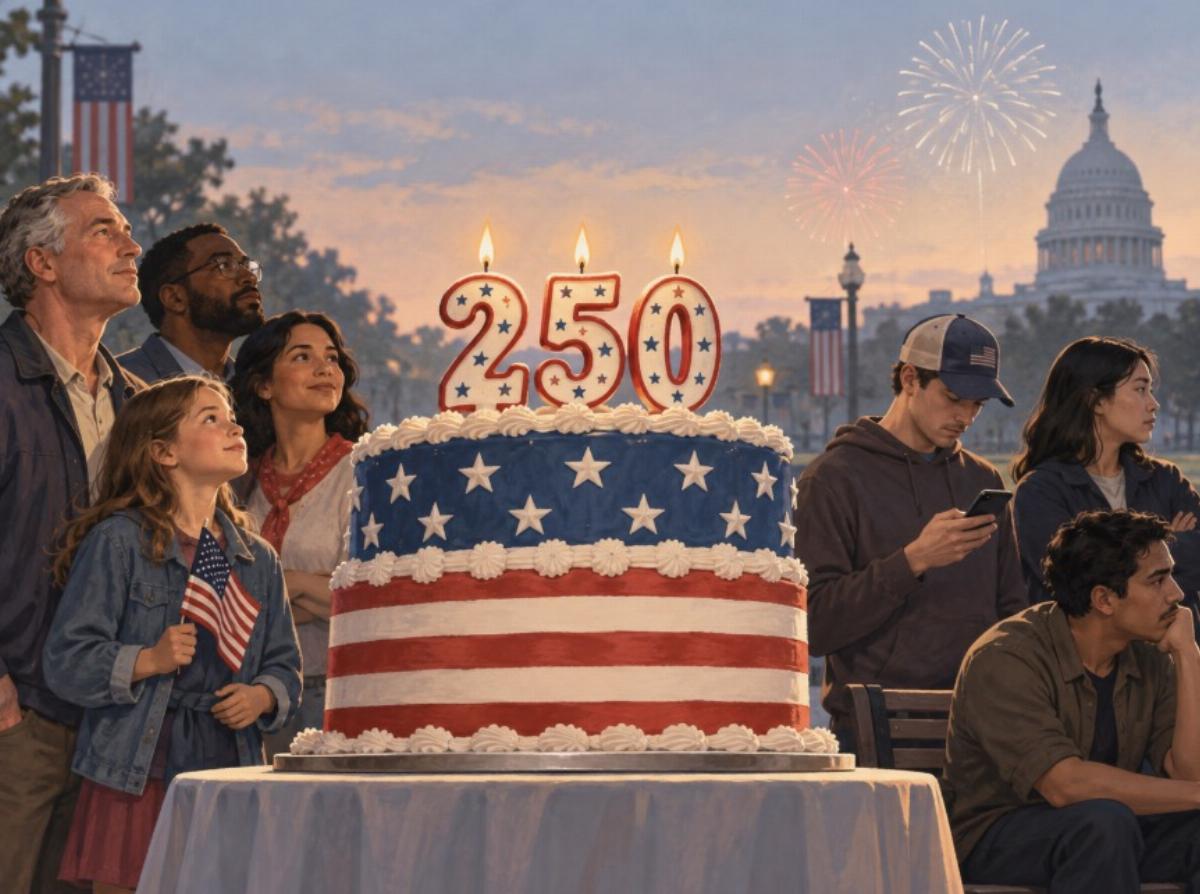
America turned 250 this year, and by most accounts, the country barely noticed. That’s the argument Joseph Ford Cotto makes in American Thinker, and it’s a harder claim to dismiss than it first sounds.
Cotto isn’t talking about the fireworks that did go off, the official ceremonies in Washington that did take place, or the flags that still flew in small towns across the country. He’s pointing to something less visible: the speed with which a nation can lose the instinct to think of itself as one people.
The Bicentennial, Revisited
To make his case, Cotto reaches back fifty years. In 1976, the bicentennial was a genuine national event — tall ships in New York Harbor, a record-setting flag suspended from the Verrazano-Narrows Bridge connecting Staten Island and Brooklyn, wagon trains retracing pioneer trails, schoolchildren memorizing the Declaration of Independence.
Television did its part. CBS aired Bicentennial Minutes. Schoolhouse Rock’s “America Rock” segments became a generational touchstone. The merchandise was inescapable: stamps, coins, mugs, plates, even commemorative toilet paper. And after dark, block parties brought Republican and Democratic neighbors together — this despite Watergate, the long shadow of Vietnam, stagflation, and a rising distrust of institutions.
“The bicentennial was a big deal,” political analyst Keith Preston told Cotto on his current-events program, News Sight. “I remember news coverage of it being everywhere, people talking about it everywhere, banners and stickers and all that kind of stuff.”
Fifty years later, Preston says, that energy is simply gone. He acknowledges the commemorative events, the ceremony in Washington, but calls it “nothing even remotely on the level of what the bicentennial was 50 years ago.”
Cotto is blunt about the cause: this isn’t a failure of programming. It’s a failure of civic life.
The Numbers Behind the Mood
The polling Cotto cites paints a stark picture. CNN, he notes, branded the anniversary the “big birthday blahs.” Nearly 70 percent of Americans say they’re dissatisfied with the country’s direction, and roughly 60 percent believe the nation’s best years are behind it. Only about half describe themselves as extremely or very proud to be American — a 25-year low. More than three in four say the Founding Fathers would be disappointed in what the country has become.
The partisan gap is where things get especially sharp. An NPR/PBS News/Marist poll found more than 90% of Republicans proud or very proud to be American, compared with just 45% of Democrats. Cotto reads that split as an indictment of contemporary leftism, which he argues taught a large share of the country to treat the flag as a right-wing prop.
Preston, whose roughly 25-year-old news-and-commentary site has hosted voices across the political spectrum — paleoconservatives, Marxists, libertarians, anarchists — frames it differently: not as one side’s failure but as a collapse of any shared story. “There’s a decline of an accepted unitary narrative about what it means to be American, what the American history represents, what American values actually are,” he told Cotto. “I don’t think anybody really agrees on what those values are.”
The 1619 Question
Cotto identifies the 1619 Project as the moment the fracture became undeniable. If 1619 — the arrival of the first enslaved Africans in the British colonies that would become the United States — is the “real” founding, then 1776 isn’t a birth. It’s a cover story. That reframing, in Cotto’s telling, is what makes a shared commemoration impossible.
Preston adds a media dimension. In 1976, he notes, “everybody was getting their news from these basic television channels and also from reading the daily newspapers.” Today’s information environment is fragmented beyond repair, and the result is a fragmented culture in which people no longer share even the basic facts of the national story.
Cotto points to coverage choices as further evidence. Readers of The Plain Dealer in Cleveland, old enough to remember 1976, described the 2026 mood as funereal — sad, angry, embarrassed, afraid. Several said the flag now feels politically loaded. The Los Angeles Times, per Cotto, treated America 250 as a dud next to the bicentennial’s years-long blowout. NPR, he writes, framed the official Washington events as President Donald Trump’s pageantry while presenting left-wing counter-programming as a stand for “equality and democracy” — which Cotto calls a refusal to celebrate the country on its birthday.
Tribes, Not a Nation
The structural forces Cotto identifies are familiar to anyone who’s been paying attention: mass immigration after 1965 shifting the cultural baseline, generational turnover erasing public memory, downward economic mobility sapping enthusiasm for capitalism, and political parties hardening into rigid packages rather than broad coalitions.
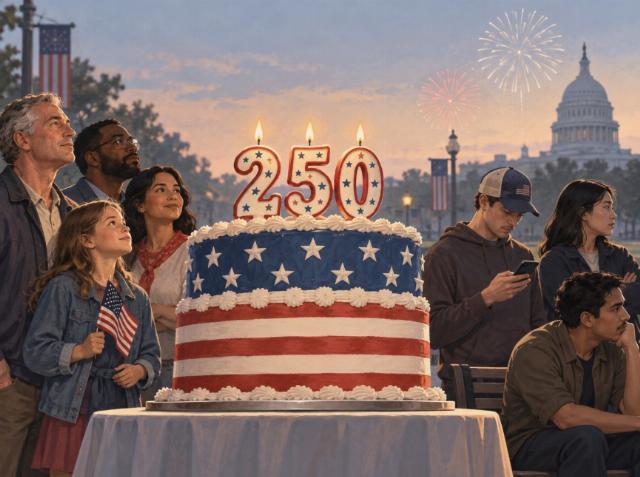
Negative partisanship, he argues, now does more work than shared identity. Politics has become a substitute church. “Increasingly you have a lot of people for whom their political identity defines every aspect of their life,” Preston said. “It’s almost like it’s their religion.”
Where does traditional patriotism survive? In the places it always survives when a culture thins, according to Cotto: rural communities, older Americans, Republicans. In many small towns, he writes, America 250 looked a lot like 1976 — the flag was just a flag, not a provocation. Elsewhere, the same flag reads as rightist aggression.
Preston offers a more measured read on the broader public: “I suspect that the majority of people in the United States are probably more indifferent to these things than the national mood might indicate.” But Cotto warns that indifference isn’t peace — it’s a vacuum, and vacuums tend to get filled by people with radical ideas.
Not a Breakup — a Drift
The future Cotto sketches isn’t a second 1976, nor a clean national divorce. Secession and the conflict it would bring, he argues, would wreck GDP and impoverish millions — and Americans, he notes dryly, hate inconvenience. What he sees instead is colder: the country keeps its name, its presidency, its Congress, its courts, its military, and its flag. Functionally, it drifts toward several countries under one roof.
Preston expects regional compacts of states and cities, more reliance on the 10th Amendment, and federal agencies nudged toward an advisory role. Red regions would still honor 1776; blue regions would treat it as a blight to overcome. Economic self-interest, not shared identity, would hold the shell together.
Cotto closes with a warning rather than a prescription. A republic, he writes, can survive debt, scandal, and ugly years. What it cannot survive is contempt for its own beginning. And increasingly, Americans no longer believe they belong to the same country as someone who votes differently — a flashing warning sign, in his view, about what comes next.
It’s an openly opinionated piece, and readers will bring their own priors to it. But the underlying data points — falling pride, rising dissatisfaction, a dramatic partisan split on whether the country is worth celebrating — aren’t in dispute. The question Cotto leaves hanging is whether anyone cares enough to look.
Source: www.americanthinker.com — https://www.americanthinker.com/articles/2026/09/america-250-proves-that-patriotism-is-vanishing/