
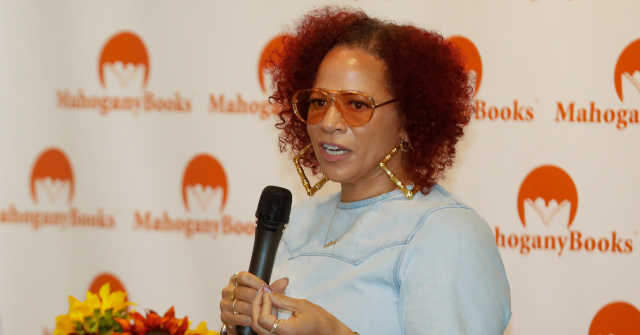
A new essay from Breitbart columnist John Nolte attacks Nikole Hannah-Jones, the journalist behind The New York Times Magazine’s 1619 Project, over her admission that she and her husband deliberately sent their only daughter to a low-income, predominantly Black school in an effort to improve it — a decision she now describes with regret.
The column, published in Breitbart’s education section, centers on passages from Hannah-Jones’s forthcoming book in which she recounts the experience of enrolling her daughter, Najya, in a school that she acknowledges wealthier families with options typically avoid. The article’s central charge is that Hannah-Jones elevated her political convictions above her child’s well-being, and that her eventual regret amounts to a tacit concession that her ideological framework was flawed.
The admissions at the heart of the criticism
According to the passages quoted by Breitbart, Hannah-Jones writes that when Najya was entering pre-K, she and her husband, Faraji, chose a “low-income and mostly Black” school, reasoning that their presence could help improve conditions “for all the children there.” Nolte seizes on that rationale as emblematic of a progressive approach to education that he characterizes as self-defeating, arguing that rewarding failure with continued enrollment ensures institutions never reform.
The quoted material goes on to describe warning signs that accumulated over several years. Hannah-Jones writes that toward the end of first grade, Najya began complaining that she disliked school and that lunch was chaotic; a visit during the lunch period left her mother shocked by what she described as a lack of adult supervision and children “running wild, chasing, hitting, and pushing each other” while aides and cafeteria workers looked on disengaged.
By fourth grade, which Hannah-Jones calls the worst year, she learned that her daughter was not performing at grade level in any academic subject and had been flagged at the start of the year as not a proficient reader. Checking her daughter’s math work, she discovered most answers were wrong — even though Najya believed math was her favorite subject and thought she was solving problems correctly because, in Hannah-Jones’s account, the teacher was not reviewing her work.
The most pointed moment comes in seventh grade, when Najya, now old enough to research her school online, encountered its poor test scores and asked her mother: “Did you know my school was bad like this when you decided to put me here?” Only then, Hannah-Jones writes, did she feel “overcome with regret,” adding that her daughter “deserved better” and that she, as Najya’s mother, “had not chosen her.”
A broader argument about ideology and family
Nolte’s column frames the episode as more than a personal parenting story. He contends that the decision was not an isolated misjudgment but the product of an ideological commitment that could not survive contact with the evidence of a single child’s declining academic trajectory. His stated conclusion is blunt: that doing what was best for her daughter would have required Hannah-Jones to admit her political beliefs were mistaken, and that family obligations should always supersede political projects.
To underscore the point, Nolte relates his own childhood experience in the mid-1970s, when his mother enrolled him in what he describes as a “special” school in a disadvantaged neighborhood. He writes that the school lacked a curriculum, that he was bullied — much of it racially — during his first semester, and that he learned nothing academic, though he eventually adapted. He draws a distinction between his mother, whom he credits with sincerely believing the arrangement benefited him, and Hannah-Jones, whom he accuses of knowingly exposing her daughter to substandard schooling through the seventh grade to make a political statement. He notes that his own experience lasted one year, while Najya’s lasted years, and calls the extended duration potentially disastrous.
Context and reaction
The essay reflects a long-running conservative critique of the 1619 Project, the Times Magazine initiative that reframed American history around the legacy of slavery and that has drawn sustained criticism from the right since its publication. Hannah-Jones, who won a Pulitzer Prize for the project and later founded the Center for Journalism and Democracy at Howard University, has been a frequent target of such criticism.
The Breitbart piece does not include a response from Hannah-Jones, and it is not clear from the column whether she has publicly addressed the interpretations placed on her book’s passages beyond the words quoted. The column also does not engage with the possibility that her account might be read as a candid reckoning with a difficult decision rather than an endorsement of it — though Nolte’s framing presents the regret itself as evidence of the error.
Parenting decisions about where to enroll children — particularly for families with the means to choose — have become a recurring flashpoint in American political debate, intersecting with arguments over school choice, integration, and the role of race in educational policy. Hannah-Jones’s stated rationale for choosing Najya’s school, that her family’s participation could help improve the institution for everyone there, reflects a well-documented tradition of idealistic families making such choices, one that has been debated for decades in cities across the country.
For now, the dispute remains largely one-sided: a critique published on a conservative outlet, built on the author’s own words, with no indication yet of how Hannah-Jones or her representatives will respond. What is clear is that the passages in question — a mother’s account of a choice she came to deeply regret — have been drafted into a much larger argument about whether the politics she championed can be separated from the personal costs documented in her own book.
Source: www.breitbart.com — https://www.breitbart.com/education/2026/09/21/nolte-1619-project-founder-nikole-hannah-jones-is-a-lousy-historian-and-mother/