
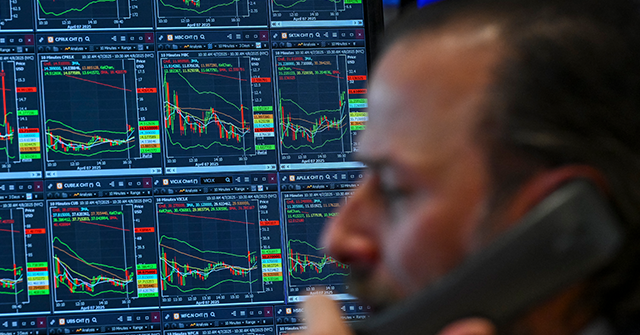
The bond market’s reputation has been getting a makeover in recent years. Traders who once seemed like faceless functionaries are increasingly cast as “bond vigilantes” — sober, disciplined enforcers warning Washington that it is borrowing too much. James Carville’s famous quip that he wanted to be reincarnated as the bond market, because it intimidates everyone, is back in circulation.
Rising Treasury yields get routinely translated into a moral verdict on fiscal policy. “Bond traders are demanding a higher return because they think inflation risk is higher,” goes one typical version. “Bond traders require higher yields because they’re worried about the government’s ability to service its debt,” goes another.
But a new VoxEU column from economists Paul Beaudry, Paolo Cavallino, and Tim Willems suggests that this reading of the bond market may be giving it far too much credit — and far too much independence.
As Breitbart Business Digest noted in its write-up of the research, the economists zoomed in on a narrow slice of the trading calendar: three-day windows around monthly payroll reports and speeches by senior Federal Reserve officials, covering the rise in Treasury yields from August 2020 through early September 2026. Those windows account for under a quarter of all trading days — just 23.9 percent. Yet they explain 90.5 percent of the increase in the 10-year Treasury yield over that stretch, and 81 percent of the rise in the average short rate expected over the coming decade.
That is a striking concentration. If yields were being driven by slow-moving forces like demographics, productivity trends, or the underlying health of the government’s balance sheet, you would not expect almost all of the action to happen in a handful of days clustered around jobs data and Fed commentary.
The authors read their results as evidence that markets are updating their expectations for the Fed’s policy path — not delivering an independent judgment about deficits and debt. Long-term yields are, in theory, a function of expected future short rates plus a term premium for locking money up for longer. Shift what investors think the Fed will do, and long-bond yields move. That is arithmetic, not a verdict.
Fed Day Matters Less Than Fed Talk
One of the more counterintuitive findings concerns where the repricing actually happened. Earlier research that looked narrowly at Fed meeting windows found none of the post-COVID yield increase. The relevant communication, in other words, appears to have occurred between meetings, as officials gave speeches and investors digested employment reports — not in the highly choreographed moments when the Federal Open Market Committee actually announces policy.
Everyone watches “Fed day.” According to this research, the quieter stretch in between may matter considerably more.
If traders are responding to their own evolving expectations about Fed policy — and, in what Breitbart Business Digest described as the classic financial hall of mirrors, to their perception of how everyone else is responding — then the vigilante label starts to look generous. The authors suggested a different metaphor: bounty hunters, chasing the rewards posted by Fed officials rather than enforcing their own code of economic justice.
A Puzzle: Why Doesn’t the Economy Push Back?
That framing creates a problem the economists have to confront. If long-term yields are largely a forecast of Fed policy, how could the central bank hold rates above the level the economy actually justifies for years on end? Under the standard story, excessively high rates should eventually bite — slowing spending and investment, weakening hiring, dragging inflation down. The economy should force a correction. That mechanism caps how far expectations alone can carry yields away from their economic foundations.
The paper’s answer is household saving. People preparing for retirement have to consider what their nest egg will earn. Higher expected returns can let them hit the same retirement goal while setting aside less from each paycheck — leaving more to spend now. Persistently low returns do the reverse, forcing households to save more to fund the same retirement.
That has uncomfortable policy implications. Cutting rates to stimulate the economy might partly backfire if households respond by saving more. Raising rates to cool inflation by restraining demand could be undercut if higher returns free up income for spending instead. The logic bears a family resemblance to Ricardian equivalence — the idea, associated with nineteenth-century economist David Ricardo but popularized by the modern economist Robert Barro, that deficit-financed stimulus can fail because households save in anticipation of future tax bills.
Apply that to monetary policy and a mistaken judgment about the neutral rate can survive for years without producing the slump that would expose it. Fed officials look at an economy still growing briskly despite high rates and conclude the neutral rate must have risen. They keep policy tight. Bond investors price that expectation into longer maturities. The underlying neutral rate never had to move at all — the economy’s response to higher rates may simply be weaker than officials assume.
Or Maybe It’s Just a Prediction Market
Even that account leaves fundamentals playing an important supporting role, with household saving behavior explaining why an economy might tolerate a long departure from neutral without an unmistakable warning. But there is a leaner view, one that Bloomberg’s Joe Weisenthal recently laid out and that Breitbart Business Digest said it was inclined to agree with: the bond market may simply be a prediction market on Fed policy.
On this reading, Treasury yields carry no necessary connection to inflation expectations, growth forecasts, or fiscal sustainability. They reflect what traders think the Fed will do over the relevant horizon — and the Fed’s reaction function is not guaranteed to be based on an accurate reading of the fundamentals in the first place.
Much of what looks like bonds trading on fundamentals, examined more closely, turns out to be bonds trading on forecasts of how the Fed will react to fundamentals. The bond market is not disciplining the Fed or Capitol Hill. It is carrying out what it believes will be the orders from the central bank.
The upshot is a deflation of the bond market’s mystique. A yield that rises because traders expect tighter Fed policy is not independent confirmation that tighter policy is economically necessary. The vigilantes, it seems, may be more like valets — and the question of who is really in charge has a simpler answer than the folklore suggests.
Source: www.breitbart.com — https://www.breitbart.com/economy/2026/09/22/breitbart-business-digest-whos-the-boss-of-the-bond-market/