
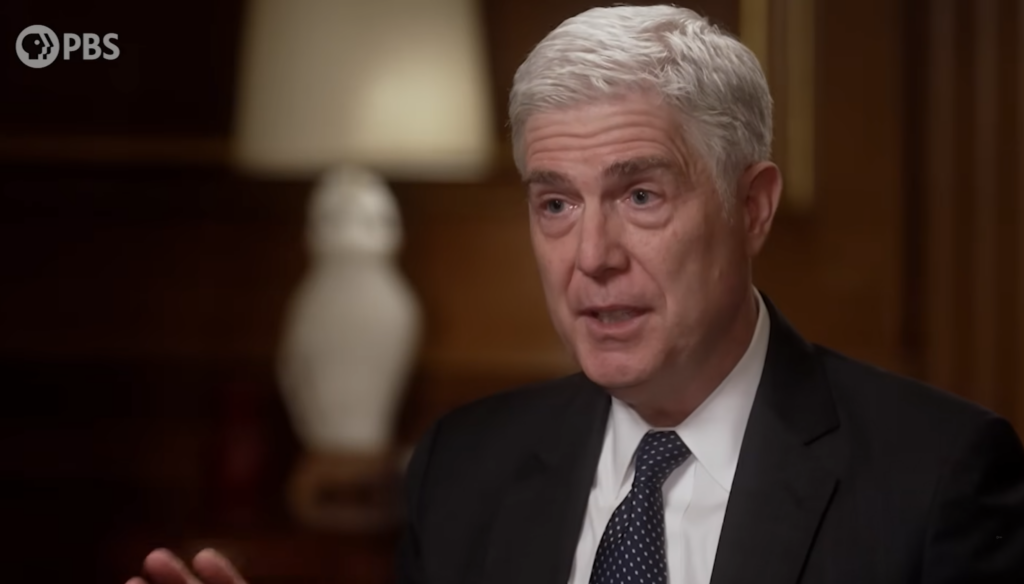
Supreme Court Justice Neil Gorsuch is drawing sharp criticism from conservative legal commentators over remarks he made regarding America’s religious foundations, with critics arguing his position on church-state separation contradicts both his originalist philosophy and the historical record.
In a July 24 interview with PBS host Margaret Hoover, Gorsuch articulated his view that the United States was founded as a religiously neutral nation rather than a Christian one. “We were never supposed to be a nation that was about one race or one religion,” Gorsuch told Hoover. “It was about those ideas [in the Declaration of Independence] … We have a First Amendment, for crying out loud. No established religion.”
The comments have sparked pushback from conservative legal scholars who argue Gorsuch’s interpretation misrepresents founding-era practices and the original intent of the First Amendment’s Establishment Clause.
The Historical Debate
Critics of Gorsuch’s position point to extensive historical evidence of Christianity’s role in early American government. At the time of the founding and for decades thereafter, several states maintained established churches. Massachusetts was the last state to formally disestablish its state church in 1833, more than four decades after ratification of the First Amendment.
According to scholarship cited by Gorsuch’s critics, some states provided public funding to Christian churches during the founding era, believing religious education essential to maintaining public morality. Public schools routinely taught Bible content and Protestant Christian doctrine. Multiple states implemented religious test oaths that effectively limited public office to Christians, and many states enacted laws requiring businesses to close on Sundays and prohibiting blasphemy.
The First Amendment’s prohibition that “Congress shall make no law respecting an establishment of religion” was intended to prevent federal establishment of a national church while preserving states’ rights to maintain their own religious establishments, according to this interpretation of the historical record.
Even Thomas Jefferson, often cited as among the founders most sympathetic to Enlightenment liberalism, encouraged Christian ministers to preach Sunday services in Congress, despite his famous 1802 letter to the Danbury Baptists referencing a “wall of separation between church and state.”
The Originalism Question
The controversy touches on a central tension in conservative legal philosophy. Gorsuch has positioned himself as an originalist — someone who interprets the Constitution based on its original public meaning at the time of ratification. However, critics argue his position on religious neutrality reflects modern liberal constitutional interpretation rather than founding-era understanding.

The shift toward strict church-state separation in American jurisprudence accelerated during the Warren Court era of the 1960s. Landmark cases including Engel v. Vitale in 1962 and Abington School District v. Schempp in 1963 prohibited public prayer and Bible reading in public schools, marking what critics describe as a dramatic departure from American tradition.
Conservative legal commentators argue that if founding-era practices like religious education in public schools would be considered unconstitutional under current Supreme Court standards, those modern standards themselves should be reconsidered.
The Political Dimension
The debate has taken on heightened political significance as Trump administration officials have articulated positions contrary to Gorsuch’s. Vice President JD Vance recently defended state laws requiring Ten Commandments displays in classrooms and Bible reading in school curricula during an interview with podcaster Joe Rogan.
When Rogan characterized such requirements as intolerant indoctrination, Vance countered that Christianity occupies a unique place in American history and formation. “Christianity is the majority religion of the United States, and is the religion that was extraordinarily influential to our founding,” Vance said during the interview.

At an October 2025 Turning Point USA event at the University of Mississippi, Vance went further, arguing that government cannot and should not be neutral on religion. He attacked Warren Court-era decisions that removed religious expression from public spaces: “You do not have to completely kick God out of the public square, which is what we’ve done in modern America. It’s not what the founders wanted, it’s not good for the United States of America, and anyone that tells you that’s it’s required by the Constitution is lying to you.”
President Trump has similarly voiced support for Christianity’s public role, stating that “to be a great nation, you must have religion, and you must have God.” His administration has worked to reverse what it characterizes as discrimination against Christians by previous administrations.
The Stakes of the Debate
The disagreement between Gorsuch and conservative critics reflects broader tensions within the conservative legal movement over how to interpret the First Amendment and what role religion should play in American public life. While Gorsuch presents America as a “creedal nation” founded on abstract principles contained in the Declaration of Independence rather than shared ethnic or religious identity, critics argue this framework concedes too much to secular liberal constitutional theory.
For conservatives who view restoration of Christianity’s public role as essential to cultural renewal, Gorsuch’s position is particularly frustrating given his appointment by a Republican president and his reputation as a conservative jurist. Critics argue his stance on religious neutrality undermines efforts to challenge what they see as hostile secular dominance in American institutions.
The debate also highlights ongoing questions about religious liberty versus religious establishment that have divided American legal thinkers since the founding. While the founding generation incorporated unprecedented religious tolerance — protecting dissenters from punishment for matters of conscience — critics of modern church-state separation doctrine argue that tolerance for religious diversity is distinct from governmental neutrality or hostility toward religion.
As the Supreme Court continues to hear cases involving religious expression in public spaces, education, and government activities, the tension between originalist interpretation of the Establishment Clause and modern separationist doctrine remains a live constitutional question with significant implications for American law and culture.
Source: thefederalist.com — https://thefederalist.com/2026/07/31/gorsuch-abandons-originalism-again-with-claims-america-isnt-a-christian-nation/