

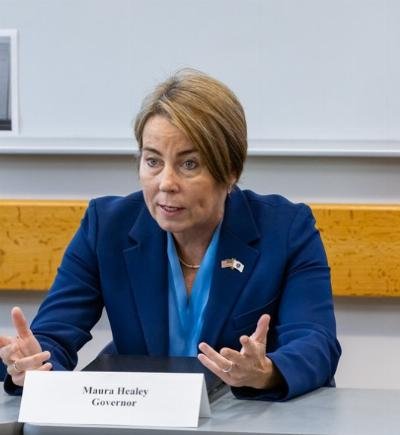
Massachusetts Gov. Maura Healey signed legislation in August 2026 that will allow abortions after 24 weeks of pregnancy, and roughly a month later touted a plan to expand a newborn and maternal health program called Welcome Family. For Jeannie DeAngelis, writing in American Thinker, the two moves are not separate policy stories — they are the two halves of a contradiction she wants voters to sit with.
DeAngelis opens by framing Healey less as a governor than as someone “dabbling in obstetrics and childcare,” and her central charge is blunt: the same administration that widens discretion to end a pregnancy late is now sending people into homes to check on the babies who made it out.
What the August law actually does
According to the commentary, Healey signed the legislation on August 10, 2026, before an audience the author describes with unmistakable contempt, and the law takes effect in November 2026. DeAngelis says it permits abortion after 24 weeks based on a physician’s subjective “professional judgment,” which she argues amounts to no meaningful time limit at all — ending, in her reading, right up to the moment of birth.
To illustrate how elastic that standard could be, she invokes Dr. Shelley Sella, a retired third-trimester abortion provider, and poses a hypothetical: what would that “professional judgment” look like for a woman seeking to end a 36-week pregnancy? DeAngelis then sketches what she says could follow — a provider evaluating the mother’s mental and physical health and the health of a baby whose head may already be in the birth canal, then, if the factors are deemed concerning, administering an injection to stop the fetal heart before inducing labor and delivery.
That is the author’s characterization of the law’s practical reach, not a neutral description of its text. It is worth being precise about that distinction: DeAngelis is not reporting a documented case. She is arguing about what a broad discretion standard could permit.
The September pivot
About a month after signing the abortion measure, DeAngelis writes, Healey “feigned concern” for babies who survive. She quotes the governor’s statement on maternal mental health at length — Healey calling becoming a mother “a profound life change,” saying every parent deserves support “not just during pregnancy, but in the months that follow,” and describing postpartum depression and anxiety as real medical conditions no mother should feel ashamed to ask help for. “We’re working to expand postpartum care, identify concerns earlier, and connect families to the mental health support they need,” the statement reads, “because taking care of moms means taking care of the whole family.”
DeAngelis seizes on that last line. If “taking care of the whole family” is the standard, she asks, how does it square with a law she believes authorizes ending a pregnancy at the threshold of birth?
An attack on biography, then on mechanics
The column takes a personal turn, noting that Healey has never been pregnant and that her parenting experience comes through helping raise her partner Joanna Lydgate’s two children, ages 12 and 15. DeAngelis uses that to argue Healey speaks about postpartum experience without having lived it — a rhetorical move that will land differently depending on the reader, but which is central to her case that the governor’s empathy is performative.
More substantive is her question about Welcome Family itself. Describing it as a program proposed for statewide expansion, she asks what actually triggers a referral, how voluntary “voluntary” really is, and what happens if a mother declines a screening or a follow-up referral after one.
She also flags a detail from state law: if a visiting health worker suspects abuse or neglect during such a visit, Massachusetts requires both an oral and a written report to the Department of Children and Families within 48 hours. For DeAngelis, that requirement is the tell — the moment a wellness check becomes a reporting apparatus.
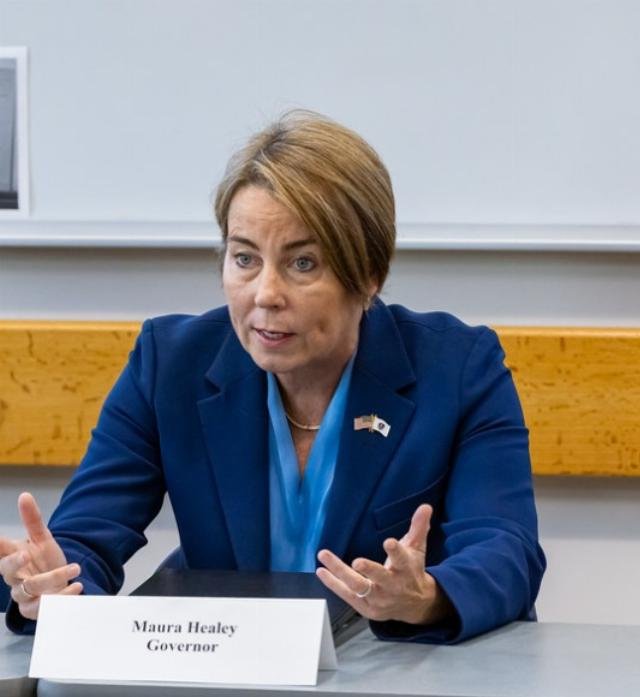
Her language for that apparatus is deliberately inflammatory, invoking “the Stasi” and “Nurse Ratched,” and she questions why the same health care workers who might assist in a late-term abortion one week would be the ones knocking on a family’s door the next.
The question underneath the outrage
Strip away the invective and a real policy question remains, and it is one that does not belong to any single party: at what point does the state’s interest in protecting a child begin, and can a state coherently draw that line at birth while expanding programs that reach into homes after it?
DeAngelis frames the inconsistency as evidence of bad faith rather than bureaucratic drift. Supporters of the abortion measure would frame the two policies as unrelated — one about reproductive autonomy and medical judgment, the other about voluntary family support — and would likely reject the premise that a home-visit program is a surveillance scheme. DeAngelis anticipates that defense and dismisses it, arguing that a state that sanctions termination late in pregnancy has forfeited the standing to arrive uninvited with a clipboard.
Her closing advice to Healey is to return to ordinary governance, stay out of OB-GYN offices, and leave family dynamics alone. Whether or not a reader accepts the “Butcher of Beacon Hill” framing — and many will not — the column lands on a tension the governor’s office has not, at least in these remarks, tried to resolve: the same administration is legislating at both ends of a birth, and it has not explained why the line falls where it does.
DeAngelis’s column is opinion, and proudly so, published amid American Thinker’s recurring appeal to readers to support its work. Its value here is less as a report on what Massachusetts intends than as a window into how one segment of the electorate is reading these two moves together — and as a reminder that the mechanics of “voluntary” programs are often decided long before anyone asks what happens when a parent says no.
Source: www.americanthinker.com — https://www.americanthinker.com/articles/2026/09/from-the-womb-to-the-em-welcome-family-em-mat/