
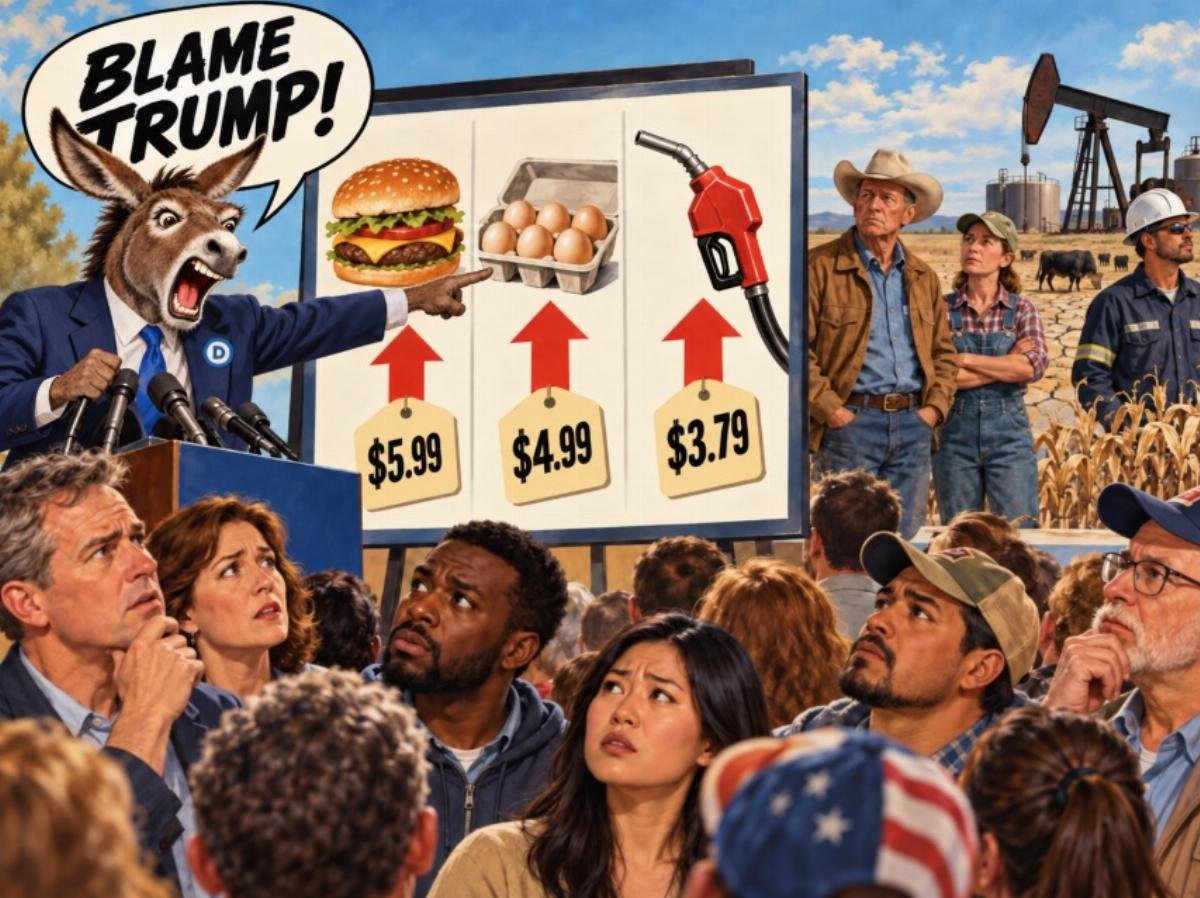
As voters head toward the midterms, the price of a pound of hamburger and a gallon of gas has become a political battleground. But a conservative writer argues that the outrage is misdirected — and that the numbers tell a different story than the one Democrats are telling.
In a piece for American Thinker, Vermont beef farmer and attorney John Klar contends that the current focus on food and fuel affordability is less about solving a real, long-term problem than about “sowing midterm angst and fear” against President Donald Trump. He frames the hamburger-price debate as “an interesting example of left-wing hyperbole” — one that, in his view, sidesteps whether Trump caused the problem, has the power to fix it, or whether it is fixable at all.
The Inflation-Adjusted Numbers
Klar’s central factual claim is a comparison across administrations, using inflation-adjusted figures. In real terms, he writes, hamburger was $8.83 per pound in February 2015, during Barack Obama’s presidency, while it stood at $8.57 in August 2026. For eggs, the contrast is starker in his telling: $2.127 per dozen now versus $4.14 per dozen in August 2015, adjusted for inflation.
He applies the same lens to gasoline. Klar cites $4.36 per gallon today, compared with $5.90 under Obama in May 2011, $5.82 under Joe Biden in June 2022, and $6.30 under George W. Bush during the Iraq War — all in inflation-adjusted terms. His conclusion: if pump prices are the sole metric, the current moment is not the crisis it is made out to be.
That framing echoes a pattern he identifies in other policy debates, invoking Obama-era deportation and family-separation controversies as examples of issues that, in his view, only become scandals when a Republican is in office.
Root Causes, Not Scapegoats
Beyond the partisan scorekeeping, Klar points to structural forces he says are being ignored. Trump, he writes, did not cause the droughts that have battered U.S. farms or the COVID-19 processing shutdowns that forced ranchers to sell stock at a loss. Nor, in his account, did Trump cause the rise in input costs that began during the Biden years and was accelerated by the Inflation Reduction Act.
On eggs, Klar acknowledges that early-2025 prices were “almost certainly exacerbated by unfair market manipulations by poultry businesses,” noting that the companies involved have settled without admitting wrongdoing. His complaint is that this corporate angle vanished from the conversation, replaced by what he characterizes as reflexive outrage that Trump had not delivered lower egg prices in his first month — followed by silence once prices fell.
The same logic applies to energy, he argues. Klar concedes that gasoline prices have risen and that the Iran conflict has compounded the problem in the short term, but calls it “an economic miracle” that prices are not higher — crediting Trump’s early support for domestic oil. He contrasts that with Democratic policies he says amount to an assault on oil production and refining, and with what he describes as Biden’s “inflation-fueling” climate spending.
Klar also invokes a broader geopolitical frame, writing that Democrats “want Iran to win” and “want to lose Greenland” — claims that reflect his political argument rather than any documented policy position.
The Midterm Calculation
The through-line of Klar’s argument is electoral. With the midterms approaching, he asks which party embraces policies that ensure fuel-price stability and which, in his words, seeks to replicate Germany’s “net-zero” energy path toward “economic ruin.” He accuses Democrats of wanting high grocery and gas prices so they can win votes — and then, once in power, of making eggs and gasoline more expensive still while blaming Trump.
He also argues that the inflation narrative crowds out what he calls “a plethora of good economic news”: inflation that has not spiraled despite the war, lower unemployment, growing GDP, and steady wage and job growth. And he warns that the federal deficit must be addressed or inflation will “pummel Americans of every political stripe” — especially on food.
The piece ends with a call to action aimed at readers: tell your “anxiety-ridden liberal neighbors” that prices were higher under Democrats and will be again unless the root problems are addressed. In Klar’s telling, “today’s Democrat Party is the root of most of America’s problems” — a conclusion that makes clear this is an argument for voters, not a neutral survey of the data.
What remains true regardless of party is the underlying squeeze Klar describes: farmers and ranchers struggling with drought and input costs, consumers demanding cheap food, and a deficit that looms over both. Whether either party has a plan to fix any of it is the question his essay leaves hanging — and the one voters may actually be asking in November.
Source: www.americanthinker.com — https://www.americanthinker.com/blog/2026/09/hamburger-was-more-expensive-under-obama-so-was-gasoline/