
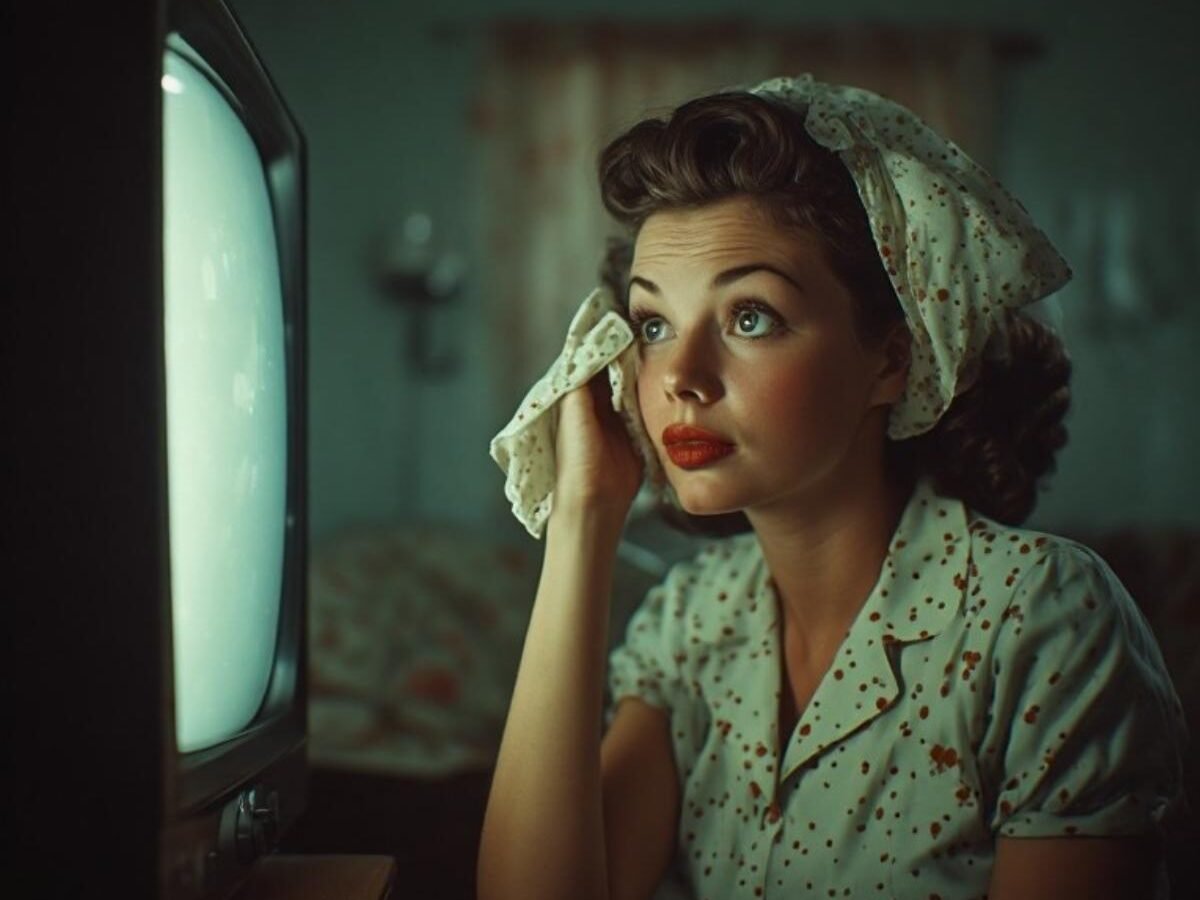
The daytime soap opera is long dead as a ratings force, but one conservative writer thinks it never really left — it just moved to Washington. In a September 24 essay for American Thinker, David DeMay argues that the serialized melodramas that once filled the noon-to-six block were never really about romance or family betrayal. Underneath the surface, he writes, they operated as a “theater of moral accounting,” running on a closed loop of score-settling and retributive justice in which characters spent decades trying to balance a ledger that could never be squared. Resolution, after all, would have meant the end of the show.
DeMay’s central claim is that this dynamic was a kind of domestic training ground, and that we have since scaled it up to the entire apparatus of federal governance. Congressional hearings, the 24-hour cable news cycle, and political rhetoric are no longer instruments of statecraft, in his telling. They are the same addictive engine of perpetual grievance and performative payback, now running at national scale.
A courtroom with no verdict
The essay’s sharpest formulation is that politics, when it becomes entirely ideological at its core, stops being about practical problem-solving or building physical reality. It becomes, instead, an endless moral courtroom where every perceived wrong demands a retroactive right — a theatrical demand for retribution that is intentionally denied, ensuring the drama never has to stop. DeMay calls this the “soap opera state,” and he frames its genius and its tragedy as the same thing: it weaponizes human psychology against itself.

Why does it persist? Because, in his account, it gets votes. The performance offers citizens what he describes as the dopamine hit of righteous vengeance without requiring any real-world construction, character, or genuine problem-solving. The system, he writes, trades the future of a civilization for a ratings share and turns the governance of a nation into a daily broadcast of institutional decay.
The ‘reclaiming my time’ problem
To make the argument concrete, DeMay points to the standard congressional dodge — politicians hiding behind procedural gimmicks like “I’m reclaiming my time” to shut down inquiry and protect a preferred narrative. That armor, he suggests, shatters the moment it is pierced. When a witness looks across the table and says, “You are abusing the public’s time,” the whole set collapses.
That single retort, in his reading, exposes the posturing and moralizing as a metabolic drain on the citizenry. It reminds everyone whose time is actually being wasted while the system spins its wheels in the mud.
What the piece asks of readers
DeMay does not pretend the fix is easy. He poses the question directly: how do you break an electorate out of a soap opera trance when the entire political-media complex profits from keeping people hooked to the screen? His answer is deliberately unglamorous. Stop playing the assigned role of passive audience member. Stop buying into what he calls the un-squared ledger of perpetual outrage, strip away the theatrical optics, and demand actual human authorship and tangible stewardship over empty theater.
The closing instruction is blunter still. As the cameras roll and the show goes on, he writes, we must not only stop watching — we must not vote for the actors, thereby meaningfully retiring the soaps.
An argument with a long pedigree
The critique is a familiar one in different packaging: the complaint that modern politics rewards performance over production, that attention is the real currency, and that the incentive structures of Congress and cable news have quietly converged. What distinguishes DeMay’s version is the entertainment-history framing — the insistence that the afternoon serial’s structural logic, not its subject matter, is what got replicated. The soaps ran on unresolved grievance because resolution killed the show. Politics, on his account, has learned the same lesson, and the audience is now the country.
Whether that diagnosis lands depends on whether a reader accepts the premise that the primary output of contemporary governance is narrative rather than legislation, and that the people doing the narrating are responding to incentives voters themselves keep renewing. DeMay’s answer to the second half of that is the reason his essay ends where it does — not with a policy proposal, but with a boycott of the performers. It is less a plan than a posture, and he seems to know it.
What the piece does capture is a genuine frustration that crosses ideological lines, even if the two sides would assign blame differently: the sense that hearings produce moments rather than outcomes, that the news cycle metabolizes outrage faster than it can be resolved, and that the whole arrangement is strangely satisfying to watch. That last part is the trap DeMay is pointing at. Soap operas were never supposed to be resolved. Congress, he suggests, is learning to run the same playbook one hearing at a time.
Source: www.americanthinker.com — https://www.americanthinker.com/blog/2026/09/the-soap-operas-are-back/