
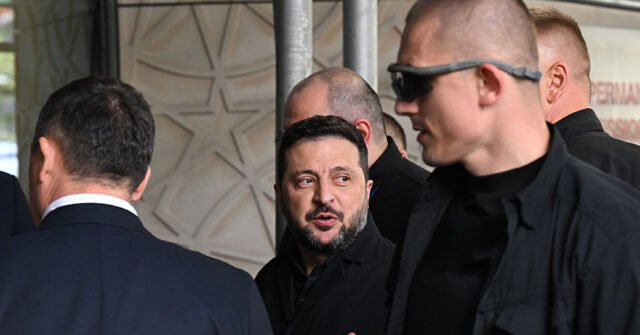
A brief, combative exchange on the sidelines of the United Nations General Assembly in New York has become one of the more quotable moments of this year’s diplomatic gathering, after Ukrainian President Volodymyr Zelensky was pressed by a Russian state media journalist about when he might travel to Moscow.
According to reporting from Breitbart News, the encounter took place Wednesday afternoon as Zelensky walked alongside the UN General Assembly building, taking shouted questions from a crowd of journalists. As the group passed the bronze handgun statue outside UN headquarters, a man repeatedly addressed the Ukrainian leader using the Russian form of his name, shouting in Russian: “Vladimir Alexandrovich, when are we going to Moscow?”
Zelensky continued answering other journalists for a time. Eventually, apparently irritated by the repeated haranguing, he responded in Russian over his shoulder — saying he would come to Moscow, but “on a missile, blyat.”
A blunt word with a diplomatic echo
The final word is a common Russian expletive that can be rendered as “damnit” at its most charitable, or as a considerably harsher obscenity in its more literal sense. Breitbart’s account notes that Germany’s Die Welt picked up on the exchange, reporting that Russia took exception to the blunt language and that the remark “caused a stir.”
The journalist has been identified in Ukrainian media as Valentin Bogdanov, a reporter for Moscow state media. Ukraine’s National Security and Defense Council, through its Centre for Countering Disinformation, has characterized Bogdanov as one of the Kremlin’s “information saboteurs in the West” and a “Russian propagandist” working for state outlets.
The setting gave the moment its charge. The UN General Assembly brings together heads of state and government from across the world each September, and the walkways and sidewalks around the complex have long been an informal stage where leaders are pursued by reporters from many countries at once. That a Russian state media correspondent was in the huddle, and that Zelensky answered him directly rather than ignoring him, turned a passing brush with the press into international news.
Not the first joke about Moscow
This is not the first time Zelensky has deflected questions about whether he would travel to Moscow for peace talks by turning them into a punchline. According to Breitbart’s earlier reporting, when Zelensky met with U.S. President Donald Trump at the NATO Ankara summit in July, he laughed off the suggestion of going to Moscow by telling Trump: “It’s difficult, there are a lot of Ukrainian drones there” — a line that drew laughter from those in the room.
The pattern is consistent: rather than engaging directly with the premise of negotiations held on Russian soil, Zelensky has repeatedly used humor to signal both dismissal and the practical realities of a war in which Ukrainian drones have struck deep inside Russia. His response this week kept that tone, though with a sharper edge than the Ankara quip.
What the exchange does — and doesn’t — say
It is worth being clear about the limits of what happened. This was a shouted question from a journalist and an off-the-cuff retort from a president, not a formal policy statement. Nothing in the exchange indicates a change in Ukraine’s stated position on the terms or location of any future talks, and no official Ukrainian or Russian government statement on negotiations followed from it. The significance lies in the optics: a wartime leader, asked in Russian whether he would come to Moscow, answering in Russian that he would — on a missile.
Moscow’s irritation, as relayed by Die Welt, fits a broader pattern in which Kremlin officials and state media treat slights to Russian language, honorifics, or national pride as material for domestic messaging. The Russian form of address the reporter used — “Vladimir Alexandrovich,” a patronymic construction — is in itself a small claim of shared cultural space, and Zelensky’s reply, delivered in Russian but pointedly hostile, rejected that framing.
The moment also illustrates how the information war between Kyiv and Moscow now plays out in third countries. A confrontation on a New York sidewalk between a Ukrainian president and a Russian state media correspondent is, in effect, a scene staged for two home audiences at once — one that Ukrainian officials will likely cite as evidence of Russian propaganda operations abroad, and one that Russian outlets may use to portray Zelensky as profane and unwilling to talk peace.
Zelensky’s public schedule in New York has centered on rallying international support for Ukraine, and he has used past appearances at the General Assembly to press allies for continued military and financial backing. Whether this week’s sidewalk exchange will matter beyond a news cycle is doubtful. But it added a vivid, impromptu beat to a week otherwise dominated by prepared speeches and carefully worded diplomacy — and it offered the clearest recent example of Zelensky declining, in real time, to treat Moscow as a destination for anything other than force.
The Ukrainian president’s office has not issued any additional comment on the exchange beyond what was captured on the sidewalk. Requests for comment from Russian state media or the Kremlin on the incident were not reported.
Source: www.breitbart.com — https://www.breitbart.com/europe/2026/09/24/blyad-zelensky-clashes-with-russian-reporter-in-ny/