
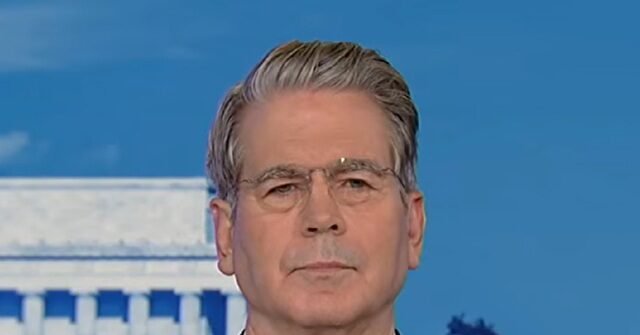
Treasury Secretary Scott Bessent said Wednesday that the United States and China have agreed to extend their so-called “economic détente” beyond its original November 10 expiration, pushing the deadline to January 10 to allow more time for negotiations on the economic relationship between the two countries.
Speaking on Fox News Channel’s “Special Report,” Bessent credited Beijing with fulfilling its soybean purchase commitments but said China has fallen behind on roughly $17 billion in other agricultural obligations — a gap he said the administration is actively pressing it to close, according to Breitbart News.
An extension, not a breakthrough
Bessent framed the decision as a deliberate pause rather than a final settlement. “We have agreed, today, that we will extend what we call the Busan Agreement, the détente — economic détente between the two countries that was scheduled to end on November 10,” he said. “That is going to be extended until January 10 to give us more time to see what we can do on the economic front.”
The treasury secretary was candid about the limits of what the extension represents. He said he is unsure whether a larger, more comprehensive deal will ultimately materialize, noting that China has lagged on certain deliverables and that Washington wants to see improvement before moving further. The two-month runway, in his telling, is designed to test whether Beijing follows through on the commitments it has already made.
The reference to the “Busan Agreement” ties the arrangement to a prior diplomatic setting, though Bessent did not elaborate on the terms beyond the truce’s expiration date and the agricultural components. The extension keeps the existing framework in place rather than replacing it with new terms.
Soybeans on track, other ag commitments behind
Bessent’s most specific numbers came in response to a question from host Bret Baier, who noted that agricultural purchase pledges have been announced before and asked whether they might be timed to yield political benefit before November.
Bessent did not engage with the political framing. Instead, he returned to the question of compliance. “What we want to ensure is that they are meeting their obligations,” he said. “The Chinese have been very good, thusfar, about meeting their obligations this year. They have agreed to buy 25 million…tons of soybeans, and they have been very fulsome in those.”
He then drew the distinction that has apparently become a sticking point in the talks: “They have about 17 billion of other ag. commitments that we think they’re a little behind schedule on, and we are encouraging them to pick those up.”
The soybean figure — 25 million tons — represents a substantial volume of trade, and Bessent’s description of Chinese performance on that front was notably positive. His characterization of the broader agricultural package was far cooler, describing a shortfall measured in billions of dollars across categories beyond soybeans.
A truce with an expiration date
The arrangement Bessent described functions as a temporary freeze in the economic standoff between the world’s two largest economies, neither a resolution nor a collapse. By extending the deadline rather than allowing it to lapse, both sides avoid an immediate return to the conditions the détente was meant to suspend, while deferring the harder questions to the new year.
Bessent’s comments also suggest the administration is using the agricultural commitments as a measurable benchmark of Chinese good faith. Soybean purchases, which flow disproportionately to U.S. farmers in politically significant states, have long been a focal point of trade discussions between Washington and Beijing. Bessent said China has been “very fulsome” on that front — a phrase he used twice during the segment — while leaving open the question of whether the same can be said for the rest of the agricultural ledger.
Agriculture has been a recurring pressure point for the administration, with farm-state constituencies closely attuned to whether announced purchase agreements translate into actual shipments and revenue. Baier’s question about whether the purchases could arrive before November reflected that political sensitivity, though Bessent declined to speculate on timing or motivations and returned repeatedly to the language of obligations and schedules.
What the extension does not include, based on Bessent’s account, is any new Chinese commitment beyond what was already agreed. Asked directly whether a larger deal is in prospect, he said he was uncertain, and indicated that the coming weeks will be spent evaluating whether China improves its performance on the outstanding items. In effect, the January 10 date sets a new checkpoint rather than a new agreement.
For now, the détente holds — but on a clock, with roughly $17 billion in non-soybean agricultural commitments serving as one of the more concrete measures of whether it will survive past the winter.
Source: www.breitbart.com — https://www.breitbart.com/clips/2026/09/24/bessent-we-extended-economic-detente-with-china-theyve-been-very-fulsome-on-soybean-purchases-but-not-other-ag-deals/