
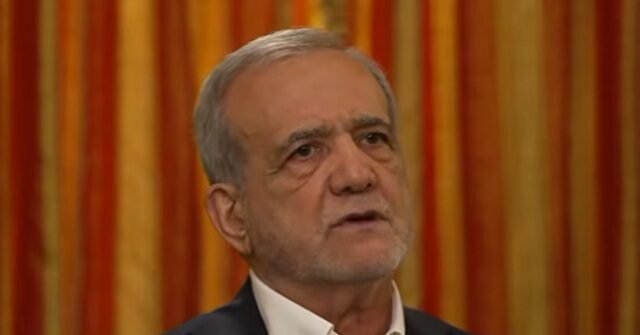
Iranian President Masoud Pezeshkian said his country will continue to resist U.S. military strikes and other pressure, dismissing questions about whether Tehran can withstand an economy in free fall and insisting that Iran’s posture has nothing to do with America’s election calendar. The comments aired Thursday on Fox News Channel’s “Special Report,” according to a clip flagged by Breitbart News.
Asked by host Bret Baier why his March warning that the economy could collapse within three weeks to a month had not come to pass, Pezeshkian did not engage with the timeline. “We will keep resisting until the very end,” he said through a translator. “Yes, we do have economic issues, certainly. But in order to remain, we will go through any hardship and endure.”
Baier had laid out a string of grim indicators: Iran’s own statistics agency reporting a 10 percent contraction, skyrocketing inflation, the rial losing more than half its value in a year, and oil loadings falling from roughly 2 million barrels a day to about 250,000 barrels a day. “In that environment, how long can Iran last?” he asked.
‘A Gift’ of Missiles and Destruction
Pezeshkian’s answer was defiant and accusatory. “This is something that has been the doing of the United States,” he said. “We will keep resisting. We will find ways, and the life of our country will continue. We will remain.”
He went on to characterize U.S. overtures toward the Iranian people as hollow: “Trump kept saying, I want to bring a gift to the people of Iran, but the gift that they brought us were guided missiles, heavy weapons, and destruction.” According to the translation, Pezeshkian added that what Washington “truly wish to do is to instigate incidents in the country that paves the way for the downfall of the system of the society, of the government.”
Pressed again on whether his March prediction was simply wrong, Pezeshkian repeated that Tehran would endure. He said Iran would “go through any hardship” to survive, and he brushed off the notion that sanctions could force capitulation. “If America thinks that they can keep sanctioning us,” he said, completing the thought with the suggestion that surrender “they can take that into their dreams.”
Elections and Escalation
The interview also touched on whether Tehran is timing its actions around U.S. politics. Pezeshkian rejected the premise outright, saying Iran pays no heed to American elections. If the current U.S. government wants an agreement within an international legal framework, he indicated, that would be acceptable; if not, the timing of any vote is immaterial. “Before the elections or after the elections, what difference does it make for us?” he said.
Asked whether the war could end before the end of the year, Pezeshkian said Iran never sought conflict. “We do not wish to fight at all. But we will stand resolutely to defend ourselves. We never sought war. We do not seek war.” He added that he believes human beings should not kill one another when dialogue can resolve disputes, and he placed responsibility for the conflict on Israel. “With instigations conducted by Israel, they have imposed this war on us. But we do not wish to continue,” he said. “It’s America that must choose whether it wants to end this or not.”
Stakes and Signals
The exchange comes amid sustained U.S. military strikes on Iran and a sanctions regime that has hammered Tehran’s economy. Pezeshkian’s refusal to acknowledge the gap between his March warning and the current reality is notable: rather than claiming the crisis had been averted, he framed hardship as a cost of survival. His remarks do not indicate a shift toward negotiations, but they also stop short of ruling them out, provided they occur inside what he described as an international legal framework.
For Washington, the interview offers little sign that economic pressure is translating into concessions. For Tehran, it projects continuity — the message that Iran will absorb pain rather than change course. Whether that position is sustainable depends on factors neither side disclosed in the exchange: the depth of Iran’s reserves, the durability of its oil exports at a fraction of prior levels, and the willingness of either government to test a diplomatic off-ramp before the window closes.
Pezeshkian’s appearance on American television also served a domestic purpose, allowing him to cast the United States and Israel as the authors of Iran’s isolation and economic misery. That framing leaves little room for the kind of compromise that would require Tehran to alter its regional posture — the very posture Washington says the strikes and sanctions are meant to change.
Baier’s questioning returned repeatedly to the same practical puzzle: if the economy is contracting, the currency is collapsing, and oil revenues have shriveled, how long can the government hold out? Pezeshkian’s answer, in effect, was that Iran measures staying power in something other than quarterly statistics. “We will remain,” he said.
That leaves the near-term trajectory of the confrontation unresolved. The U.S. has not signaled it will ease pressure, and Iran’s president has just said, on American airwaves, that it will not buckle. The next signal — whether either side moves toward talks or further escalation — has yet to be sent.
Source: www.breitbart.com — https://www.breitbart.com/clips/2026/09/24/iranian-president-pezeshkian-we-will-keep-resisting-we-will-find-ways/