
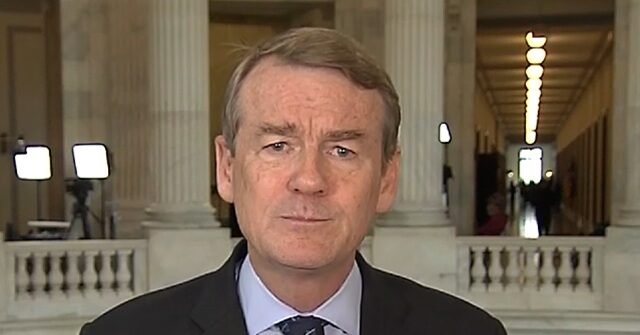
Sen. Michael Bennet (D-CO) said Thursday that voters are poised to send the country in a “different direction” in the upcoming midterm elections, and suggested that a Democratic victory could produce policies that bring down diesel prices and interest rates — though he hedged that outcome with a “maybe.”
Appearing on Bloomberg’s “Balance of Power,” Bennet framed the midterms as a referendum on President Donald Trump’s decision to strike Iran, which he described as a “war of choice” undertaken without a coherent plan. According to a clip flagged by Breitbart News, Bennet said the intelligence community had warned the president that airstrikes could not remove Iran’s leadership or eliminate its nuclear program from the air, and that the strikes would instead usher in a more hardline government, attacks on shipping lanes, and assaults on U.S. bases and those of American allies.
‘A different direction’
From there, Bennet pivoted to domestic economics. He said he expects voters to demonstrate in November that they want a change in course, and that such a change might deliver relief on two fronts that have weighed on household budgets: fuel costs and borrowing costs.
“And I think the American people are going to demonstrate, in these midterm elections, that we want to go in a different direction,” Bennet said, “and maybe in that direction, we will find energy policies that lead to lower diesel prices, not higher diesel prices, to lower interest rates, not higher interest rates.”
The phrasing drew attention because it left the specifics of those policies unstated. Bennet did not detail which energy measures he had in mind, nor did he explain how a Democratic Congress would bring down interest rates, which are largely set by the Federal Reserve rather than by legislation. The word “find” also suggested the policies were not yet identified rather than already drafted and ready to move.
His remarks reflect a broader Democratic messaging push heading into the midterms, one that seeks to tie the administration’s foreign policy to pocketbook concerns at home. By linking the Iran strikes to diesel prices and interest rates, Bennet attempted to fold national security and economic anxiety into a single argument for turning Congress over to his party.
Warnings he says were ignored
The Colorado senator was pointed in his criticism of the president’s decision-making, saying Trump “should never have done” what he did in Iran and asserting that he was disregarding explicit guidance from the intelligence community. Bennet listed the warnings in sequence: that the mullahs could not be removed from the air, that nuclear weapons could not be taken out from the air, that the leadership would be replaced by a more radical version more committed to developing nuclear weapons, and that sea lanes and U.S. and allied bases in the region would come under attack.
“That is the cost of this war that Donald Trump has taken, this war of choice that he has pursued in Iran,” Bennet said.
It is a line of attack that Democrats have increasingly embraced as the midterms approach, arguing that the administration committed the country to a conflict without adequate planning for the aftermath. Bennet’s version of that argument leans heavily on the claim that the president was told in advance what the consequences would be — a framing intended to undercut any suggestion that the strikes were a measured or limited success.
Republicans have countered that the strikes were necessary to degrade Iran’s nuclear capabilities and that the intelligence picture is more complicated than Bennet described. The White House has not responded to Bennet’s specific characterizations of the briefings he referenced.
A campaign message still taking shape
Bennet’s appearance comes as both parties try to define what the midterm elections will be about. For Democrats, that has meant a focus on costs — gasoline, groceries, rent, and interest rates — while also making the case that the president’s foreign policy carries economic consequences at home. Bennet’s answer on “Balance of Power” effectively merged the two, though it did so without committing to a specific legislative agenda.
The hesitation embedded in “maybe” is notable in its own right. Candidates in the final stretch of a campaign typically project confidence about what their party would do if handed power. Bennet instead described the prospect of lower diesel and interest rates as something that might emerge from a change in direction, rather than something Democrats have a plan to deliver.
Whether that framing helps or hurts his party in November is an open question. Voters who are frustrated with the cost of fuel and credit may hear in Bennet’s remarks a recognition of their concerns — or they may hear a party that is still searching for answers. Republicans are likely to seize on the latter reading, pointing to the senator’s own words as evidence that Democrats lack a concrete economic program.
Bennet did not offer a timeline for any of the policies he alluded to, and his office did not immediately provide additional detail about what they might include. The clip of his remarks circulated quickly among political observers, with the conditional language drawing as much scrutiny as the substance.
With the midterms looming, the exchange offers a snapshot of how Democrats are trying to convert dissatisfaction with the administration’s Iran policy into a broader economic argument — and how carefully some of them are hedging when asked what that argument would actually produce.
Source: www.breitbart.com — https://www.breitbart.com/clips/2026/09/24/dem-sen-bennet-if-dems-win-midterms-maybe-well-find-policies-to-lower-diesel-prices-interest-rates/